Liu Xianzhi, Wang Lifu, Tan Siwei, Chen Zebin, Wu Bin, Wu Xiaoying
Department of Gastroenterology, The Third Affiliated Hospital of Sun Yat-sen University, Guangzhou, China.
Guangdong Provincial Key Laboratory of Liver Disease Research, Guangzhou, China.
Front Pharmacol. 2022 Mar 2;13:814871. doi: 10.3389/fphar.2022.814871. eCollection 2022.
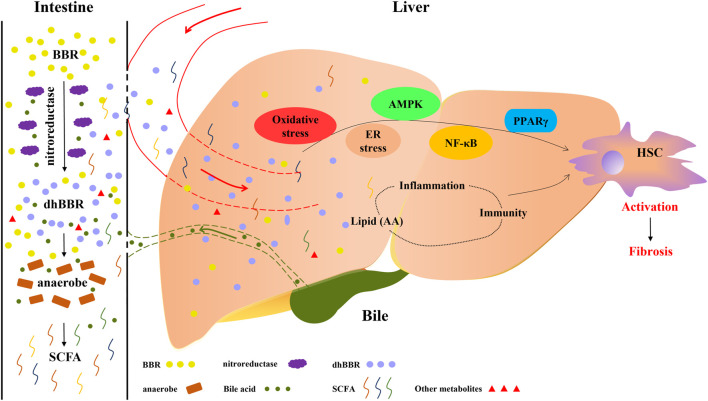
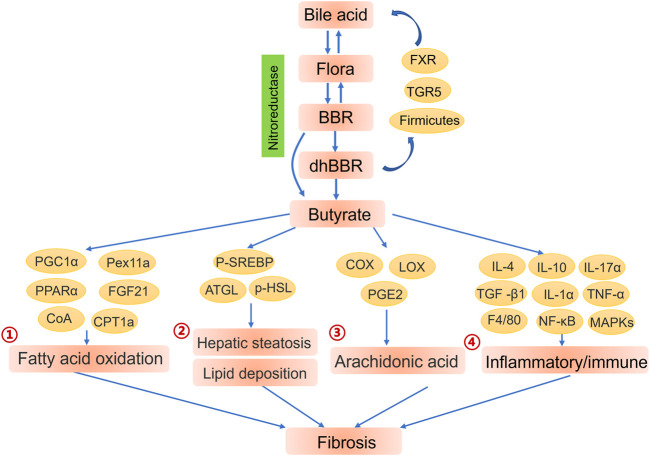
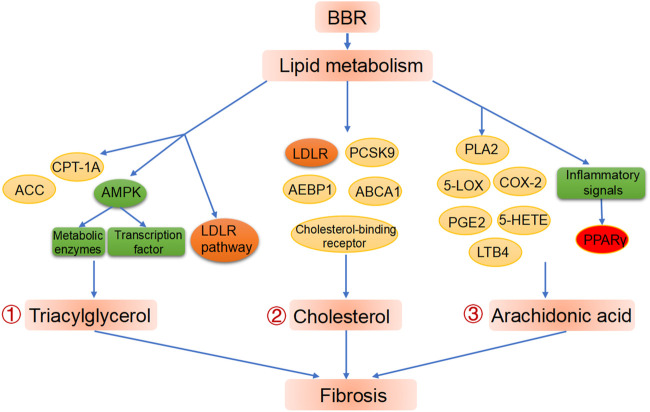
Liver cirrhosis is a form of liver fibrosis resulting from chronic hepatitis caused by various liver diseases, such as viral hepatitis, alcoholic liver damage, nonalcoholic , autoimmune liver disease, and by parasitic diseases such as . Liver fibrosis is the common pathological base and precursors of cirrhosis. Inflammation and disorders of lipid metabolism are key drivers in liver fibrosis. Studies have determined that parts of the arachidonic acid pathway, such as its metabolic enzymes and biologically active products, are hallmarks of inflammation, and that aberrant peroxisome proliferator-activated receptor gamma (PPARγ)-mediated regulation causes disorders of lipid metabolism. However, despite the ongoing research focus on delineating the mechanisms of liver fibrosis that underpin various chronic liver diseases, effective clinical treatments have yet to be developed. Berberine (BBR) is an isoquinoline alkaloid with multiple biological activities, such as anti-inflammatory, anti-bacterial, anti-cancer, and anti-hyperlipidemic activities. Many studies have also found that BBR acts via multiple pathways to alleviate liver fibrosis. Furthermore, the absorption of BBR is increased by nitroreductase-containing intestinal flora, and is strengthened via crosstalk with bile acid metabolism. This improves the oral bioavailability of BBR, thereby enhancing its clinical utility. The production of butyrate by intestinal anaerobic bacteria is dramatically increased by BBR, thereby amplifying butyrate-mediated alleviation of liver fibrosis. In this review, we discuss the effects of BBR on liver fibrosis and lipid metabolism, particularly the metabolism of arachidonic acid, and highlight the potential mechanisms by which BBR relieves liver fibrosis through lipid metabolism related and intestinal flora related pathways. We hope that this review will provide insights on the BBR-based treatment of liver cirrhosis and related research in this area, and we encourage further studies that increase the ability of BBR to enhance liver health.
肝硬化是由各种肝脏疾病引起的慢性肝炎导致的一种肝纤维化形式,这些肝脏疾病包括病毒性肝炎、酒精性肝损伤、非酒精性脂肪性肝病、自身免疫性肝病以及寄生虫病等。肝纤维化是肝硬化的共同病理基础和先兆。炎症和脂质代谢紊乱是肝纤维化的关键驱动因素。研究已确定,花生四烯酸途径的某些部分,如其代谢酶和生物活性产物,是炎症的标志,而过氧化物酶体增殖物激活受体γ(PPARγ)介导的调节异常会导致脂质代谢紊乱。然而,尽管目前一直在研究各种慢性肝病背后的肝纤维化机制,但尚未开发出有效的临床治疗方法。黄连素(BBR)是一种具有多种生物活性的异喹啉生物碱,如抗炎、抗菌、抗癌和抗高血脂活性。许多研究还发现,BBR通过多种途径发挥作用以减轻肝纤维化。此外,含硝基还原酶的肠道菌群可增加BBR的吸收,并通过与胆汁酸代谢的相互作用而增强。这提高了BBR的口服生物利用度,从而增强了其临床应用价值。BBR可显著增加肠道厌氧菌产生丁酸盐,从而放大丁酸盐介导的肝纤维化缓解作用。在本综述中,我们讨论了BBR对肝纤维化和脂质代谢的影响,特别是花生四烯酸的代谢,并强调了BBR通过脂质代谢相关途径和肠道菌群相关途径减轻肝纤维化的潜在机制。我们希望本综述能为基于BBR的肝硬化治疗及该领域的相关研究提供见解,并鼓励进一步开展研究以增强BBR改善肝脏健康的能力。