Antonopoulou Io, Sapountzaki Eleftheria, Rova Ulrika, Christakopoulos Paul
Biochemical Process Engineering, Division of Chemical Engineering, Department of Civil, Environmental and Natural Resources Engineering, Luleå University of Technology, SE-97187 Luleå, Sweden.
Comput Struct Biotechnol J. 2022;20:1306-1344. doi: 10.1016/j.csbj.2022.03.009. Epub 2022 Mar 14.
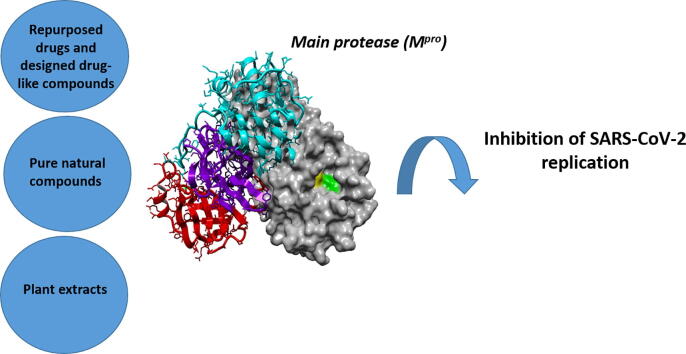
The emergence of the Severe Acute Respiratory Syndrome Coronavirus-2 (SARS-CoV-2) has resulted in a long pandemic, with numerous cases and victims worldwide and enormous consequences on social and economic life. Although vaccinations have proceeded and provide a valuable shield against the virus, the approved drugs are limited and it is crucial that further ways to combat infection are developed, that can also act against potential mutations. The main protease (M) of the virus is an appealing target for the development of inhibitors, due to its importance in the viral life cycle and its high conservation among different coronaviruses. Several compounds have shown inhibitory potential against M, both and , with few of them also having entered clinical trials. These candidates include: known drugs that have been repurposed, molecules specifically designed based on the natural substrate of the protease or on structural moieties that have shown high binding affinity to the protease active site, as well as naturally derived compounds, either isolated or in plant extracts. The aim of this work is to collectively present the results of research regarding M inhibitors to date, focusing on the function of the compounds founded by simulations and further explored by and assays. Creating an extended portfolio of promising compounds that may block viral replication by inhibiting M and by understanding involved structure-activity relationships, could provide a basis for the development of effective solutions against SARS-CoV-2 and future related outbreaks.
严重急性呼吸综合征冠状病毒2(SARS-CoV-2)的出现导致了一场长期的大流行,全球出现了大量病例和受害者,对社会和经济生活造成了巨大影响。尽管疫苗接种已经展开并为抵御该病毒提供了宝贵的防护,但获批的药物有限,因此开发更多对抗感染的方法至关重要,这些方法还应能对抗潜在的病毒突变。该病毒的主要蛋白酶(M)因其在病毒生命周期中的重要性以及在不同冠状病毒中的高度保守性,成为开发抑制剂的一个有吸引力的靶点。有几种化合物已显示出对M蛋白酶的抑制潜力,包括 和 等,其中少数还进入了临床试验阶段。这些候选药物包括:已被重新利用的已知药物、基于蛋白酶天然底物或对蛋白酶活性位点具有高结合亲和力的结构部分专门设计的分子以及天然衍生化合物(无论是分离得到的还是植物提取物中的)。这项工作的目的是集中展示迄今为止关于M蛋白酶抑制剂的研究结果,并重点关注通过 模拟发现并经 和 实验进一步探索的化合物的功能。通过创建一个可能通过抑制M蛋白酶来阻断病毒复制且包含有前景化合物的扩展库,并了解其中涉及的构效关系,可为开发针对SARS-CoV-2及未来相关疫情爆发的有效解决方案提供基础。