Falkai Peter, Koutsouleris Nikolaos, Bertsch Katja, Bialas Mirko, Binder Elisabeth, Bühner Markus, Buyx Alena, Cai Na, Cappello Silvia, Ehring Thomas, Gensichen Jochen, Hamann Johannes, Hasan Alkomiet, Henningsen Peter, Leucht Stefan, Möhrmann Karl Heinz, Nagelstutz Elisabeth, Padberg Frank, Peters Annette, Pfäffel Lea, Reich-Erkelenz Daniela, Riedl Valentin, Rueckert Daniel, Schmitt Andrea, Schulte-Körne Gerd, Scheuring Elfriede, Schulze Thomas G, Starzengruber Rudolf, Stier Susanne, Theis Fabian J, Winkelmann Juliane, Wurst Wolfgang, Priller Josef
Department of Psychiatry and Psychotherapy, University Hospital, LMU Munich, Munich, Germany.
Institute of Psychiatry, Psychology and Neuroscience, King's College London, London, United Kingdom.
Front Psychiatry. 2022 Mar 4;13:815718. doi: 10.3389/fpsyt.2022.815718. eCollection 2022.
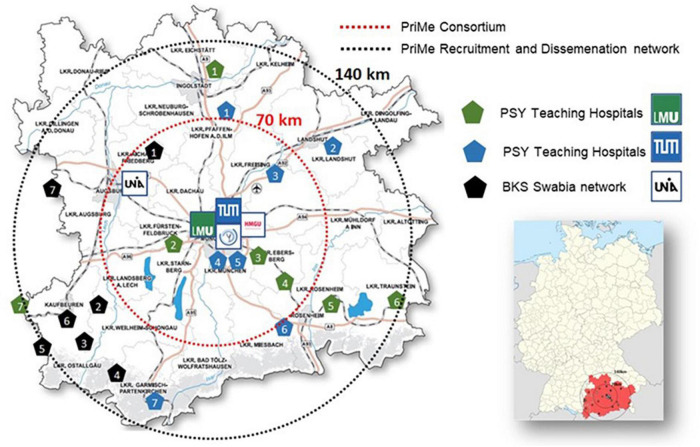
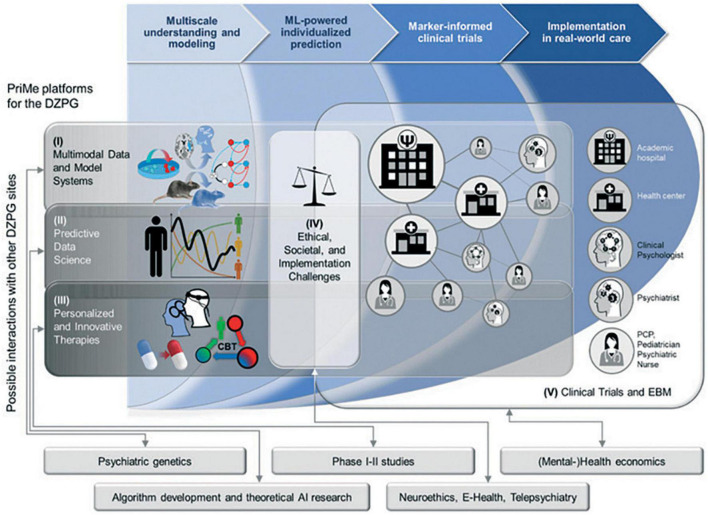
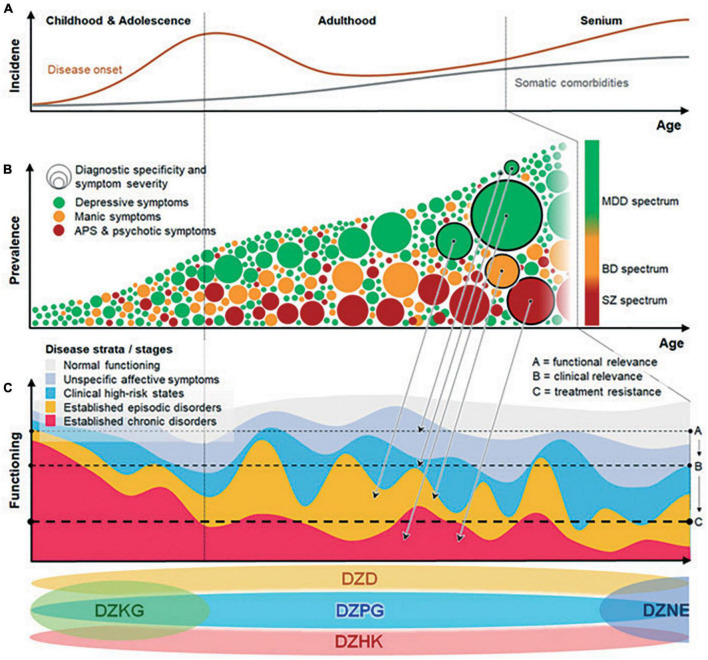
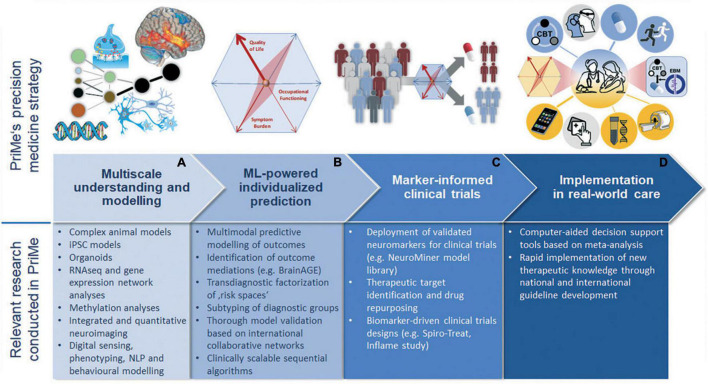
The Federal Ministry of Education and Research (BMBF) issued a call for a new nationwide research network on mental disorders, the German Center of Mental Health (DZPG). The Munich/Augsburg consortium was selected to participate as one of six partner sites with its concept "Precision in Mental Health (PriMe): Understanding, predicting, and preventing chronicity." PriMe bundles interdisciplinary research from the Ludwig-Maximilians-University (LMU), Technical University of Munich (TUM), University of Augsburg (UniA), Helmholtz Center Munich (HMGU), and Max Planck Institute of Psychiatry (MPIP) and has a focus on schizophrenia (SZ), bipolar disorder (BPD), and major depressive disorder (MDD). PriMe takes a longitudinal perspective on these three disorders from the at-risk stage to the first-episode, relapsing, and chronic stages. These disorders pose a major health burden because in up to 50% of patients they cause untreatable residual symptoms, which lead to early social and vocational disability, comorbidities, and excess mortality. PriMe aims at reducing mortality on different levels, e.g., reducing death by psychiatric and somatic comorbidities, and will approach this goal by addressing interdisciplinary and cross-sector approaches across the lifespan. PriMe aims to add a precision medicine framework to the DZPG that will propel deeper understanding, more accurate prediction, and personalized prevention to prevent disease chronicity and mortality across mental illnesses. This framework is structured along the translational chain and will be used by PriMe to innovate the preventive and therapeutic management of SZ, BPD, and MDD from rural to urban areas and from patients in early disease stages to patients with long-term disease courses. Research will build on platforms that include one on model systems, one on the identification and validation of predictive markers, one on the development of novel multimodal treatments, one on the regulation and strengthening of the uptake and dissemination of personalized treatments, and finally one on testing of the clinical effectiveness, utility, and scalability of such personalized treatments. In accordance with the translational chain, PriMe's expertise includes the ability to integrate understanding of bio-behavioral processes based on innovative models, to translate this knowledge into clinical practice and to promote user participation in mental health research and care.
德国联邦教育与研究部(BMBF)发起号召,建立一个新的全国性精神障碍研究网络——德国心理健康中心(DZPG)。慕尼黑/奥格斯堡财团凭借其“心理健康精准化(PriMe):理解、预测和预防慢性病”的理念,作为六个合作站点之一被选中参与其中。PriMe整合了来自路德维希 - 马克西米利安大学(LMU)、慕尼黑工业大学(TUM)、奥格斯堡大学(UniA)、慕尼黑亥姆霍兹中心(HMGU)和马克斯·普朗克精神病学研究所(MPIP)的跨学科研究,重点关注精神分裂症(SZ)、双相情感障碍(BPD)和重度抑郁症(MDD)。PriMe从风险阶段到首发、复发和慢性阶段,对这三种疾病采取纵向研究视角。这些疾病带来了重大的健康负担,因为在高达50%的患者中会导致无法治疗的残留症状,进而导致早期社会和职业残疾、合并症以及过高的死亡率。PriMe旨在在不同层面降低死亡率,例如减少精神和躯体合并症导致的死亡,并将通过在整个生命周期采用跨学科和跨部门方法来实现这一目标。PriMe旨在为DZPG添加一个精准医学框架,以推动更深入的理解、更准确的预测和个性化预防,从而预防各种精神疾病的慢性病和死亡率。这个框架沿着转化链构建,PriMe将利用它在从农村到城市地区,以及从疾病早期患者到长期病程患者中,创新SZ、BPD和MDD的预防和治疗管理。研究将基于多个平台展开,其中包括一个模型系统平台、一个预测标志物识别与验证平台、一个新型多模式治疗开发平台、一个个性化治疗的采用与传播的规范和强化平台,以及最后一个此类个性化治疗的临床有效性、实用性和可扩展性测试平台。根据转化链,PriMe的专业知识包括基于创新模型整合对生物行为过程的理解、将这些知识转化为临床实践,以及促进用户参与心理健康研究和护理的能力。