Wolff Nicole, Eberlein Matthias, Stroth Sanna, Poustka Luise, Roepke Stefan, Kamp-Becker Inge, Roessner Veit
Department of Child and Adolescent Psychiatry and Psychotherapy, Faculty of Medicine, Technische Universität Dresden, Dresden, Germany.
Institute of Circuits and Systems, Faculty of Electrical and Computer Engineering, Technische Universität Dresden, Dresden, Germany.
Front Psychiatry. 2022 Mar 3;13:826043. doi: 10.3389/fpsyt.2022.826043. eCollection 2022.
Although autism spectrum disorder (ASD) is a relatively common, well-known but heterogeneous neuropsychiatric disorder, specific knowledge about characteristics of this heterogeneity is scarce. There is consensus that IQ contributes to this heterogeneity as well as complicates diagnostics and treatment planning. In this study, we assessed the accuracy of the Autism Diagnostic Observation Schedule (ADOS/2) in the whole and IQ-defined subsamples, and analyzed if the ADOS/2 accuracy may be increased by the application of machine learning (ML) algorithms that processed additional information including the IQ level.
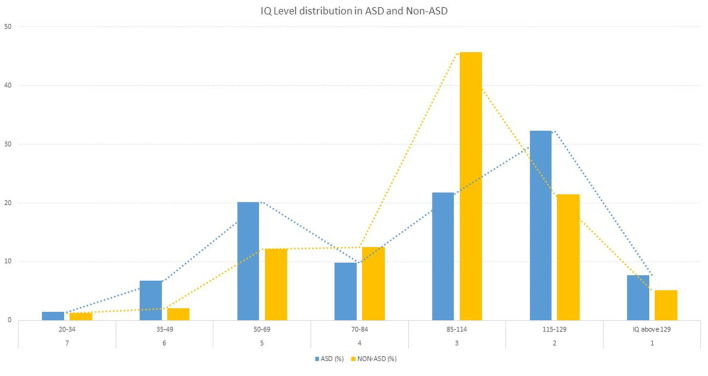
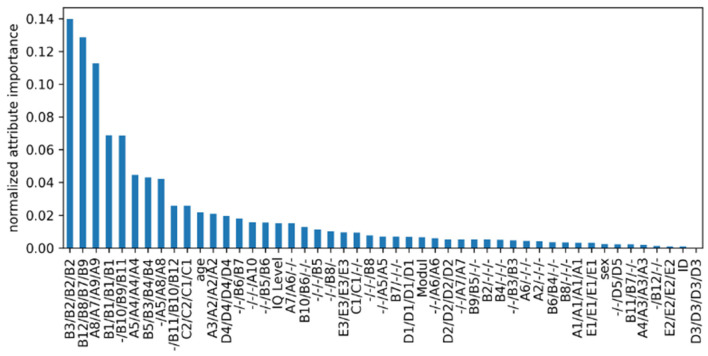
The study included 1,084 individuals: 440 individuals with ASD (with a mean IQ level of 3.3 ± 1.5) and 644 individuals without ASD (with a mean IQ level of 3.2 ± 1.2). We applied and analyzed Random Forest (RF) and Decision Tree (DT) to the ADOS/2 data, compared their accuracy to ADOS/2 cutoff algorithms, and examined most relevant items to distinguish between ASD and Non-ASD. In sum, we included 49 individual features, independently of the applied ADOS module.
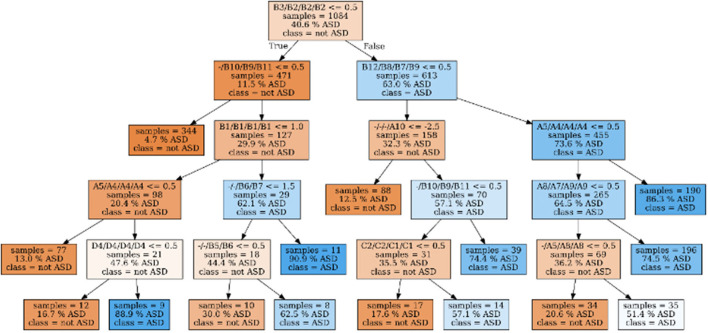
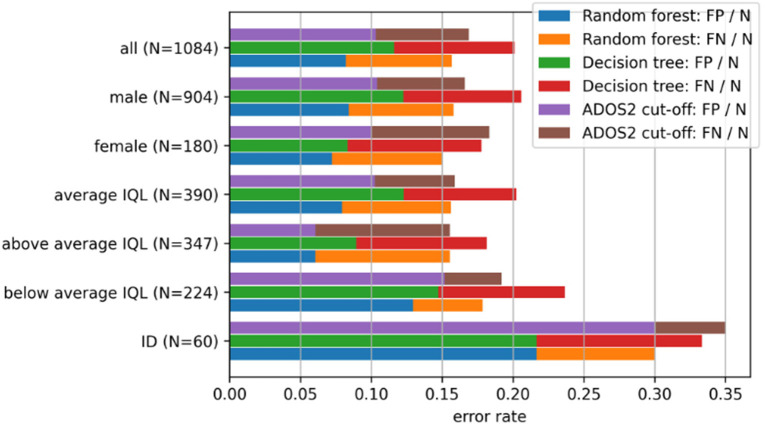
In DT analyses, we observed that for the decision ASD/Non-ASD, solely one to four items are sufficient to differentiate between groups with high accuracy. In addition, in sub-cohorts of individuals with (a) below (IQ level ≥4)/ID and (b) above average intelligence (IQ level ≤ 2), the ADOS/2 cutoff showed reduced accuracy. This reduced accuracy results in (a) a three times higher risk of false-positive diagnoses or (b) a 1.7 higher risk for false-negative diagnoses; both errors could be significantly decreased by the application of the alternative ML algorithms.
Using ML algorithms showed that a small set of ADOS/2 items could help clinicians to more accurately detect ASD in clinical practice across all IQ levels and to increase diagnostic accuracy especially in individuals with below and above average IQ level.
尽管自闭症谱系障碍(ASD)是一种相对常见、广为人知但具有异质性的神经精神疾病,但关于这种异质性特征的具体知识却很匮乏。人们普遍认为智商导致了这种异质性,同时也使诊断和治疗计划变得复杂。在本研究中,我们评估了自闭症诊断观察量表(ADOS/2)在整个样本以及由智商定义的子样本中的准确性,并分析了应用处理包括智商水平在内的额外信息的机器学习(ML)算法是否可以提高ADOS/2的准确性。
该研究纳入了1084名个体:440名患有ASD的个体(平均智商水平为3.3±1.5)和644名未患ASD的个体(平均智商水平为3.2±1.2)。我们将随机森林(RF)和决策树(DT)应用于ADOS/2数据,将它们的准确性与ADOS/2截断算法进行比较,并检查区分ASD和非ASD的最相关项目。总之,我们纳入了49个个体特征,与所应用的ADOS模块无关。
在DT分析中,我们观察到对于ASD/非ASD的判定,仅一到四个项目就足以高精度地区分不同组。此外,在(a)智商水平低于4/有智力障碍(IQ水平≥4)和(b)智商高于平均水平(IQ水平≤2)的个体亚组中ADOS/2截断值的准确性降低。这种准确性降低导致(a)假阳性诊断风险增加三倍或(b)假阴性诊断风险增加1.7倍;应用替代ML算法可显著降低这两种错误。
使用ML算法表明,一小部分ADOS/2项目可以帮助临床医生在临床实践中更准确地检测所有智商水平的ASD,并提高诊断准确性,特别是在智商低于和高于平均水平的个体中。