Yadav Pranjali, Chaturvedi Shubhra, Biswas Samir Kumar, Srivastava Rohit, Kailasam Kamalakannan, Mishra Anil Kumar, Shanavas Asifkhan
Institute of Nano Science and Technology, Sector-81, Knowledge City, SAS Nagar, Punjab 140306, India.
Division of Cyclotron and Radiopharmaceutical Sciences, Institute of Nuclear Medicine and Allied Sciences, DRDO, Delhi 110054, India.
ACS Omega. 2022 Mar 4;7(10):8928-8937. doi: 10.1021/acsomega.1c07324. eCollection 2022 Mar 15.
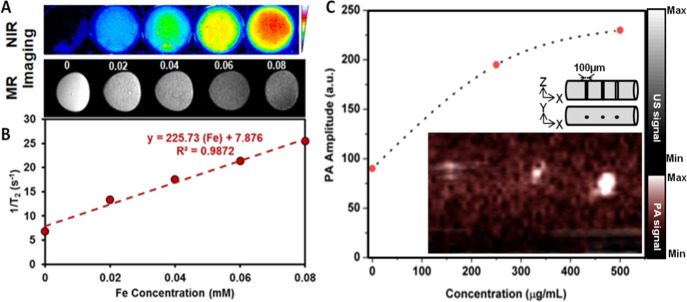
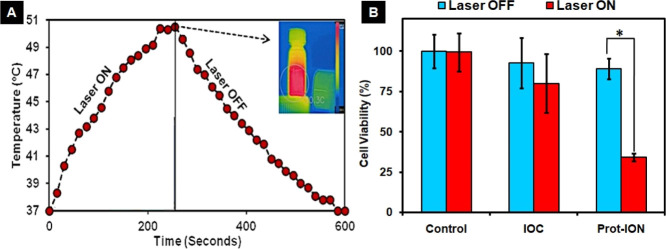
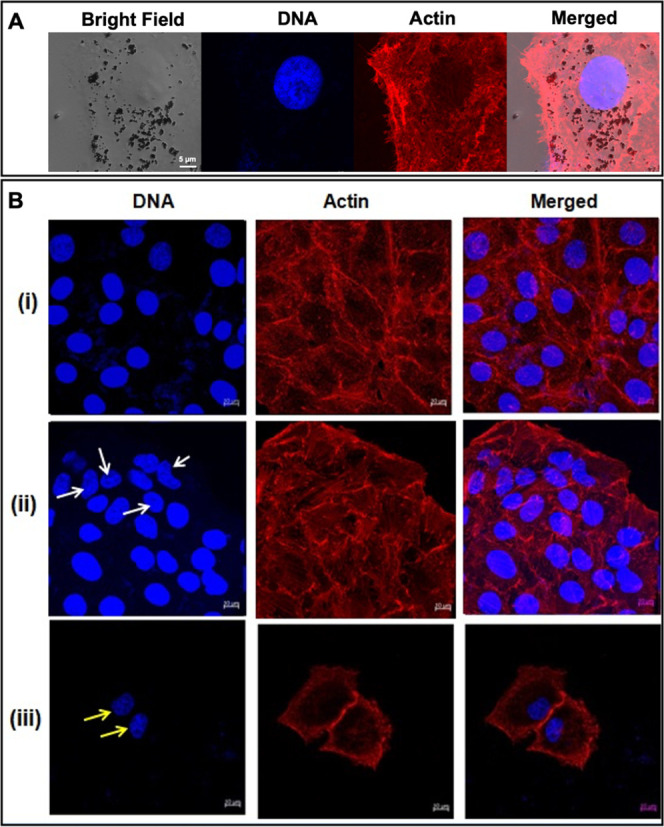
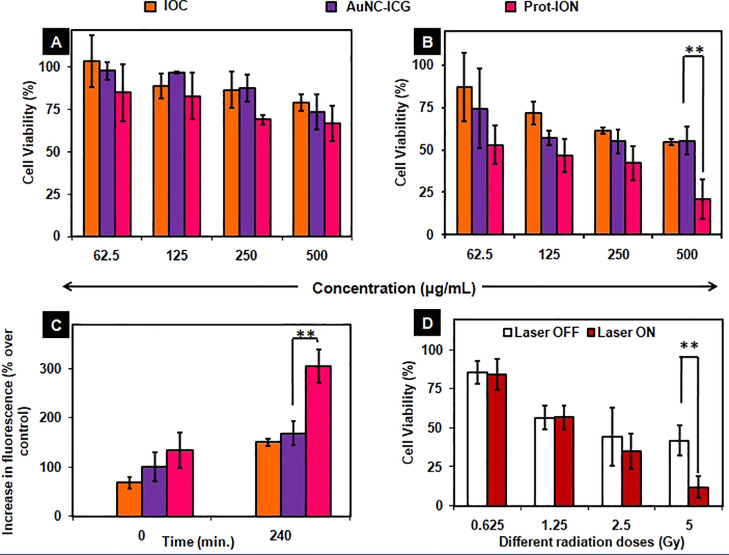
Inorganic nanomaterials require optimal engineering to retain their functionality yet can also biodegrade within physiological conditions to avoid chronic accumulation in their native form. In this work, we have developed gelatin-stabilized iron oxide nanoclusters having a primary crystallite size of ∼10 nm and surface-functionalized with indocyanine green (ICG)-bound albumin-stabilized gold nanoclusters (Prot-IONs). The Prot-IONs are designed to undergo disintegration in an acidic microenvironment of tumor in the presence of proteolytic enzymes within 72 h. These nanoassemblies demonstrate bio- and hemocompatibility and show significant photothermal efficiency due to strong near infrared absorption contributed by ICG. The surface gold nanoclusters could efficiently sensitize hepatoma cells to γ-irradiation with substantial cytoskeletal and nuclear damage. Sequential irradiation of Prot-ION-treated cancer cells with near infrared (NIR) laser (λ = 750 nm) and γ-irradiation could cause ∼90% cell death compared to single treatment groups at a lower dose of nanoparticles. The superparamagnetic nature of Prot-IONs imparted significant relaxivity (∼225 mM s) for T-weighted magnetic resonance imaging. Additionally, they could also be engaged as photoacoustic and NIR imaging contrast agents. This work demonstrates bioeliminable inorganic nanoassemblies with significant theranostic potential.
无机纳米材料需要进行优化设计,以保持其功能,同时还能在生理条件下生物降解,避免以其原始形式长期积累。在这项工作中,我们开发了明胶稳定的氧化铁纳米团簇,其初级微晶尺寸约为10纳米,并通过与吲哚菁绿(ICG)结合的白蛋白稳定的金纳米团簇(Prot-IONs)进行表面功能化。Prot-IONs被设计为在肿瘤的酸性微环境中,在蛋白水解酶存在的情况下,在72小时内发生分解。这些纳米组装体表现出生物相容性和血液相容性,并且由于ICG产生的强烈近红外吸收而显示出显著的光热效率。表面金纳米团簇可以有效地使肝癌细胞对γ射线辐射敏感,造成大量细胞骨架和细胞核损伤。与较低剂量纳米颗粒的单一治疗组相比,用近红外(NIR)激光(λ = 750 nm)和γ射线对经Prot-ION处理的癌细胞进行顺序照射可导致约90%的细胞死亡。Prot-IONs的超顺磁性赋予了T加权磁共振成像显著的弛豫率(约225 mM s)。此外,它们还可用作光声和近红外成像造影剂。这项工作展示了具有显著诊疗潜力的可生物消除的无机纳米组装体。