Jiang Liang, Zhang Chuanyang, Wang Siyu, Ai Zhongping, Shen Tingwen, Zhang Hong, Duan Shaofeng, Yin Xindao, Chen Yu-Chen
Department of Radiology, Nanjing First Hospital, Nanjing Medical University, Nanjing, China.
Department of Radiology, Nanjing Gaochun People's Hospital, Nanjing, China.
Front Aging Neurosci. 2022 Mar 3;14:782036. doi: 10.3389/fnagi.2022.782036. eCollection 2022.
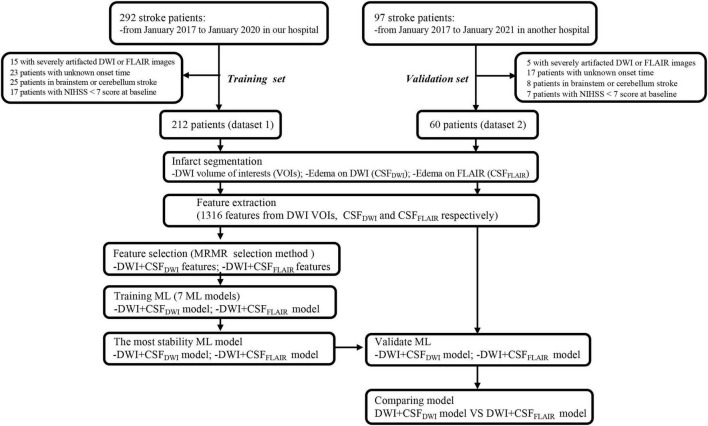
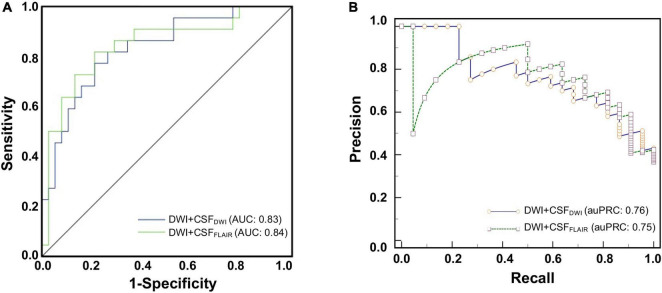
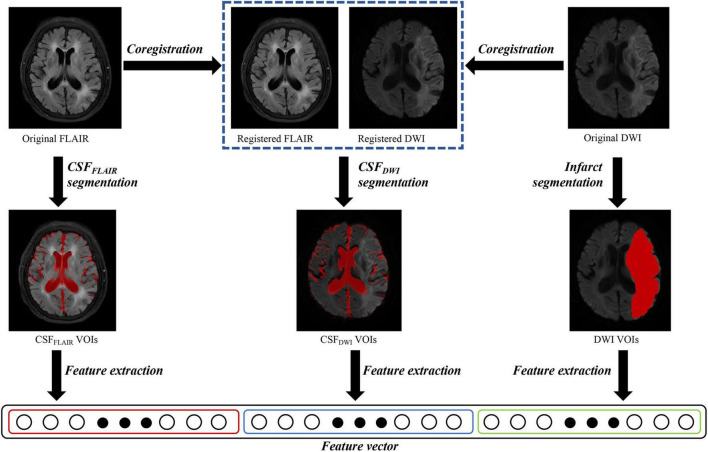
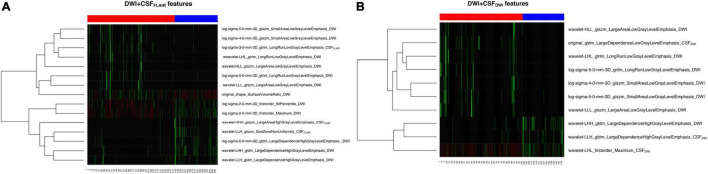
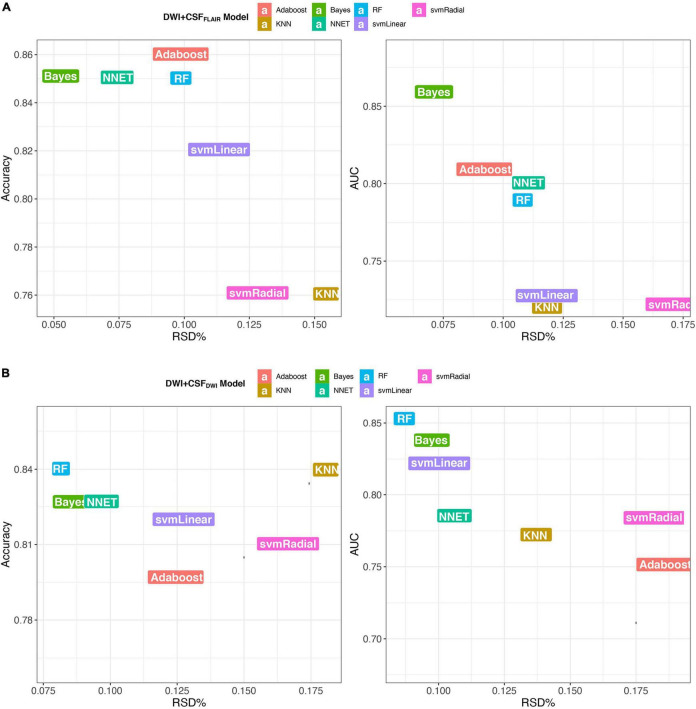
Neuroimaging biomarkers that predict the edema after acute stroke may help clinicians provide targeted therapies and minimize the risk of secondary injury. In this study, we applied pretherapy MRI radiomics features from infarction and cerebrospinal fluid (CSF) to predict edema after acute ischemic stroke. MRI data were obtained from a prospective, endovascular thrombectomy (EVT) cohort that included 389 patients with acute stroke from two centers (dataset 1, = 292; dataset 2, = 97), respectively. Patients were divided into edema group (brain swelling and midline shift) and non-edema group according to CT within 36 h after therapy. We extracted the imaging features of infarct area on diffusion weighted imaging (DWI) (abbreviated as DWI), CSF on fluid-attenuated inversion recovery (FLAIR) (CSF) and CSF on DWI (CSF), and selected the optimum features associated with edema for developing models in two forms of feature sets (DWI + CSF and DWI + CSF) respectively. We developed seven ML models based on dataset 1 and identified the most stable model. External validations (dataset 2) of the developed stable model were performed. Prediction model performance was assessed using the area under the receiver operating characteristic curve (AUC). The Bayes model based on DWI + CSF and the RF model based on DWI + CSF had the best performances (DWI + CSF: AUC, 0.86; accuracy, 0.85; recall, 0.88; DWI + CSF: AUC, 0.86; accuracy, 0.84; recall, 0.84) and the most stability (RSD% in DWI + CSF AUC: 0.07, RSD% in DWI + CSF AUC: 0.09), respectively. External validation showed that the AUC of the Bayes model based on DWI + CSF was 0.84 with accuracy of 0.77 and area under precision-recall curve (auPRC) of 0.75, and the AUC of the RF model based on DWI + CSF was 0.83 with accuracy of 0.81 and the auPRC of 0.76. The MRI radiomics features from infarction and CSF may offer an effective imaging biomarker for predicting edema.
能够预测急性中风后水肿情况的神经影像学生物标志物,可能有助于临床医生提供针对性治疗,并将继发性损伤风险降至最低。在本研究中,我们应用来自梗死灶和脑脊液(CSF)的治疗前MRI影像组学特征来预测急性缺血性中风后的水肿情况。MRI数据取自一个前瞻性血管内血栓切除术(EVT)队列,该队列分别包含来自两个中心的389例急性中风患者(数据集1,n = 292;数据集2,n = 97)。根据治疗后36小时内的CT检查结果,将患者分为水肿组(脑肿胀和中线移位)和非水肿组。我们提取了扩散加权成像(DWI)上梗死灶区域的影像特征(简称为DWI)、液体衰减反转恢复序列(FLAIR)上的脑脊液(CSF)以及DWI上的脑脊液(CSF),并分别在两种特征集形式(DWI + CSF和DWI + CSF)中选择与水肿相关的最优特征来构建模型。我们基于数据集1开发了七个机器学习模型,并确定了最稳定的模型。对所开发的稳定模型进行了外部验证(数据集2)。使用受试者操作特征曲线下面积(AUC)评估预测模型的性能。基于DWI + CSF的贝叶斯模型和基于DWI + CSF的随机森林(RF)模型分别具有最佳性能(DWI + CSF:AUC为0.86;准确率为0.85;召回率为0.88;DWI + CSF:AUC为0.86;准确率为0.84;召回率为0.84)和最高稳定性(DWI + CSF AUC的相对标准偏差(RSD%):0.07,DWI + CSF AUC的RSD%:0.09)。外部验证表明,基于DWI + CSF的贝叶斯模型的AUC为0.84,准确率为0.77,精确召回率曲线下面积(auPRC)为0.75,基于DWI + CSF的RF模型的AUC为0.83,准确率为0.81,auPRC为0.76。来自梗死灶和脑脊液的MRI影像组学特征可能为预测水肿提供一种有效的影像学生物标志物。