Department of Thoracic Surgery, National Cancer Center, National Clinical Research Center for Cancer, Cancer Hospital, Chinese Academy of Medical Sciences and Peking Union Medical College, Beijing 100021, China.
J Healthc Eng. 2022 Mar 11;2022:2227629. doi: 10.1155/2022/2227629. eCollection 2022.
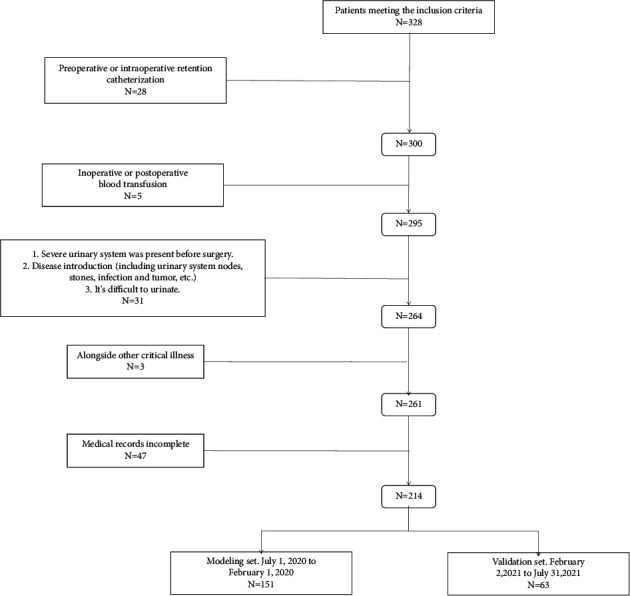
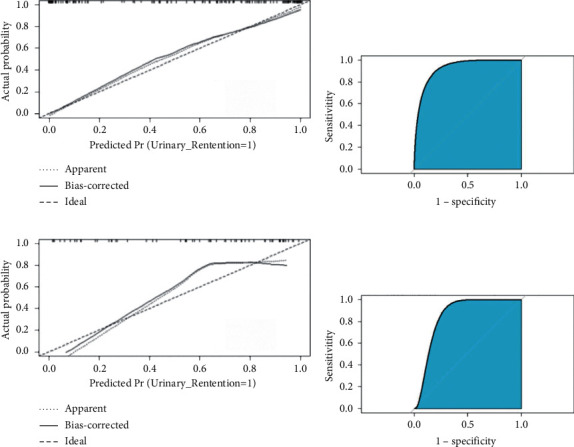
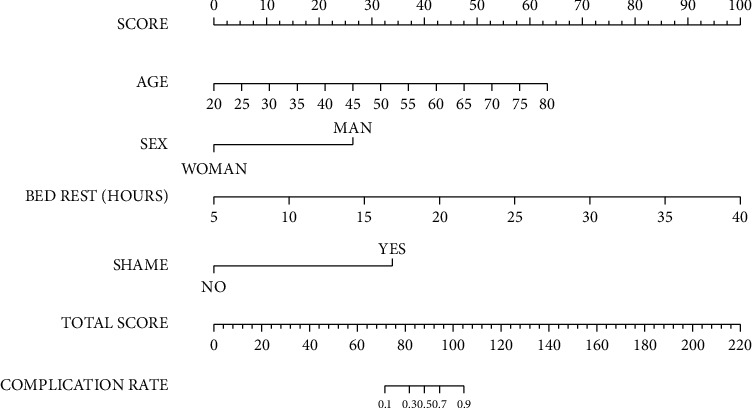
Indwelling catheter is a routine procedure in surgical patients. Studies have shown that prolonged indwelling urinary catheterization increases the risk of postoperative urinary tract infection. Although early removal of the urinary catheter after operation can reduce the risk of postoperative urinary symptoms and tract infections, it may lead to postoperative anesthetic dysuria. Therefore, this study investigates the urinary retention and related risk factors in patients after thoracoscopic lobectomy under general anesthesia. The clinical data of 214 patients who underwent thoracoscopic lobectomy in the Department of Thoracic Surgery of a tertiary class A cancer hospital in Beijing from July 2020 to April 2021 were collected. A risk prediction model was established by logistic regression analysis, and the prediction effect was determined using the area under the receiver operating characteristic (ROC) curve. The incidence of indwelling catheter after thoracoscopic lobectomy was 44.8% (96/214). Sex (OR = 21.102, 95% CI: 2.906-153.239, =0.003), perception of shame (OR = 74.256, 95% CI: 6.171-893.475, =0.001), age (OR = 1.095, 95% CI: 1.014-1.182, =0.021), and bed rest time (OR = 1.598, 95% CI: 1.263-2.023, < 0.021) were the factors influencing urinary retention after thoracoscopic lobectomy. This model can effectively predict the occurrence of postoperative urinary retention in patients with lung cancer and help medical staff to intervene effectively before the onset of urinary retention, which provides reference for preventive treatment and nursing intervention.
留置导尿管是外科患者的常规操作。研究表明,留置导尿时间延长会增加术后尿路感染的风险。虽然术后尽早拔除导尿管可以降低术后尿路症状和感染的风险,但可能导致术后麻醉性尿潴留。因此,本研究调查了全身麻醉下胸腔镜肺叶切除术后患者的尿潴留及相关危险因素。收集了 2020 年 7 月至 2021 年 4 月期间在北京一家三级甲等癌症医院胸外科行胸腔镜肺叶切除术的 214 例患者的临床资料。采用 logistic 回归分析建立风险预测模型,并通过受试者工作特征(ROC)曲线下面积确定预测效果。胸腔镜肺叶切除术后留置导尿管的发生率为 44.8%(96/214)。性别(OR=21.102,95%CI:2.906-153.239,=0.003)、羞耻感(OR=74.256,95%CI:6.171-893.475,=0.001)、年龄(OR=1.095,95%CI:1.014-1.182,=0.021)和卧床时间(OR=1.598,95%CI:1.263-2.023, < 0.021)是影响胸腔镜肺叶切除术后尿潴留的因素。该模型可有效预测肺癌患者术后尿潴留的发生,有助于医护人员在尿潴留发生前进行有效干预,为预防治疗和护理干预提供参考。