Rivière Denis, Leprince Yann, Labra Nicole, Vindas Nabil, Foubet Ophélie, Cagna Bastien, Loh Kep Kee, Hopkins William, Balzeau Antoine, Mancip Martial, Lebenberg Jessica, Cointepas Yann, Coulon Olivier, Mangin Jean-François
Université Paris-Saclay, CEA, CNRS UMR 9027, Baobab, NeuroSpin, Gif-sur-Yvette, France.
PaleoFED Team, UMR 7194, CNRS, Département Homme et Environnement, Muséum National d'Histoire Naturelle, Musée de l'Homme, Paris, France.
Front Neuroinform. 2022 Mar 3;16:803934. doi: 10.3389/fninf.2022.803934. eCollection 2022.
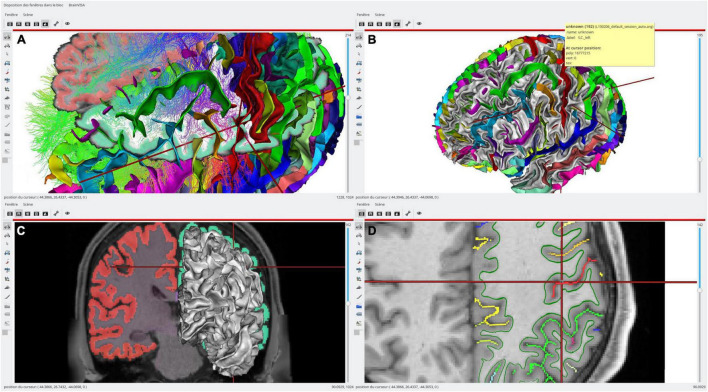
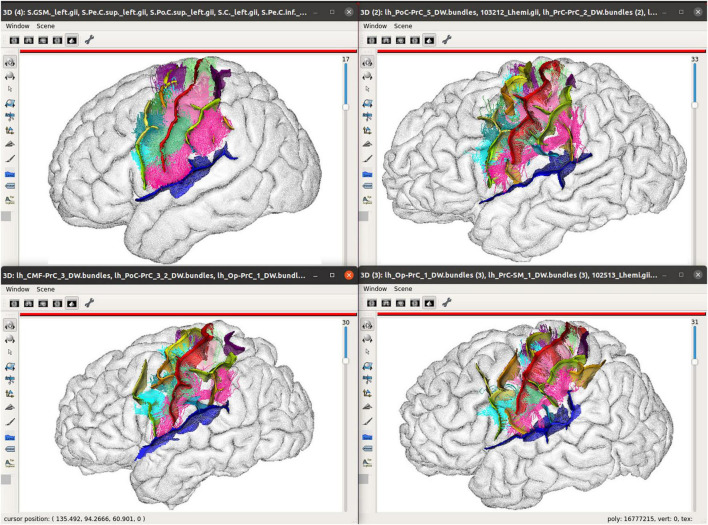
Brain mapping studies often need to identify brain structures or functional circuits into a set of individual brains. To this end, multiple atlases have been published to represent such structures based on different modalities, subject sets, and techniques. The mainstream approach to exploit these atlases consists in spatially deforming each individual data onto a given atlas using dense deformation fields, which supposes the existence of a continuous mapping between atlases and individuals. However, this continuity is not always verified, and this "iconic" approach has limits. We present in this study an alternative, complementary, "structural" approach, which consists in extracting structures from the individual data, and comparing them without deformation. A "structural atlas" is thus a collection of annotated individual data with a common structure nomenclature. It may be used to characterize structure shape variability across individuals or species, or to train machine learning systems. This study exhibits , a powerful structural 3D visualization software dedicated to building, exploring, and editing structural atlases involving a large number of subjects. It has been developed primarily to decipher the cortical folding variability; cortical sulci vary enormously in both size and shape, and some may be missing or have various topologies, which makes iconic approaches inefficient to study them. We, therefore, had to build structural atlases for cortical sulci, and use them to train sulci identification algorithms. can display multiple subject data in multiple views, supports all kinds of neuroimaging data, including compound structural object graphs, handles arbitrary coordinate transformation chains between data, and has multiple display features. It is designed as a programming library in both C++ and Python languages, and may be extended or used to build dedicated custom applications. Its generic design makes all the display and structural aspects used to explore the variability of the cortical folding pattern work in other applications, for instance, to browse axonal fiber bundles, deep nuclei, functional activations, or other kinds of cortical parcellations. Multimodal, multi-individual, or inter-species display is supported, and adaptations to large scale screen walls have been developed. These very original features make it a unique viewer for structural atlas browsing.
脑图谱研究通常需要在一组个体大脑中识别脑结构或功能回路。为此,已经发布了多个图谱来基于不同的模态、受试者群体和技术来表示此类结构。利用这些图谱的主流方法是使用密集变形场将每个个体数据在空间上变形到给定的图谱上,这假定图谱和个体之间存在连续映射。然而,这种连续性并不总是成立的,并且这种“标志性”方法存在局限性。在本研究中,我们提出了一种替代的、互补的“结构”方法,该方法包括从个体数据中提取结构,并在不进行变形的情况下进行比较。因此,“结构图谱”是具有共同结构命名法的带注释个体数据的集合。它可用于表征个体或物种之间结构形状的变异性,或用于训练机器学习系统。本研究展示了一款功能强大的结构三维可视化软件,该软件专门用于构建、探索和编辑涉及大量受试者的结构图谱。它主要是为了解析皮质折叠变异性而开发的;皮质沟在大小和形状上差异极大,有些可能缺失或具有各种拓扑结构,这使得标志性方法在研究它们时效率低下。因此,我们必须为皮质沟构建结构图谱,并使用它们来训练沟识别算法。[软件名称]可以在多个视图中显示多个受试者的数据,支持各种神经成像数据,包括复合结构对象图,处理数据之间的任意坐标变换链,并且具有多种显示功能。它被设计为用C++和Python语言编写的编程库,可以进行扩展或用于构建专用的定制应用程序。其通用设计使得所有用于探索皮质折叠模式变异性的显示和结构方面在其他应用中也能发挥作用,例如浏览轴突纤维束、深部核团、功能激活或其他类型的皮质分区。支持多模态、多个体或跨物种显示,并且已经开发了适用于大型屏幕墙的适配方案。这些非常独特的功能使其成为用于浏览结构图谱的独特查看器。