Kincannon William M, Zahn Michael, Clare Rita, Lusty Beech Jessica, Romberg Ari, Larson James, Bothner Brian, Beckham Gregg T, McGeehan John E, DuBois Jennifer L
Department of Biochemistry, Montana State University, Bozeman, MT 59717.
Centre for Enzyme Innovation, University of Portsmouth, Portsmouth, PO1 2PY, United Kingdom.
Proc Natl Acad Sci U S A. 2022 Mar 29;119(13):e2121426119. doi: 10.1073/pnas.2121426119. Epub 2022 Mar 21.
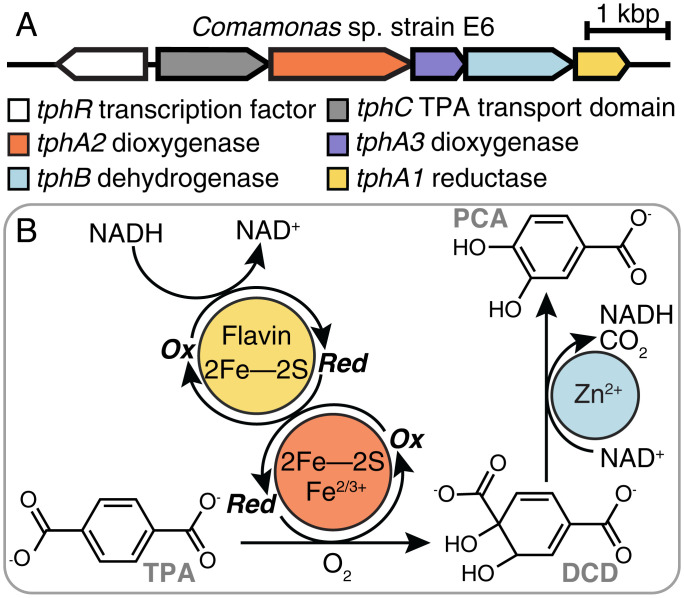
SignificanceMore than 400 million tons of plastic waste is produced each year, the overwhelming majority of which ends up in landfills. Bioconversion strategies aimed at plastics have emerged as important components of enabling a circular economy for synthetic plastics, especially those that exhibit chemically similar linkages to those found in nature, such as polyesters. The enzyme system described in this work is essential for mineralization of the xenobiotic components of poly(ethylene terephthalate) (PET) in the biosphere. Our description of its structure and substrate preferences lays the groundwork for in vivo or ex vivo engineering of this system for PET upcycling.
意义
每年产生超过4亿吨塑料垃圾,其中绝大多数最终被填埋。旨在处理塑料的生物转化策略已成为实现合成塑料循环经济的重要组成部分,尤其是那些与天然存在的化学键具有化学相似性的塑料,如聚酯。这项工作中描述的酶系统对于生物圈中聚对苯二甲酸乙二酯(PET)的异生物质成分的矿化至关重要。我们对其结构和底物偏好的描述为该系统在体内或体外进行PET升级再造工程奠定了基础。