Merry R, Espina M J, Lorenz A J, Stupar R M
Department of Agronomy and Plant Genetics, University of Minnesota, Saint Paul, MN, 55108, USA.
Plant Methods. 2022 Mar 21;18(1):36. doi: 10.1186/s13007-022-00855-5.
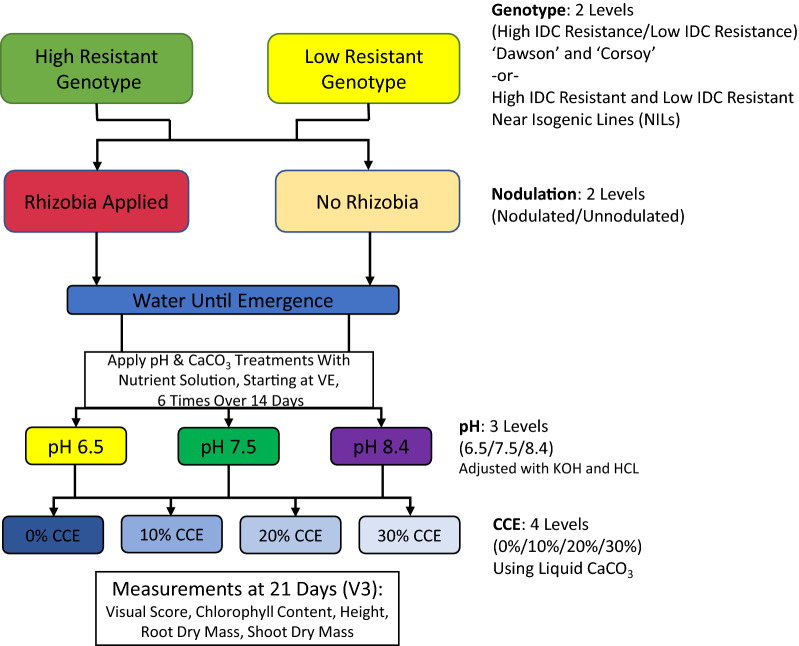
Soybean iron deficiency chlorosis (IDC) is an important nutrient stress frequently found in high pH and/or soils high in calcium carbonates. To advance the understanding of IDC resistance in soybean, a rapid (21-day) controlled-environment assay was developed to investigate the effects of nodulation, pH, and calcium carbonate levels on soybean iron deficiency traits. This system was tested on four genotypes known to exhibit differences in iron efficiency, including two standard IDC check cultivars and a pair of near-isogenic lines exhibiting variation at an IDC resistance quantitative trait locus. Visual score, chlorophyll content, plant height, root dry mass, and shoot dry mass were measured to quantify iron stress.
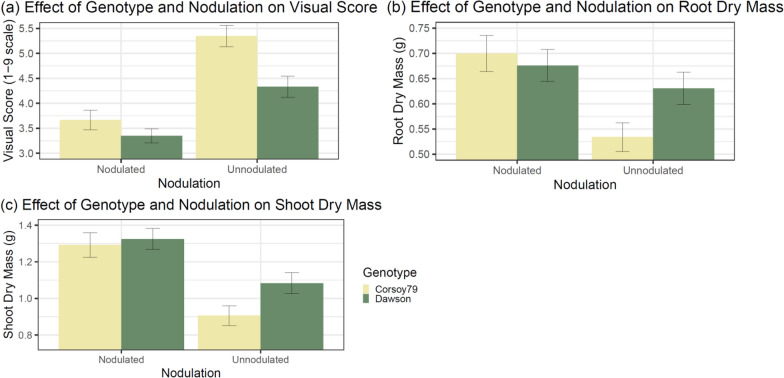
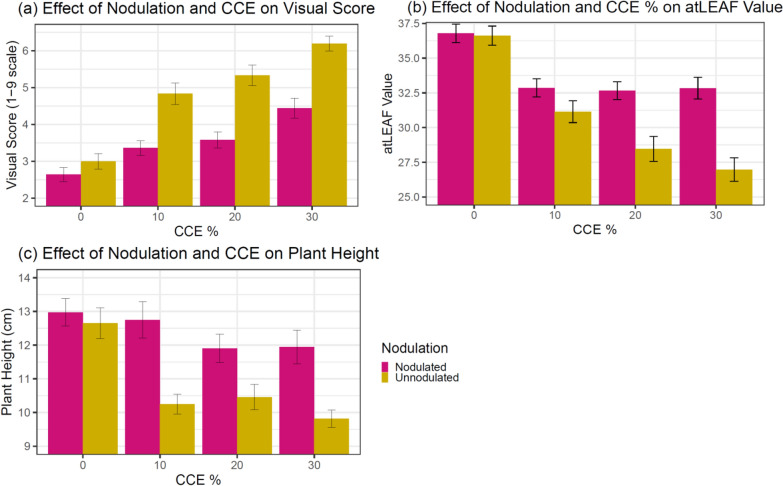
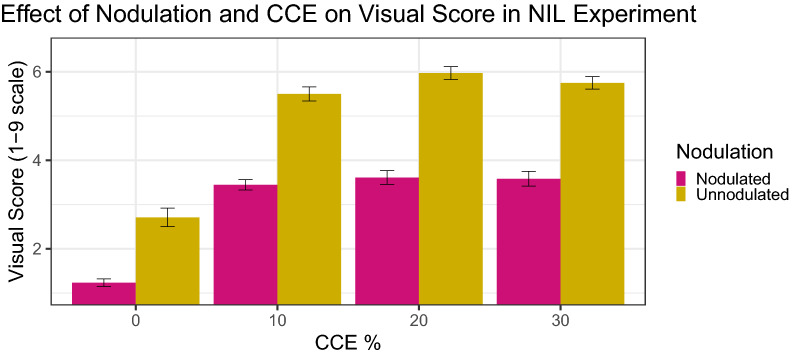
Calcium carbonate levels and nodulation were found to have the greatest effects on IDC severity. Increasing calcium carbonate levels worsened IDC symptoms, while nodulation reduced symptoms in all genotypes. Higher pH levels increased iron deficiency symptoms in check genotypes 'Corsoy 79' and 'Dawson', but did not induce iron deficiency symptoms in near-isogenic lines. A significant interaction was observed between genotype, nodulation, and calcium carbonate level, indicating that a specific treatment level could discern IDC symptoms between genotypes differing in resistance to IDC.
IDC symptoms were successfully induced in the Check Genotypes Experiment as well as the NIL Experiment, indicating the success of using this assay for inducing IDC in controlled environments. However, our results suggest that treatment levels that best differentiate genotypes for their IDC resistance may need to be determined for each experiment because of the unique way in which different genotypes display symptoms and respond to iron deficiency conditions.
大豆缺铁黄化病(IDC)是在高pH值和/或高碳酸钙土壤中常见的一种重要养分胁迫。为了深入了解大豆对IDC的抗性,开发了一种快速(21天)的可控环境试验,以研究结瘤、pH值和碳酸钙水平对大豆缺铁性状的影响。该系统在已知铁效率存在差异的四个基因型上进行了测试,包括两个标准的IDC对照品种和一对在IDC抗性数量性状位点上表现出变异的近等基因系。通过视觉评分、叶绿素含量、株高、根干重和地上部干重的测量来量化铁胁迫。
发现碳酸钙水平和结瘤对IDC严重程度影响最大。碳酸钙水平的增加会加重IDC症状,而结瘤则会减轻所有基因型的症状。较高的pH值增加了对照基因型“Corsoy 79”和“Dawson”的缺铁症状,但在近等基因系中未诱发缺铁症状。观察到基因型、结瘤和碳酸钙水平之间存在显著的相互作用,表明特定的处理水平可以区分对IDC抗性不同的基因型之间的IDC症状。
在对照基因型试验和近等基因系试验中均成功诱导出IDC症状,表明该试验在可控环境中诱导IDC成功。然而,我们的结果表明,由于不同基因型表现症状和对缺铁条件反应的独特方式,可能需要为每个试验确定最能区分基因型对IDC抗性的处理水平。