Bai Geng, Jenkins Shawn, Yuan Wenan, Graef George L, Ge Yufeng
Department of Biological Systems Engineering, University of Nebraska-Lincoln, Lincoln, NE, United States.
Department of Agronomy and Horticulture, University of Nebraska-Lincoln, Lincoln, NE, United States.
Front Plant Sci. 2018 Jul 11;9:1002. doi: 10.3389/fpls.2018.01002. eCollection 2018.
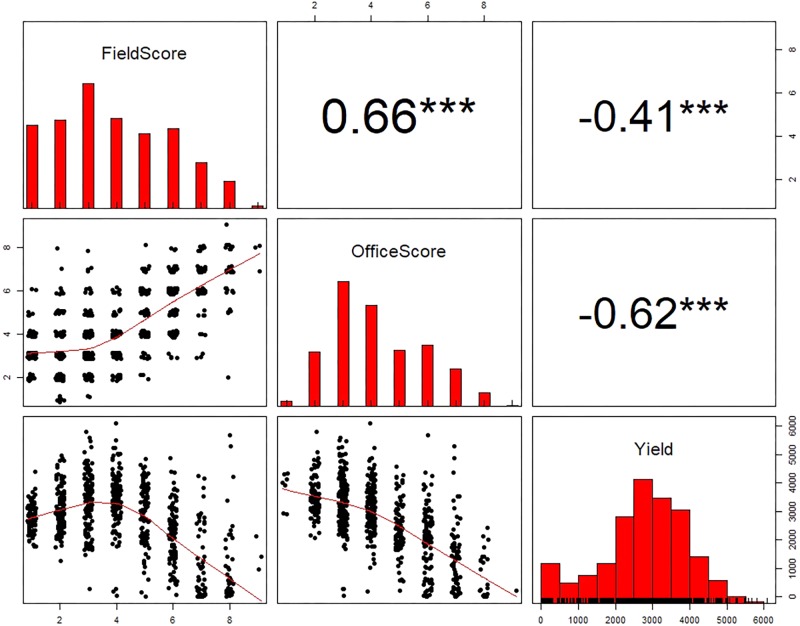
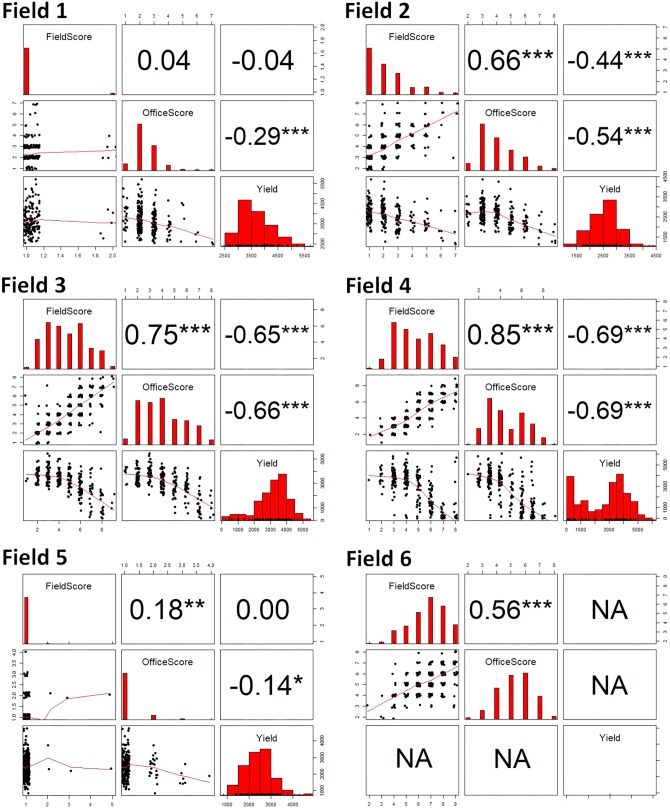
Iron deficiency chlorosis (IDC) is an abiotic stress in soybean that can cause significant biomass and yield reduction. IDC is characterized by stunted growth and yellowing and interveinal chlorosis of early trifoliate leaves. Scoring IDC severity in the field is conventionally done by visual assessment. The goal of this study was to investigate the usefulness of Red Green Blue (RGB) images of soybean plots captured under the field condition for IDC scoring. A total of 64 soybean lines with four replicates were planted in 6 fields over 2 years. Visual scoring (referred to as Field Score, or FS) was conducted at V3-V4 growth stage; and concurrently RGB images of the field plots were recorded with a high-throughput field phenotyping platform. A second set of IDC scores was done on the plot images (displayed on a computer screen) consistently by one person in the office (referred to as Office Score, or OS). Plot images were then processed to remove weeds and extract six color features, which were used to train computer-based IDC scoring models (referred to as Computer Score, or CS) using linear discriminant analysis (LDA) and support vector machine (SVM). The results showed that, in the fields where severe IDC symptoms were present, FS and OS were strongly positively correlated with each other, and both of them were strongly negatively correlated with yield. CS could satisfactorily predict IDC scores when evaluated using FS and OS as the reference (overall classification accuracy > 81%). SVM models appeared to outperform LDA models; and the SVM model trained to predict IDC OS gave the highest prediction accuracy. It was anticipated that coupling RGB imaging from the high-throughput field phenotyping platform with real-time image processing and IDC CS models would lead to a more rapid, cost-effective, and objective scoring pipeline for soybean IDC field screening and breeding.
缺铁黄化病(IDC)是大豆面临的一种非生物胁迫,会导致生物量和产量显著降低。IDC的特征是生长发育迟缓,以及早期三出复叶发黄和脉间黄化。传统上,通过目视评估来在田间对IDC严重程度进行评分。本研究的目的是调查在田间条件下拍摄的大豆地块的红、绿、蓝(RGB)图像用于IDC评分的有效性。在两年时间里,共有64个大豆品系,每个品系四个重复,种植在6块田地里。在V3 - V4生长阶段进行目视评分(称为田间评分,或FS);同时,使用高通量田间表型分析平台记录田间地块的RGB图像。由一人在办公室对地块图像(显示在电脑屏幕上)一致地进行第二轮IDC评分(称为办公室评分,或OS)。然后对地块图像进行处理以去除杂草,并提取六个颜色特征,使用线性判别分析(LDA)和支持向量机(SVM)来训练基于计算机的IDC评分模型(称为计算机评分,或CS)。结果表明,在出现严重IDC症状的田块中,FS和OS彼此之间呈强正相关,并且它们二者都与产量呈强负相关。当以FS和OS作为参考进行评估时,CS能够令人满意地预测IDC评分(总体分类准确率>81%)。SVM模型似乎优于LDA模型;并且训练用于预测IDC OS的SVM模型给出了最高的预测准确率。预计将高通量田间表型分析平台的RGB成像与实时图像处理以及IDC CS模型相结合,将为大豆IDC田间筛选和育种带来更快速、更具成本效益且客观的评分流程。