Dobbels Austin A, Lorenz Aaron J
Department of Agronomy and Plant Genetics, University of Minnesota, 1991 Upper Buford Circle, 411 Borlaug Hall, St. Paul, MN 55108 USA.
Plant Methods. 2019 Aug 20;15:97. doi: 10.1186/s13007-019-0478-9. eCollection 2019.
Iron deficiency chlorosis (IDC) is an abiotic stress in soybean [Glycine max (L.) Merr.] that causes significant yield reductions. Symptoms of IDC include interveinal chlorosis and stunting of the plant. While there are management practices that can overcome these drastic yield losses, the preferred way to manage IDC is growing tolerant soybean varieties. To develop varieties tolerant to IDC, breeders may easily phenotype up to thousands of candidate soybean lines every year for severity of symptoms related to IDC, a task traditionally done with a 1-5 visual rating scale. The visual rating scale is subjective and, because it is time consuming and laborious, can typically only be accomplished once or twice during a growing season.
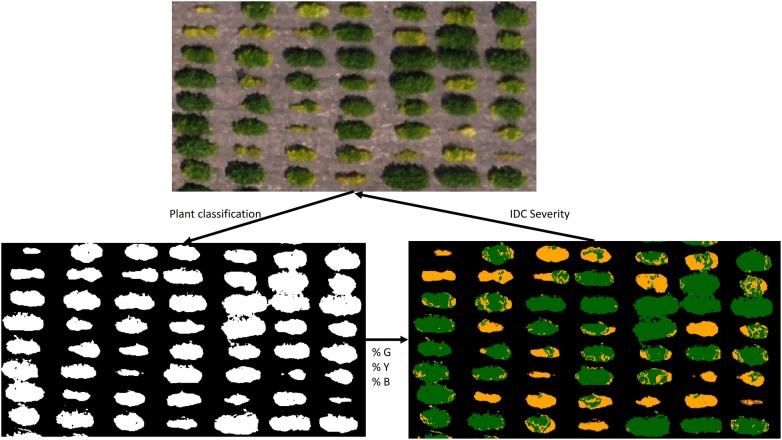
The goal of this study was to use an unmanned aircraft system (UAS) to improve field screening for tolerance to soybean IDC. During the summer of 2017, 3386 plots were visually scored for IDC stress on two different dates. In addition, images were captured with a DJI Inspire 1 platform equipped with a modified dual camera system which simultaneously captures digital red, green, blue images as well as red, green, near infrared (NIR) images. A pipeline was created for image capture, orthomosaic generation, processing, and analysis. Plant and soil classification was achieved using unsupervised classification resulting in 95% overall classification accuracy. Within the plant classified canopy, the green, yellow, and brown plant pixels were classified and used as features for random forest and neural network models. Overall, the random forest and neural network models achieved similar misclassification rates and classification accuracy, which ranged from 68 to 77% across rating dates. All 36 trials in the field were analyzed using a linear model for both visual score and UAS predicted values on both dates. In 32 of the 36 tests on date 1 and 33 of 36 trials on date 2, the LSD associated with UAS image-based IDC scores was lower than the LSD associated with visual scores, indicating the image-based scores provided more precise measurements of IDC severity.
Overall, the UAS was able to capture differences in IDC stress and may be used for evaluations of candidate breeding lines in a soybean breeding program. This system was both more efficient and precise than traditional scoring methods.
缺铁黄化病(IDC)是大豆[Glycine max (L.) Merr.]面临的一种非生物胁迫,会导致显著的产量下降。IDC的症状包括叶脉间黄化和植株发育不良。虽然有一些管理措施可以克服这些严重的产量损失,但管理IDC的首选方法是种植耐缺铁黄化病的大豆品种。为了培育耐IDC的品种,育种者每年可以轻松地对多达数千个候选大豆品系进行与IDC相关症状严重程度的表型分析,这项任务传统上是用1-5级视觉评分量表来完成的。视觉评分量表具有主观性,而且由于耗时费力,通常在一个生长季节只能完成一到两次。
本研究的目的是使用无人机系统(UAS)来改进对大豆IDC耐受性的田间筛选。2017年夏季,在两个不同日期对3386个地块的IDC胁迫进行了视觉评分。此外,使用配备了改良双相机系统的大疆Inspire 1平台拍摄图像,该系统可同时捕获数字红、绿、蓝图像以及红、绿、近红外(NIR)图像。创建了一个用于图像捕获、正射镶嵌图生成、处理和分析的流程。使用无监督分类实现了植物和土壤分类,总体分类准确率达到95%。在分类出的植物冠层内,对绿色、黄色和棕色植物像素进行分类,并将其用作随机森林和神经网络模型的特征。总体而言,随机森林和神经网络模型的错误分类率和分类准确率相似,在不同评分日期范围内为68%至77%。使用线性模型对两个日期的视觉评分和UAS预测值进行了分析,涵盖了田间所有36次试验。在日期1的36次测试中的32次以及日期2的36次试验中的第33次试验中,与基于UAS图像的IDC评分相关的最小显著差(LSD)低于与视觉评分相关的LSD,这表明基于图像的评分提供了更精确的IDC严重程度测量。
总体而言,UAS能够捕捉到IDC胁迫的差异,并可用于大豆育种计划中候选育种品系的评估。该系统比传统评分方法更高效、精确。