Licari Amelia, Castagnoli Riccardo, Ciprandi Riccardo, Brambilla Ilaria, Guasti Eleonora, Marseglia Gian Luigi, Ciprandi Giorgio
Clinica Pediatrica, Fondazione IRCCS Policlinico San Matteo, Pavia, Italy.
Department of Pediatrics, Fondazione IRCCS Policlinico San Matteo, University of Pavia, Pavia, Italy.
Acta Biomed. 2022 Mar 14;93(1):e2022021. doi: 10.23750/abm.v93i1.10731.
Anxiety and depression may affect asthma control. Previously, it has been reported that the hospital anxiety depression scale (HADS) questionnaire was fruitful in the management of adolescents with asthma. This study compared the scores of two different questionnaires, namely the Childhood Anxiety Sensitivity Index (CASI) and Children's Depression Inventory (CDI), with asthma control level and lung function in asthmatic adolescents, evaluated in a real-life setting.
A group of adolescents with asthma was consecutively enrolled. Asthma was diagnosed according to the GINA document, and consistently the symptom control grade was assessed. The adolescents completed the CASI, CDI, and Asthma Control Test (ACT) questionnaires. Visual Analogue Scale (VAS) for asthma symptoms perception and doctor's asthma control evaluation were considered. Lung function and clinical characteristics were also assessed.
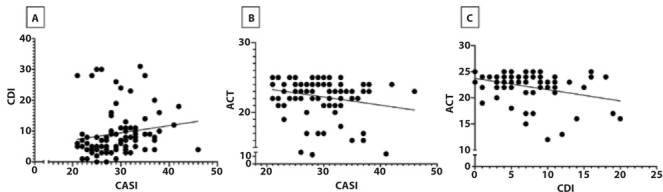
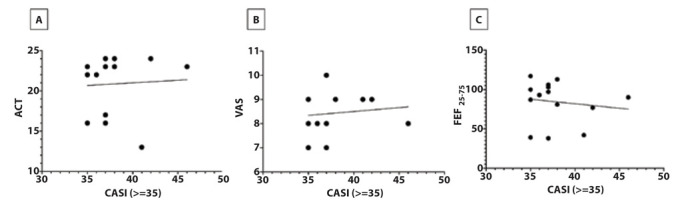
Totally, 87 asthmatic adolescents (60 males, 27 females, median age 14.2 years) were evaluated. 16.1% of asthmatic adolescents had anxious symptoms detected by CASI, and 11.5% depressive symptoms revealed by CDI. High scores of both CASI and CDI were significantly associated with uncontrolled asthma (p= 0.013 and 0.043, respectively).
This study showed that anxiety and depression affected asthma control. Thus, in clinical practice, the psychological assessment could be included in asthmatic adolescents' asthma work-up.
焦虑和抑郁可能影响哮喘控制。此前有报道称,医院焦虑抑郁量表(HADS)问卷在哮喘青少年的管理中成效显著。本研究在现实环境中评估了哮喘青少年中两种不同问卷,即儿童焦虑敏感性指数(CASI)和儿童抑郁量表(CDI)的得分与哮喘控制水平及肺功能的关系。
连续纳入一组哮喘青少年。根据全球哮喘防治创议(GINA)文件诊断哮喘,并持续评估症状控制等级。青少年完成CASI、CDI和哮喘控制测试(ACT)问卷。考虑哮喘症状感知的视觉模拟量表(VAS)和医生对哮喘控制的评估。还评估了肺功能和临床特征。
共评估了87名哮喘青少年(60名男性,27名女性,中位年龄14.2岁)。CASI检测出16.1%的哮喘青少年有焦虑症状,CDI显示11.5%有抑郁症状。CASI和CDI的高分均与哮喘控制不佳显著相关(分别为p = 0.
013和0.043)。
本研究表明焦虑和抑郁影响哮喘控制。因此,在临床实践中,心理评估可纳入哮喘青少年哮喘检查中。