Center for Health Research, Kaiser Permanente Northwest, Portland, OR.
Kaiser Permanente Vaccine Study Center, Oakland, CA.
J Low Genit Tract Dis. 2022 Apr 1;26(2):135-139. doi: 10.1097/LGT.0000000000000659.
Since 2006, the US human papillomavirus (HPV) vaccination program has led to decreases in HPV infections caused by high-risk vaccine-targeted HPV types (HPV 16/18). We assessed differences in high-risk HPV prevalence by cervical cytology result among 20- to 24-year-old persons participating in routine cervical cancer screening in 2015-2017 compared with 2007.
Residual routine cervical cancer screening specimens were collected from 20- to 24-year-old members of 2 integrated healthcare delivery systems as part of a cross-sectional study and were tested for 37 HPV types. Cytology results and vaccination status (≥1 dose) were extracted from medical records. Cytology categories were normal, atypical squamous cells of undefined significance, low-grade squamous intraepithelial lesions (SIL), or high-grade SIL/atypical squamous cells cannot exclude high-grade SIL. Prevalences of HPV categories (HPV 16/18, HPV 31/33/45/52/58, HPV 35/39/51/56/59/66/68) were estimated by cytology result for 2007 and 2015-2017.
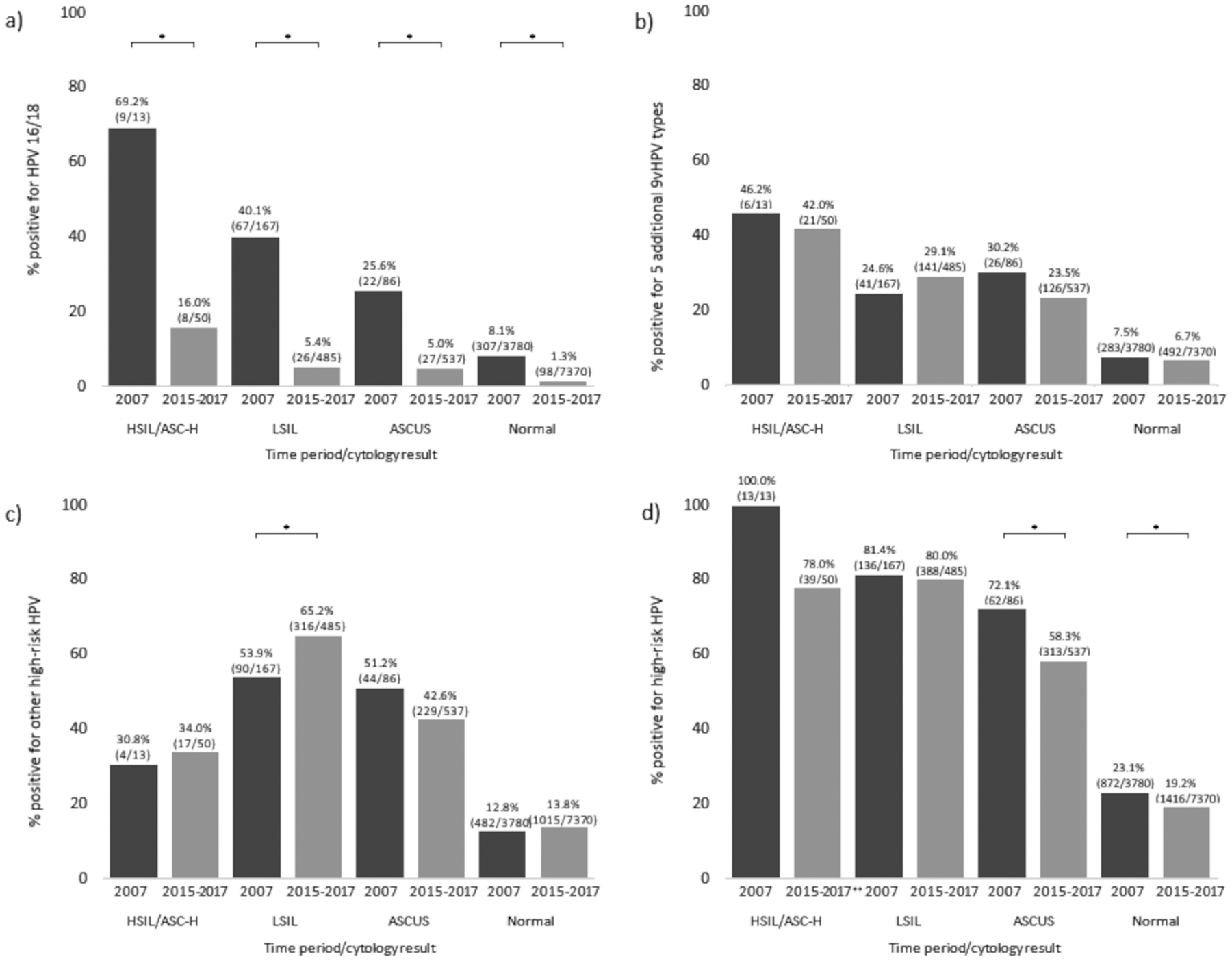
Specimens from 2007 (n = 4046) were from unvaccinated participants; 4574 of 8442 specimens (54.2%) from 2015-2017 were from vaccinated participants. Overall, HPV 16/18 positivity was lower in 2015-2017 compared with 2007 in all groups: high-grade SIL/atypical squamous cells cannot exclude high-grade SIL, 16.0% vs 69.2%; low-grade SIL, 5.4% vs 40.1%; atypical squamous cells of undefined significance, 5.0% vs 25.6%; and normal, 1.3% vs 8.1%. Human papillomavirus 31/33/45/52/58 prevalence was stable for all cytology groups; HPV 35/39/51/56/59/66/68 prevalence increased among low-grade SIL specimens (53.9% to 65.2%) but remained stable in other groups.
Prevalence of vaccine-targeted high-risk HPV types 16/18 was dramatically lower in 2015-2017 than 2007 across all cytology result groups while prevalence of other high-risk HPV types was mainly stable, supporting vaccine impact with no evidence of type replacement.
自 2006 年以来,美国的人乳头瘤病毒(HPV)疫苗接种计划降低了由高风险疫苗靶向 HPV 类型(HPV 16/18)引起的 HPV 感染。我们评估了 2015-2017 年期间,参加常规宫颈癌筛查的 20-24 岁人群中,与 2007 年相比,不同宫颈细胞学结果的高危 HPV 流行率的差异。
作为一项横断面研究的一部分,从 2 个综合医疗服务提供系统的 20-24 岁成员中收集了剩余的常规宫颈癌筛查标本,并对 37 种 HPV 类型进行了检测。细胞学结果和疫苗接种状况(≥1 剂)从病历中提取。细胞学类别为正常、非典型鳞状细胞意义不明、低级别鳞状上皮内病变(LSIL)或高级别 SIL/非典型鳞状细胞不能排除高级别 SIL。根据 2007 年和 2015-2017 年的细胞学结果,估计了 HPV 类别(HPV 16/18、HPV 31/33/45/52/58、HPV 35/39/51/56/59/66/68)的流行率。
2007 年的标本(n=4046)来自未接种疫苗的参与者;2015-2017 年的 8442 份标本中,有 4574 份(54.2%)来自接种疫苗的参与者。总体而言,与 2007 年相比,2015-2017 年所有组中 HPV 16/18 阳性率均较低:高级别 SIL/非典型鳞状细胞不能排除高级别 SIL,分别为 16.0%和 69.2%;低级别 SIL,分别为 5.4%和 40.1%;非典型鳞状细胞意义不明,分别为 5.0%和 25.6%;正常,分别为 1.3%和 8.1%。所有细胞学组 HPV 31/33/45/52/58 的流行率保持稳定;HPV 35/39/51/56/59/66/68 的流行率在低级别 SIL 标本中增加(分别为 53.9%至 65.2%),但在其他组中保持稳定。
与 2007 年相比,2015-2017 年所有细胞学结果组中,疫苗靶向的高危 HPV 类型 16/18 的流行率显著降低,而其他高危 HPV 类型的流行率主要保持稳定,支持疫苗的影响,没有证据表明类型替换。