Xi Yang, Deng Yu-Qin, Chen Shi-Ming, Kong Yong-Gang, Xu Yu, Li Fen, Jiao Wo-Er, Lu Gan, Tao Ze-Zhang
Department of Otolaryngology, Head and Neck Surgery, Renmin Hospital of Wuhan University, 238 Jie-Fang Road, Wuhan, 430060, Hubei, People's Republic of China.
Institute of Otolaryngology, Head and Neck Surgery, Renmin Hospital of Wuhan University, Wuhan, People's Republic of China.
Allergy Asthma Clin Immunol. 2022 Mar 22;18(1):27. doi: 10.1186/s13223-022-00669-z.
Epidemiological evidence between the sleep disorders and allergy-related outcomes is limited.
The purpose of the present study was to estimate the relationship between sleep disorders and allergy-related outcomes in adults.
We built logistic regression models to examine the associations between sleep disorders and allergy-related outcomes in adult participants using the 2005-2006 NHANES database. Allergy-related outcomes included sIgE levels, asthma, hay fever, sneezing, wheezing, and eczema. Sleep disorders included sleep latency, sleep length, sleep problems, OSA symptoms, and daytime sleepiness. A t-test was used for between-group comparisons.
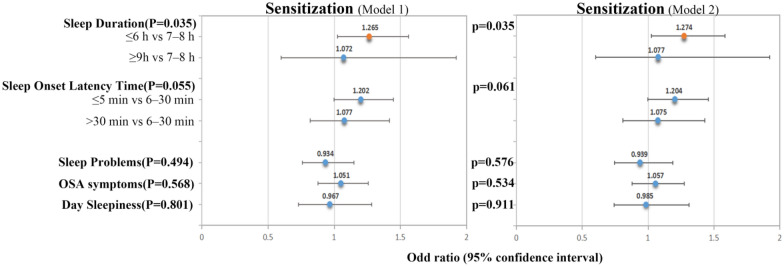
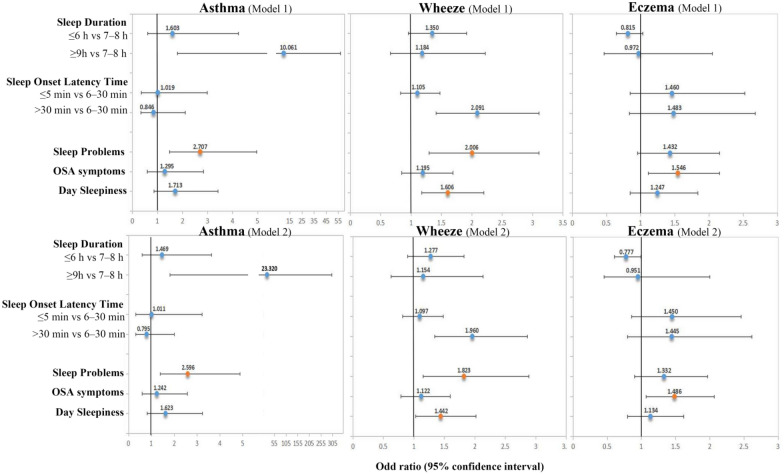
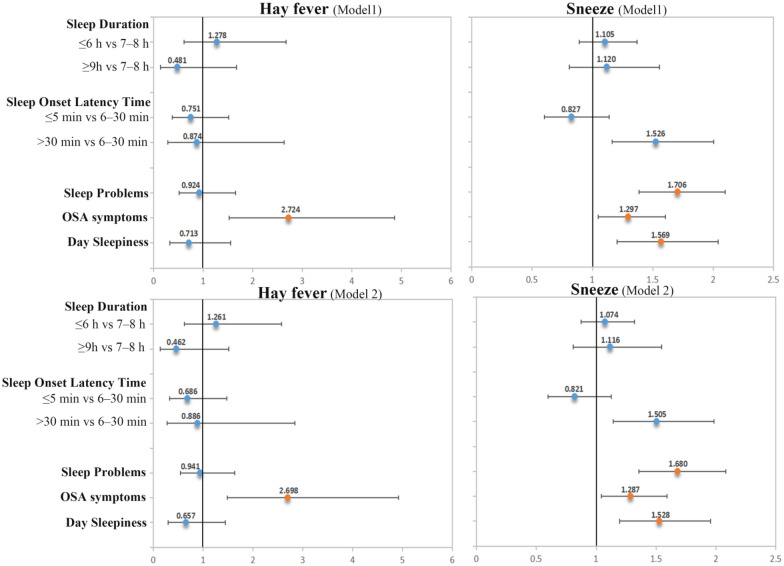
Participants with OSA symptoms had 2.72 × higher odds of experiencing hay fever and 1.54 × higher odds of having eczema compared to Non-OSA symptoms participants. Participants with insufficient sleep (≤ 6 h/night) had 1.27 × higher odds of developing allergic sensitisation compared to participants with adequate sleep (7-8 h/night). Sneezing was positively associated with sleep problems (OR: 1.706; 95% CI 1.386, 2.099), OSA symptoms (OR: 1.297; 95% CI 1.049, 1.605), and daytime sleepiness (OR: 1.569; 95% CI 1.205, 2.04).
Our findings suggest a positive association between allergy-related outcomes and sleep disorders. In particular, OSA symptoms, daytime sleepiness, and sleep problems are strongly associated with allergic conditions.
睡眠障碍与过敏相关结局之间的流行病学证据有限。
本研究旨在评估成人睡眠障碍与过敏相关结局之间的关系。
我们使用2005 - 2006年美国国家健康与营养检查调查(NHANES)数据库建立逻辑回归模型,以检验成年参与者中睡眠障碍与过敏相关结局之间的关联。过敏相关结局包括特异性免疫球蛋白E(sIgE)水平、哮喘、花粉热、打喷嚏、喘息和湿疹。睡眠障碍包括入睡潜伏期、睡眠时间、睡眠问题、阻塞性睡眠呼吸暂停(OSA)症状和日间嗜睡。采用t检验进行组间比较。
与无OSA症状的参与者相比,有OSA症状的参与者患花粉热的几率高2.72倍,患湿疹的几率高1.54倍。与睡眠充足(每晚7 - 8小时)的参与者相比,睡眠不足(每晚≤6小时)的参与者发生过敏致敏的几率高1.27倍。打喷嚏与睡眠问题(比值比:1.706;95%置信区间1.386, 2.099)、OSA症状(比值比:1.297;95%置信区间1.049, 1.605)和日间嗜睡(比值比:1.569;95%置信区间1.205, 2.04)呈正相关。
我们的研究结果表明过敏相关结局与睡眠障碍之间存在正相关。特别是,OSA症状、日间嗜睡和睡眠问题与过敏状况密切相关。