Department of Pediatrics, Clinical Sciences Lund, Lund University, Lund, Sweden.
The Sahlgrenska Centre for Pediatric Ophthalmology Research, Department of Clinical Neuroscience, Institute of Neuroscience and Physiology, Sahlgrenska Academy, University of Gothenburg, Gothenburg, Sweden.
Acta Paediatr. 2022 Jun;111(6):1167-1175. doi: 10.1111/apa.16316. Epub 2022 Mar 22.
This study investigated childhood diagnoses in children born extremely preterm before 24 weeks of gestation.
Diagnoses of neurodevelopmental disorders and selected somatic diagnoses were retrospectively retrieved from national Swedish registries for children born before 24 weeks from 2007 to 2018. Their individual medical files were also examined.
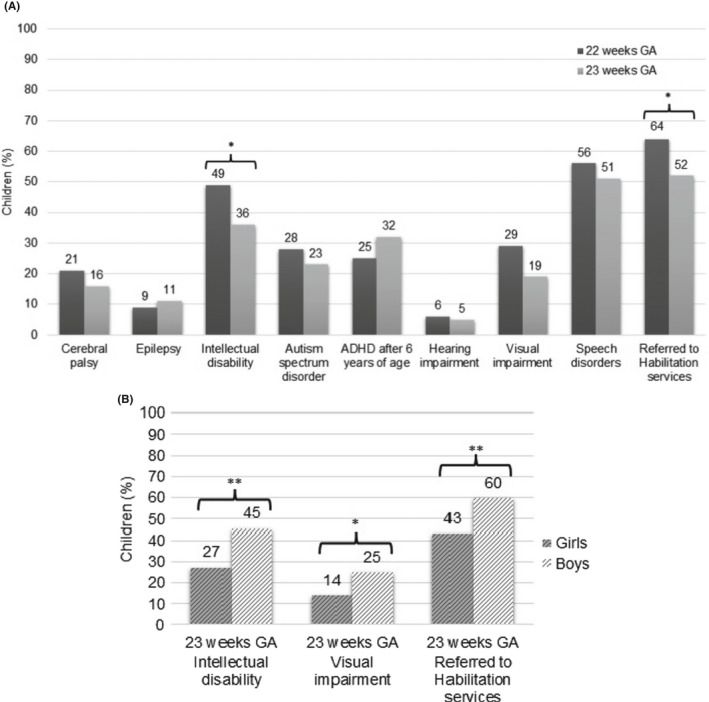
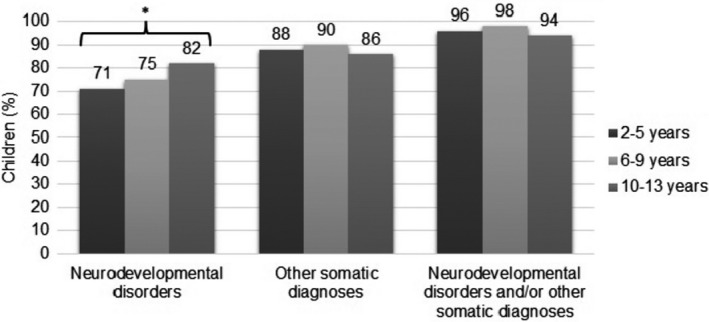
We studied 383 children born at a median of 23.3 (range 21.9-23.9) weeks, with a median birthweight of 565 (range 340-874) grams. Three-quarters (75%) had neurodevelopmental disorders, including speech disorders (52%), intellectual disabilities (40%), attention deficit hyperactivity disorder (30%), autism spectrum disorders (24%), visual impairment (22%), cerebral palsy (17%), epilepsy (10%) and hearing impairment (5%). More boys than girls born at 23 weeks had intellectual disabilities (45% vs. 27%, p < 0.01) and visual impairment (25% vs. 14%, p < 0.01). Just over half of the cohort (55%) received habilitation care. The majority (88%) had somatic diagnoses, including asthma (63%) and failure to thrive/short stature (39%).
Most children born before 24 weeks had neurodevelopmental disorders and/or additional somatic diagnoses in childhood and were referred to habilitation services. Clinicians should be aware of the multiple health and developmental problems affecting these children. Resources are needed to identify their long-term support needs at an early stage.
本研究调查了极早早产(妊娠 24 周前)出生的儿童的儿童期诊断情况。
从 2007 年至 2018 年,我们从瑞典全国性登记处检索了神经发育障碍和选定的躯体诊断的诊断结果,这些诊断结果来自于妊娠 24 周前出生的儿童。同时还检查了他们的个人医疗档案。
我们研究了 383 名中位数胎龄为 23.3(范围 21.9-23.9)周、中位数出生体重为 565(范围 340-874)克的儿童。四分之三(75%)患有神经发育障碍,包括言语障碍(52%)、智力残疾(40%)、注意缺陷多动障碍(30%)、自闭症谱系障碍(24%)、视力障碍(22%)、脑瘫(17%)、癫痫(10%)和听力障碍(5%)。在 23 周出生的儿童中,男孩比女孩更容易患有智力残疾(45%比 27%,p<0.01)和视力障碍(25%比 14%,p<0.01)。超过一半的队列(55%)接受了康复护理。大多数(88%)患有躯体疾病,包括哮喘(63%)和生长迟缓/身材矮小(39%)。
大多数在 24 周前出生的儿童在儿童期都有神经发育障碍和/或其他躯体诊断,并被转介到康复服务机构。临床医生应该意识到这些儿童存在多种健康和发育问题。需要资源来早期确定他们的长期支持需求。