Department of Nuclear Medicine, University Hospital Marburg, Marburg, Germany.
Department of Internal Medicine, Hematology, Oncology and Immunology, University Hospital Marburg, Marburg, Germany.
Eur J Nucl Med Mol Imaging. 2022 Jul;49(9):3247-3256. doi: 10.1007/s00259-022-05762-4. Epub 2022 Mar 23.
Concern is growing about long-term side effects of differentiated thyroid cancer treatment, most notably radioactive iodine (RAI) therapy. However, published studies on the subject have had heterogeneous cohorts and conflicting results. This review seeks to provide an updated evaluation of published evidence, and to elucidate the risk of second primary malignancies (SPMs), especially secondary hematologic malignancies (SHMs), attributable to RAI therapy.
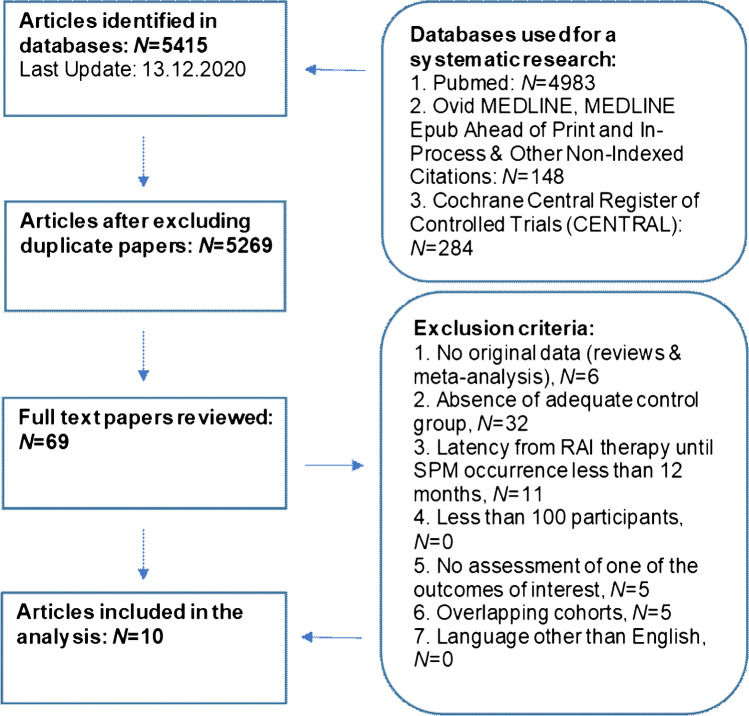
An extensive literature search was performed in Ovid MEDLINE, Ovid MEDLINE and In-Process & Other Non-Indexed Citations, Ovid MEDLINE Epub Ahead of Print, Cochrane Central Register of Controlled Trials (CENTRAL) and PubMed. Studies regarding RAI-induced SPMs or a dose-response relationship between RAI therapy and SPMs were identified, 10 of which were eligible for the analysis. We evaluated risk of bias in each study and judged quality of evidence (QOE) across all studies using the Grading of Recommendations, Assessment, Development and Evaluations approach.
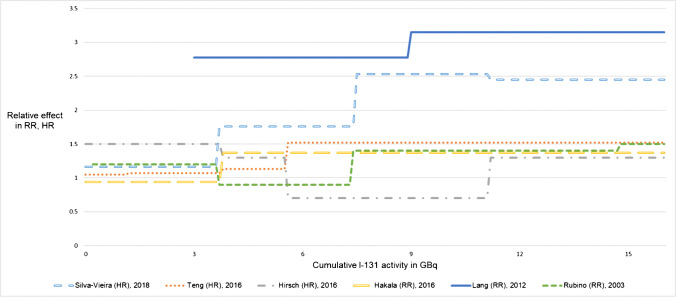
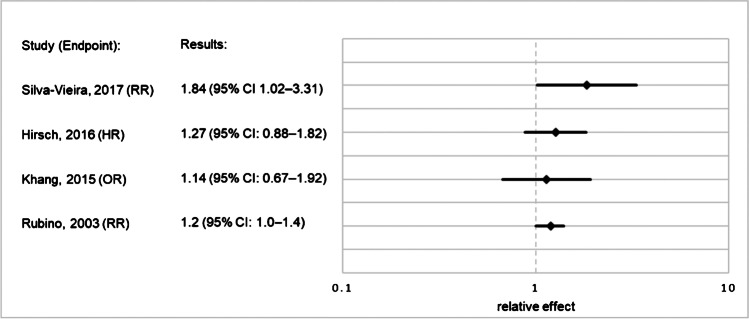
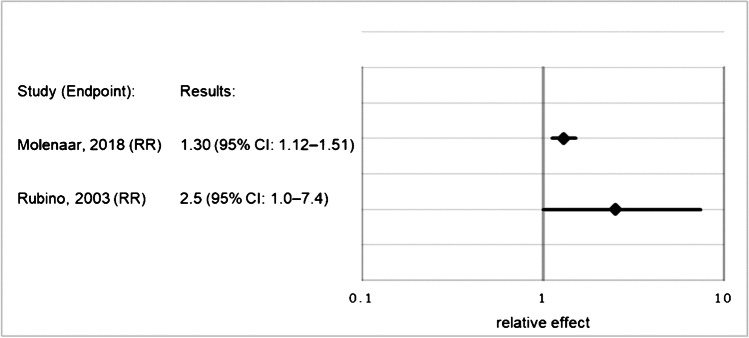
For the outcome "SPM", the relative effect (relative risk, hazard ratio, or odds ratio) of RAI vs. no RAI ranged from 1.14 to 1.84 across studies, but most results were not statistically significant. For the outcome "SHM", reported relative effects ranged from 1.30 to 2.50, with 2/3 of the studies presenting statistically significant results. In 7/8 of the studies, increased risk for SPM was shown with increasing cumulative RAI activity. QOE was "very low" regarding SPM after RAI and regarding a dose-response relationship, and "low" for SHM after RAI.
Based on low quality evidence, an excess risk for the development of SPM cannot be excluded but is expected to be small.
人们越来越关注分化型甲状腺癌治疗的长期副作用,尤其是放射性碘(RAI)治疗。然而,关于这一主题的已发表研究具有异质队列和相互矛盾的结果。本综述旨在提供对已发表证据的最新评估,并阐明归因于 RAI 治疗的第二原发性恶性肿瘤(SPM),特别是继发性血液恶性肿瘤(SHM)的风险。
在 Ovid MEDLINE、Ovid MEDLINE 和 In-Process & Other Non-Indexed Citations、Ovid MEDLINE Epub Ahead of Print、Cochrane 中央对照试验注册库(CENTRAL)和 PubMed 中进行了广泛的文献检索。确定了关于 RAI 诱导的 SPM 或 RAI 治疗与 SPM 之间剂量反应关系的研究,其中有 10 项研究符合分析条件。我们评估了每项研究的偏倚风险,并使用推荐评估、制定与评价分级方法(Grading of Recommendations, Assessment, Development and Evaluations approach)对所有研究的证据质量(QOE)进行了判断。
对于“SPM”这一结局,与无 RAI 相比,RAI 的相对效应(相对风险、风险比或优势比)在研究中范围为 1.14 至 1.84,但大多数结果无统计学意义。对于“SHM”这一结局,报告的相对效应范围为 1.30 至 2.50,其中 2/3 的研究结果具有统计学意义。在 7/8 的研究中,随着累积 RAI 活性的增加,SPM 的风险增加。关于 RAI 后 SPM 以及关于剂量反应关系的 QOE 为“非常低”,关于 RAI 后 SHM 的 QOE 为“低”。
基于低质量证据,不能排除 RAI 后发生 SPM 的风险增加,但预计风险较小。