National Food Virology Reference Centre, Bureau of Microbial Hazards, Health Canada, Ottawa, ON, Canada.
Department of Biochemistry, Microbiology and Immunology, Faculty of Medicine, University of Ottawa, Ottawa, ON, Canada.
Food Environ Virol. 2022 Jun;14(2):212-216. doi: 10.1007/s12560-022-09520-5. Epub 2022 Mar 23.
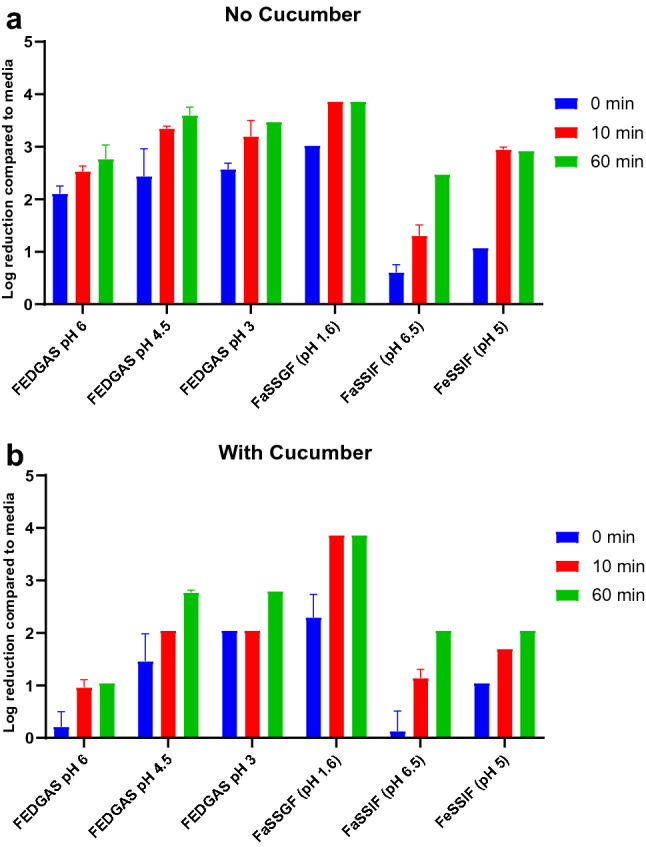
The involvement of the gastrointestinal (GI) tract in severe acute respiratory syndrome coronavirus-2 (SARS-CoV-2) infection has been reported in multiple studies. Since it has been demonstrated that human intestinal epithelial cells support productive viral replication and that a substantial portion of infected individuals shed the virus in feces, the possibility of fecal-oral and fecal-respiratory modes of transmission have been proposed for SARS-CoV-2. In order to establish viral replication in the intestine, enteric viruses need to retain their infectivity in often low pH gastric fluids, and in intestinal fluids, which contain digestive enzymes and bile salts. In this study, we examined whether human coronaviruses OC43 (HCoV-OC43) can remain infectious in simulated GI fluids that models human fasting-state and fed-state, in the presence or absence of food. We demonstrated that except for fasting-state gastric fluid (pH 1.6), the virus can remain infectious in all other gastrointestinal fluids for 1 h. Furthermore, we demonstrated that presence of food could significantly improve viral survival in gastric fluids. Therefore, this study provides evidence that ingestion with food could protect the virus against inactivation by the GI fluids.
胃肠道(GI)在严重急性呼吸综合征冠状病毒 2 型(SARS-CoV-2)感染中的参与在多项研究中均有报道。由于已经证明人类肠道上皮细胞支持病毒的有效复制,并且相当一部分感染个体在粪便中排出病毒,因此提出了 SARS-CoV-2 通过粪-口和粪-呼吸途径传播的可能性。为了在肠道中建立病毒复制,肠道病毒需要在通常 pH 值较低的胃酸和含有消化酶和胆盐的肠道液中保持其感染力。在这项研究中,我们研究了人冠状病毒 OC43(HCoV-OC43)在模拟的 GI 液中是否可以保持感染性,这些模拟液模拟了人类空腹和进食状态,以及在有或没有食物的情况下。我们证明,除了空腹胃液(pH 1.6)外,病毒在所有其他胃肠道液中 1 小时内仍保持感染性。此外,我们还证明,食物的存在可以显著提高胃液中病毒的存活率。因此,这项研究提供了证据,表明摄入食物可以保护病毒免受 GI 液的失活作用。