Quality and Safety Division, Pok Oi Hospital, New Territories, Hong Kong
Nursing Services Division, Pok Oi Hospital, New Territories, Hong Kong.
BMJ Open Qual. 2022 Mar;11(1). doi: 10.1136/bmjoq-2021-001696.
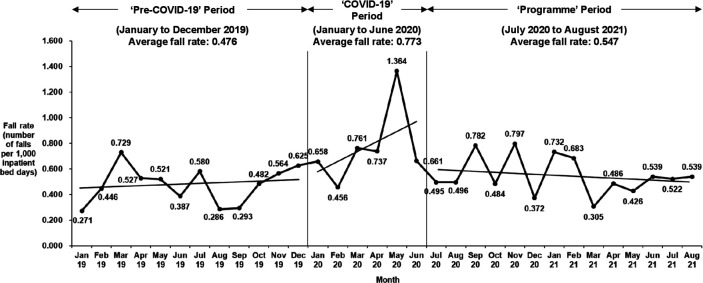
Inpatient falls are frequently reported incidents in hospitals around the world. The recent COVID-19 pandemic has further exacerbated the risk. With the rising importance of human factors and ergonomics (HF&E), a fall prevention programme was introduced by applying HF&E principles to reduce inpatient falls from a systems engineering perspective. The programme was conducted in an acute public hospital with around 750 inpatient beds in Hong Kong. A hospital falls review team (the team) was formed in June 2020 to plan and implement the programme. The 'Define, Measure, Analyse, Improve and Control' (DMAIC) method was adopted. Improvement actions following each fall review were implemented. Fall rates in the 'pre-COVID-19' period (January-December 2019), 'COVID-19' period (January-June 2020) and 'programme' period (July 2020-August 2021) were used for evaluation of the programme effectiveness. A total of 120, 85 and 142 inpatient falls in the 'pre-COVID-19', 'COVID-19' and 'programme' periods were reviewed, respectively. Thirteen areas with fall risks were identified by the team where improvement actions applying HF&E principles were implemented accordingly. The average fall rates were 0.476, 0.773 and 0.547 per 1000 patient bed days in these periods, respectively. The average fall rates were found to be significantly increased from the pre-COVID-19 to COVID-19 periods (mean difference=0.297 (95% CI 0.068 to 0.526), p=0.009), which demonstrated that the COVID-19 pandemic might have affected the hospitals fall rates, while a significant decrease was noted between the COVID-19 and programme periods (mean difference=-0.226 (95% CI -0.449 to -0.003), p=0.047), which proved that the programme in apply HF&E principles to prevent falls was effective. Since HF&E principles are universal, the programme can be generalised to other healthcare institutes, which the participation of staff trained in HF&E in the quality improvement team is vital to its success.
住院患者跌倒在全球各地的医院中经常被报告为事件。最近的 COVID-19 大流行进一步加剧了这种风险。随着人为因素和工效学(HF&E)的重要性日益增加,从系统工程的角度应用 HF&E 原则,通过实施跌倒预防计划来降低住院患者跌倒率。该计划在香港一家拥有约 750 张住院床位的急性公立医院进行。2020 年 6 月成立了一个医院跌倒审查小组(小组),负责规划和实施该计划。采用了“定义、测量、分析、改进和控制”(DMAIC)方法。在每次跌倒审查后实施改进措施。用于评估该计划有效性的是“新冠前”时期(2019 年 1 月至 12 月)、“新冠”时期(2020 年 1 月至 6 月)和“计划”时期(2020 年 7 月至 2021 年 8 月)的住院患者跌倒率。分别审查了 120、85 和 142 例住院患者跌倒事件。小组确定了 13 个存在跌倒风险的领域,并相应地实施了应用 HF&E 原则的改进措施。这些时期的平均跌倒率分别为每 1000 张病床 0.476、0.773 和 0.547。发现从“新冠前”到“新冠”时期的平均跌倒率显著增加(平均差异=0.297(95%置信区间 0.068 至 0.526),p=0.009),表明 COVID-19 大流行可能影响了医院的跌倒率,而在“新冠”和“计划”时期之间则显著下降(平均差异=-0.226(95%置信区间-0.449 至-0.003),p=0.047),这证明了应用 HF&E 原则预防跌倒的计划是有效的。由于 HF&E 原则具有普遍性,因此该计划可以推广到其他医疗机构,而在质量改进团队中参与 HF&E 培训的员工对于其成功至关重要。