• 文献检索
  • 文档翻译
  • 深度研究
  • 学术资讯
  • Suppr Zotero 插件Zotero 插件
  • 邀请有礼
  • 套餐&价格
  • 历史记录
应用&插件
Suppr Zotero 插件Zotero 插件浏览器插件Mac 客户端Windows 客户端微信小程序
定价
高级版会员购买积分包购买API积分包
服务
文献检索文档翻译深度研究API 文档MCP 服务
关于我们
关于 Suppr公司介绍联系我们用户协议隐私条款
关注我们

Suppr 超能文献

核心技术专利:CN118964589B侵权必究
粤ICP备2023148730 号-1Suppr @ 2026

文献检索

告别复杂PubMed语法,用中文像聊天一样搜索,搜遍4000万医学文献。AI智能推荐,让科研检索更轻松。

立即免费搜索

文件翻译

保留排版,准确专业,支持PDF/Word/PPT等文件格式,支持 12+语言互译。

免费翻译文档

深度研究

AI帮你快速写综述,25分钟生成高质量综述,智能提取关键信息,辅助科研写作。

立即免费体验

全球电子健康能力:对世界卫生组织电子健康数据的二次分析及其对资源匮乏环境中肾脏保健服务提供的影响。

Global eHealth capacity: secondary analysis of WHO data on eHealth and implications for kidney care delivery in low-resource settings.

机构信息

Medicine, University of Cape Town, Cape Town, South Africa.

Department of Medicine, University of Alberta, Edmonton, Alberta, Canada.

出版信息

BMJ Open. 2022 Mar 23;12(3):e055658. doi: 10.1136/bmjopen-2021-055658.

DOI:10.1136/bmjopen-2021-055658
PMID:35321893
原文链接:https://pmc.ncbi.nlm.nih.gov/articles/PMC8943769/
Abstract

OBJECTIVE

To describe the use of electronic health (eHealth) in support of health coverage for kidney care across International Society of Nephrology (ISN) regions.

DESIGN

Secondary analysis of WHO survey on eHealth as well as use of data from the World Bank, and Internet World Stats on global eHealth services.

SETTING

A web-based survey on the use of eHealth in support of universal health coverage.

PARTICIPANTS

125 WHO member states provided response.

PRIMARY OUTCOME MEASURES

Availability of eHealth services (eg, electronic health records, telehealth, etc) and governance frameworks (policies) for kidney care across ISN regions.

RESULTS

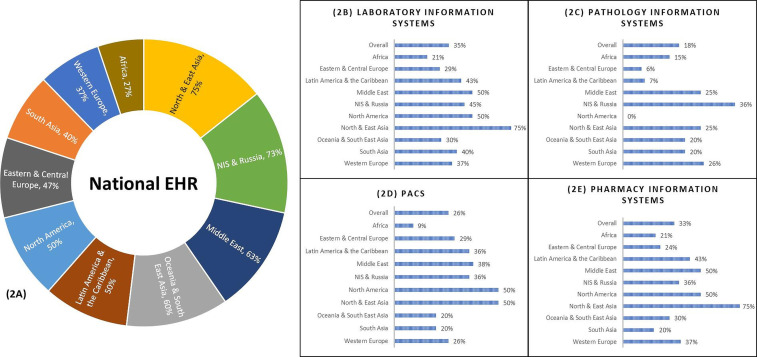
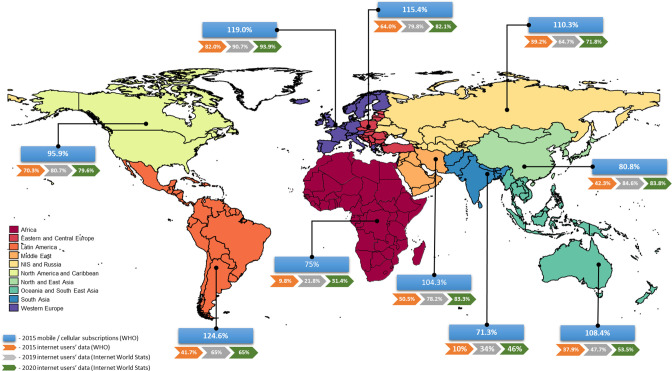
The survey conducted by the WHO received responses from 125 (64.4%) member states, representing 4.4 billion people globally. The number of mobile cellular subscriptions was <100% of the population in Africa, South Asia, North America and North East Asia; the percentage of internet users increased from 2015 to 2020 in all regions. Western Europe had the highest percentage of internet users in all the periods: 2015 (82.0%), 2019 (90.7%) and 2020 (93.9%); Africa had the least: 9.8%, 21.8% and 31.4%, respectively. The North East Asia region had the highest availability of national electronic health record system (75%) and electronic learning access in medical schools (100%), with the lowest in Africa (27% and 39%, respectively). Policies concerning governance aspects of eHealth (eg, privacy, liability, data sharing) were more widely available in high-income countries (55%-93%) than in low-income countries (0%-47%), while access to mobile health for treatment adherence was more available in low-income countries (21%) than in high-income countries (7%).

CONCLUSION

The penetration of eHealth services across ISN regions is suboptimal, particularly in low-income countries. Increasing utilisation of internet communication technologies provides an opportunity to improve access to kidney education and care globally, especially in low-income countries.

摘要

目的

描述电子健康(eHealth)在支持国际肾脏病学会(ISN)区域内肾脏保健覆盖范围方面的应用。

设计

对世界卫生组织(WHO)关于电子健康调查的二次分析,以及对世界银行、全球电子健康服务的互联网世界统计(Internet World Stats)数据的利用。

设置

一项关于电子健康在支持全民健康覆盖方面的应用的网络调查。

参与者

125 个世界卫生组织成员国提供了回复。

主要结果测量指标

ISN 区域内电子健康服务(如电子健康记录、远程医疗等)的可用性和肾脏保健治理框架(政策)。

结果

由世界卫生组织进行的调查收到了来自 125 个(64.4%)成员国的回复,代表了全球 44 亿人口。在非洲、南亚、北美和东北亚,移动蜂窝订阅数不到人口的 100%;在所有区域,互联网用户的百分比在 2015 年至 2020 年期间都有所增加。在所有时期,西欧的互联网用户百分比最高:2015 年(82.0%)、2019 年(90.7%)和 2020 年(93.9%);非洲则最低:分别为 9.8%、21.8%和 31.4%。东北亚地区的国家电子健康记录系统(75%)和医学院电子学习通道(100%)的可用性最高,而非洲的这两个指标的可用性最低(分别为 27%和 39%)。在电子健康治理方面的政策(如隐私、责任、数据共享)在高收入国家(55%-93%)比在低收入国家(0%-47%)更为广泛,而在治疗依从性方面的移动医疗的可及性在低收入国家(21%)比在高收入国家(7%)更高。

结论

在 ISN 区域内,电子健康服务的普及程度不理想,特别是在低收入国家。越来越多地利用互联网通信技术为改善全球范围内肾脏教育和保健提供了机会,特别是在低收入国家。
https://cdn.ncbi.nlm.nih.gov/pmc/blobs/1f7a/8943769/82ae1ac9853b/bmjopen-2021-055658f02.jpg
https://cdn.ncbi.nlm.nih.gov/pmc/blobs/1f7a/8943769/81bfa57bc810/bmjopen-2021-055658f01.jpg
https://cdn.ncbi.nlm.nih.gov/pmc/blobs/1f7a/8943769/82ae1ac9853b/bmjopen-2021-055658f02.jpg
https://cdn.ncbi.nlm.nih.gov/pmc/blobs/1f7a/8943769/81bfa57bc810/bmjopen-2021-055658f01.jpg
https://cdn.ncbi.nlm.nih.gov/pmc/blobs/1f7a/8943769/82ae1ac9853b/bmjopen-2021-055658f02.jpg

相似文献

1
Global eHealth capacity: secondary analysis of WHO data on eHealth and implications for kidney care delivery in low-resource settings.全球电子健康能力:对世界卫生组织电子健康数据的二次分析及其对资源匮乏环境中肾脏保健服务提供的影响。
BMJ Open. 2022 Mar 23;12(3):e055658. doi: 10.1136/bmjopen-2021-055658.
2
Progress of nations in the organisation of, and structures for, kidney care delivery between 2019 and 2023: cross sectional survey in 148 countries.2019 年至 2023 年间各国在肾脏护理服务的组织和架构方面的进展:148 个国家的横断面调查。
BMJ. 2024 Oct 14;387:e079937. doi: 10.1136/bmj-2024-079937.
3
An update on the global disparities in kidney disease burden and care across world countries and regions.全球各国和地区肾脏疾病负担和护理的全球差异更新。
Lancet Glob Health. 2024 Mar;12(3):e382-e395. doi: 10.1016/S2214-109X(23)00570-3.
4
Assessment of Global Kidney Health Care Status.全球肾脏健康护理状况评估。
JAMA. 2017 May 9;317(18):1864-1881. doi: 10.1001/jama.2017.4046.
5
Capacity for the management of kidney failure in the International Society of Nephrology Oceania and South East Asia (OSEA) region: report from the 2023 ISN Global Kidney Health Atlas (ISN-GKHA).国际肾脏病学会大洋洲及东南亚(OSEA)地区的肾衰竭管理能力:来自2023年国际肾脏病学会全球肾脏健康地图(ISN-GKHA)的报告。
Kidney Int Suppl (2011). 2024 Apr;13(1):110-122. doi: 10.1016/j.kisu.2024.01.004. Epub 2024 Apr 8.
6
A global snapshot on health systems capacity for detection, monitoring, and management of acute kidney injury: A multinational study from the ISN-GKHA.全球卫生系统对急性肾损伤的检测、监测及管理能力的现状:一项来自国际肾脏病学会-全球肾脏健康行动(ISN-GKHA)的多国研究
PLOS Glob Public Health. 2024 Oct 15;4(10):e0003823. doi: 10.1371/journal.pgph.0003823. eCollection 2024.
7
E-health: determinants, opportunities, challenges and the way forward for countries in the WHO African Region.电子健康:世卫组织非洲区域各国的决定因素、机遇、挑战及未来方向
BMC Public Health. 2005 Dec 20;5:137. doi: 10.1186/1471-2458-5-137.
8
Capacity for the management of kidney failure in the International Society of Nephrology North and East Asia region: report from the 2023 ISN Global Kidney Health Atlas (ISN-GKHA).国际肾脏病学会北亚和东亚地区肾衰竭管理能力:来自2023年国际肾脏病学会全球肾脏健康地图(ISN-GKHA)的报告。
Kidney Int Suppl (2011). 2024 Apr;13(1):97-109. doi: 10.1016/j.kisu.2024.02.001. Epub 2024 Apr 8.
9
Availability and prioritisation of COVID-19 vaccines among patients with advanced chronic kidney disease and kidney failure during the height of the pandemic: a global survey by the International Society of Nephrology.在大流行高峰期,患有晚期慢性肾脏病和肾衰竭的患者中 COVID-19 疫苗的供应和优先排序:国际肾脏病学会的全球调查。
BMJ Open. 2022 Dec 30;12(12):e065112. doi: 10.1136/bmjopen-2022-065112.
10
SERIES: eHealth in primary care. Part 6: Global perspectives: Learning from eHealth for low-resource primary care settings and across high-, middle- and low-income countries.系列:初级保健中的电子健康。第 6 部分:全球视角:从电子健康中学习,以改善资源匮乏的初级保健环境,并在高、中、低收入国家实施。
Eur J Gen Pract. 2023 Dec;29(1):2241987. doi: 10.1080/13814788.2023.2241987.

引用本文的文献

1
Enhancing treatment adherence in dialysis patients through digital health interventions: a systematic review and meta-analysis of randomized controlled trials.通过数字健康干预提高透析患者的治疗依从性:随机对照试验的系统评价和荟萃分析
Ren Fail. 2025 Dec;47(1):2482885. doi: 10.1080/0886022X.2025.2482885. Epub 2025 Mar 26.
2
Big data research is everyone's research-Making epilepsy data science accessible to the global community: Report of the ILAE big data commission.大数据研究是所有人的研究——让癫痫数据科学为全球社区所用:国际抗癫痫联盟大数据委员会报告
Epileptic Disord. 2024 Dec;26(6):733-752. doi: 10.1002/epd2.20288. Epub 2024 Oct 24.

本文引用的文献

1
Impact of training nephrologists from developing nations and strategies for sustaining a training program in its fourth decade.发展中国家肾脏病专科医生培训的影响及维持一项已开展四十年的培训项目的策略。
Kidney Int. 2021 May;99(5):1073-1076. doi: 10.1016/j.kint.2021.02.029. Epub 2021 Mar 9.
2
Impact of Telemedicine on Hospitalisation and Mortality Rates in Community-Based Haemodialysis Centres in Singapore during the COVID-19 Pandemic.新加坡社区血液透析中心在 COVID-19 大流行期间远程医疗对住院率和死亡率的影响。
Ann Acad Med Singap. 2020 Oct;49(10):756-763.
3
Medical Education and E-Learning During COVID-19 Pandemic: Awareness, Attitudes, Preferences, and Barriers Among Undergraduate Medicine and Nursing Students at Makerere University, Uganda.
新冠疫情期间的医学教育与电子学习:乌干达马凯雷雷大学本科医学与护理专业学生的认知、态度、偏好及障碍
J Med Educ Curric Dev. 2020 Nov 19;7:2382120520973212. doi: 10.1177/2382120520973212. eCollection 2020 Jan-Dec.
4
Perceptions of medical students towards online teaching during the COVID-19 pandemic: a national cross-sectional survey of 2721 UK medical students.COVID-19 大流行期间医学生对在线教学的看法:对 2721 名英国医学生的全国横断面调查。
BMJ Open. 2020 Nov 5;10(11):e042378. doi: 10.1136/bmjopen-2020-042378.
5
Successfully implementing a national electronic health record: a rapid umbrella review.成功实施国家电子健康记录系统:快速伞式综述。
Int J Med Inform. 2020 Dec;144:104281. doi: 10.1016/j.ijmedinf.2020.104281. Epub 2020 Sep 23.
6
Challenges of access to kidney care for children in low-resource settings.在资源匮乏环境下,儿童获得肾脏护理的挑战。
Nat Rev Nephrol. 2021 Jan;17(1):33-45. doi: 10.1038/s41581-020-00338-7. Epub 2020 Oct 1.
7
Impact and efficacy of mobile health intervention in the management of diabetes and hypertension: a systematic review and meta-analysis.移动健康干预在糖尿病和高血压管理中的影响及效果:一项系统综述和荟萃分析
BMJ Open Diabetes Res Care. 2020 Sep;8(1). doi: 10.1136/bmjdrc-2020-001225.
8
Effectiveness of a mobile health intervention on uptake of recommended postnatal care services in Nigeria.移动健康干预对尼日利亚推荐产后护理服务利用率的影响。
PLoS One. 2020 Sep 14;15(9):e0238911. doi: 10.1371/journal.pone.0238911. eCollection 2020.
9
Digital tools against COVID-19: taxonomy, ethical challenges, and navigation aid.数字工具对抗 COVID-19:分类、伦理挑战和导航辅助。
Lancet Digit Health. 2020 Aug;2(8):e425-e434. doi: 10.1016/S2589-7500(20)30137-0. Epub 2020 Jun 29.
10
Using Telenephrology to Improve Access to Nephrologist and Global Kidney Management of CKD Primary Care Patients.利用远程肾脏病学改善慢性肾脏病初级保健患者获得肾病专家服务及全球肾脏管理的机会。
Kidney Int Rep. 2020 Apr 21;5(6):920-923. doi: 10.1016/j.ekir.2020.03.002. eCollection 2020 Jun.