Potapenko Ivan, Thiesson Bo, Kristensen Mads, Hajari Javad Nouri, Ilginis Tomas, Fuchs Josefine, Hamann Steffen, la Cour Morten
Department of Ophthalmology, Rigshospitalet, Copenhagen, Denmark.
Faculty of Health and Medical Sciences, University of Copenhagen, Copenhagen, Denmark.
Acta Ophthalmol. 2022 Dec;100(8):927-936. doi: 10.1111/aos.15133. Epub 2022 Mar 23.
In this study, we investigate the potential of a novel artificial intelligence-based system for autonomous follow-up of patients treated for neovascular age-related macular degeneration (AMD).
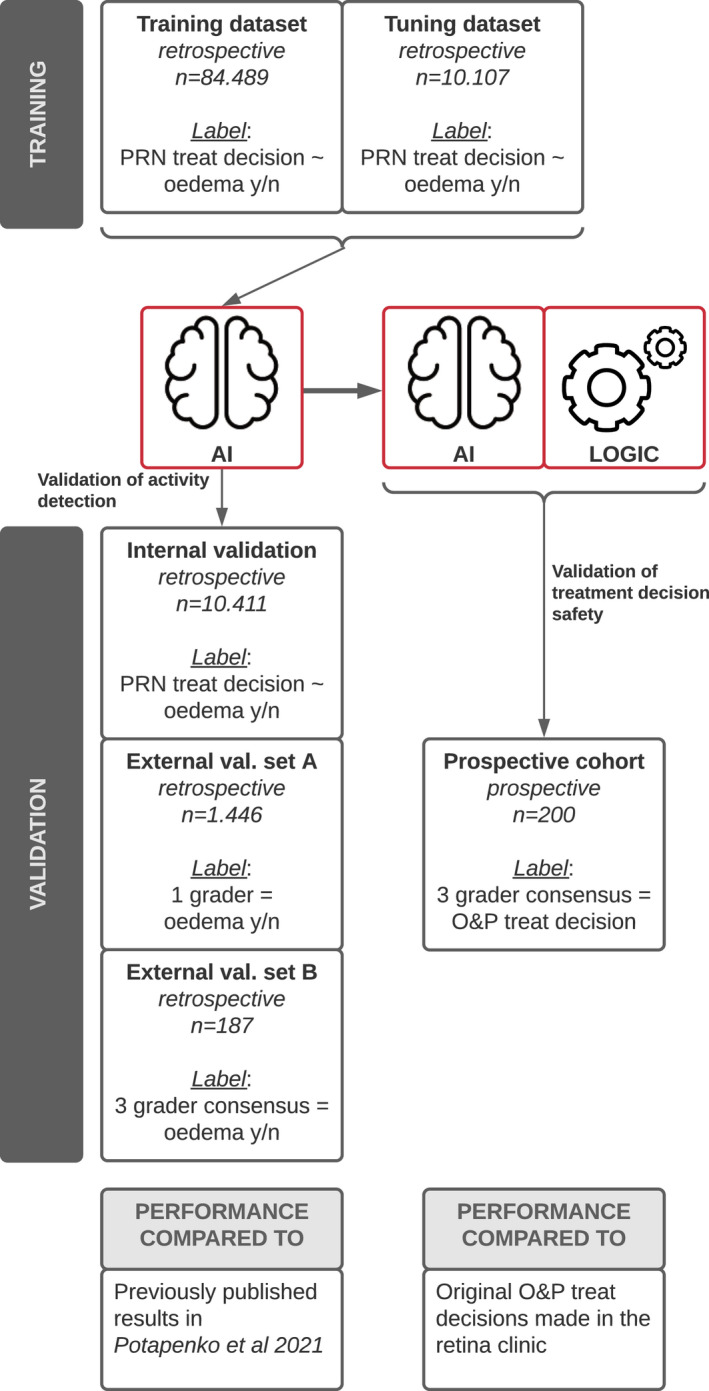
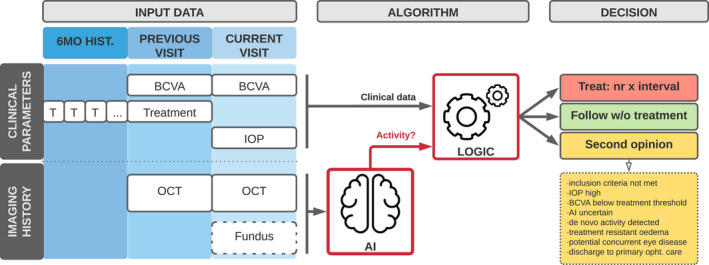
A temporal deep learning model was trained on a data set of 84 489 optical coherence tomography scans from AMD patients to recognize disease activity, and its performance was compared with a published non-temporal model trained on the same data (Acta Ophthalmol, 2021). An autonomous follow-up system was created by augmenting the AI model with deterministic logic to suggest treatment according to the observe-and-plan regimen. To validate the AI-based system, a data set comprising clinical decisions and imaging data from 200 follow-up consultations was collected prospectively. In each case, both the autonomous AI decision and original clinical decision were compared with an expert panel consensus.
The temporal AI model proved superior at detecting disease activity compared with the model without temporal input (area under the curve 0.900 (95% CI 0.894-0.906) and 0.857 (95% CI 0.846-0.867) respectively). The AI-based follow-up system could make an autonomous decision in 73% of the cases, 91.8% of which were in agreement with expert consensus. This was on par with the 87.7% agreement rate between decisions made in the clinic and expert consensus (p = 0.33).
The proposed autonomous follow-up system was shown to be safe and compliant with expert consensus on par with clinical practice. The system could in the future ease the pressure on public ophthalmology services from an increasing number of AMD patients.
在本研究中,我们探究了一种基于人工智能的新型系统对接受新生血管性年龄相关性黄斑变性(AMD)治疗的患者进行自主随访的潜力。
在来自AMD患者的84489张光学相干断层扫描数据集上训练一个时间深度学习模型,以识别疾病活动,并将其性能与在相同数据上训练的已发表的非时间模型(《Acta Ophthalmol》,2021年)进行比较。通过用确定性逻辑增强人工智能模型来创建一个自主随访系统,以根据观察和计划方案建议治疗。为了验证基于人工智能的系统,前瞻性收集了一个包含来自200次随访会诊的临床决策和影像数据的数据集。在每种情况下,将自主人工智能决策和原始临床决策都与专家小组共识进行比较。
与没有时间输入的模型相比,时间人工智能模型在检测疾病活动方面表现更优(曲线下面积分别为0.900(95%CI 0.894 - 0.906)和0.857(95%CI 0.846 - 0.867))。基于人工智能的随访系统在73%的病例中能够做出自主决策,其中91.8%与专家共识一致。这与临床决策和专家共识之间87.7%的一致率相当(p = 0.33)。
所提出的自主随访系统被证明是安全的,并且在与临床实践相当的程度上符合专家共识。该系统未来可以缓解公共眼科服务因越来越多的AMD患者而面临的压力。