Fairfield Beth, Padulo Caterina, Bortolotti Alessandro, Perfetti Bernardo, Mammarella Nicola, Balsamo Michela
Department of Humanistic Studies, University Federico II of Naples, 80138 Naples, Italy.
Department of Psychological, Heath and Territorial Sciences, University of Chieti, 66013 Chieti, Italy.
Brain Sci. 2022 Mar 15;12(3):393. doi: 10.3390/brainsci12030393.
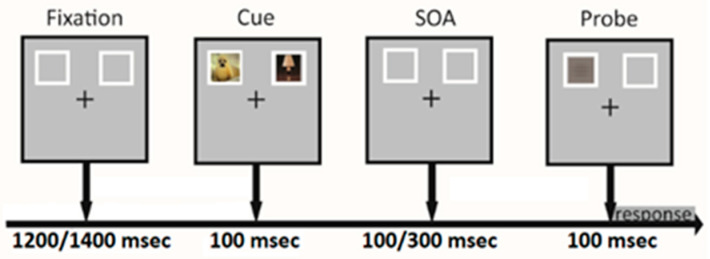
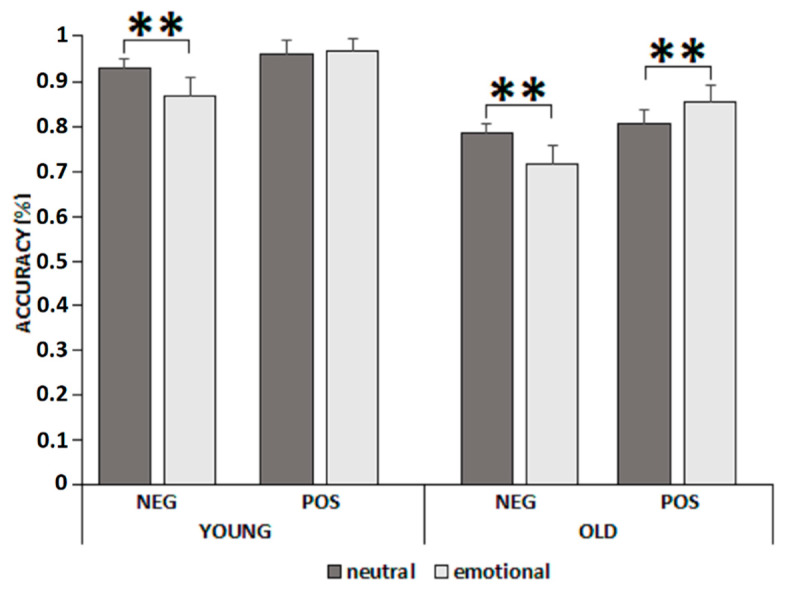
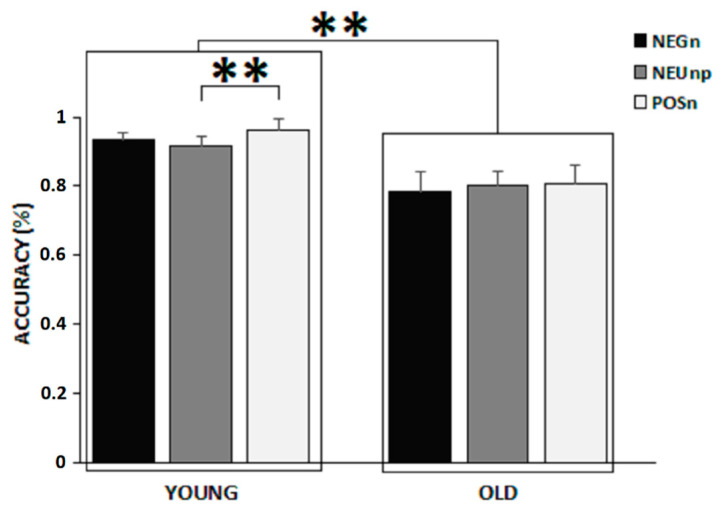
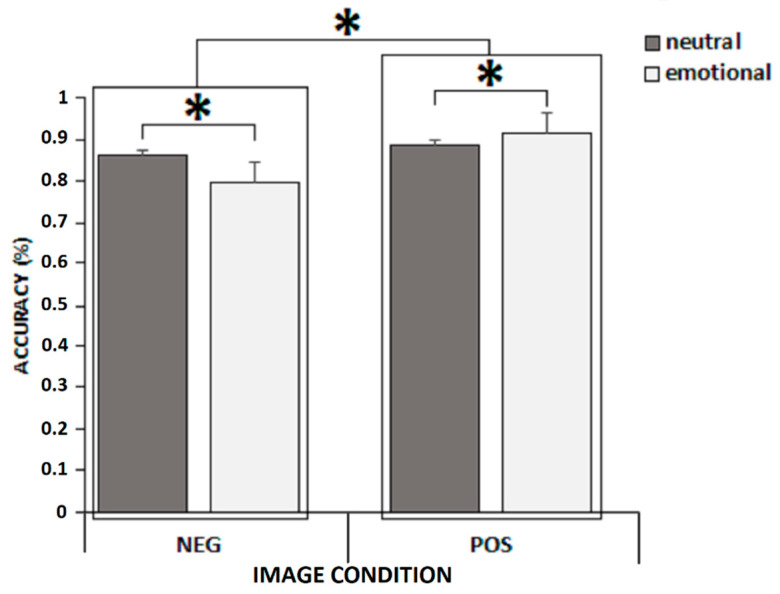
Affective information is processed in different ways across one's lifespan. Explanations for this pattern of performance are multiple and range from top-down motivational shifts and cognitive control to faster bottom-up and implicit processes. In this study, we aimed to investigate implicit affective information processing and positivity effects by examining performance in a modified version of the dot-probe task across three image-pair conditions (positive/neutral; negative/neutral; and positive/negative). We examined data from 50 older adults and 50 younger adults. The results showed that affective information processing varies with age and valence and that age effects in affective processing may occur early during information processing. Positivity biases emerge in both younger and older adults. However, while younger adults seem to prioritize positive information independently of context, older adults showed this prioritization only when presented in an emotional (i.e., negative) context. Moreover, older adults showed a tendency to avoid negative information whereas younger adults showed a general bias for affective content modulated by image-pair context.
情感信息在人的一生中以不同方式被处理。对于这种表现模式的解释多种多样,从自上而下的动机转变和认知控制到更快的自下而上和内隐过程。在本研究中,我们旨在通过考察在三种图像对条件(正性/中性;负性/中性;以及正性/负性)下的点探测任务修改版中的表现,来研究内隐情感信息处理和积极效应。我们考察了50名老年人和50名年轻人的数据。结果表明,情感信息处理随年龄和效价而变化,且情感处理中的年龄效应可能在信息处理的早期就出现。正性偏差在年轻人和老年人中均会出现。然而,虽然年轻人似乎独立于情境优先处理积极信息,但老年人只有在处于情绪性(即负性)情境中时才会表现出这种优先处理。此外,老年人表现出避免负性信息的倾向,而年轻人则表现出由图像对情境调节的情感内容的一般偏差。