Kerle Irina A, Jägerhuber Ludwig, Secci Ramona, Pfarr Nicole, Blüm Philipp, Roesch Romina, Götze Katharina S, Weichert Wilko, Bassermann Florian, Ruland Jürgen, Winter Christof
Department of Medicine III, Klinikum Rechts der Isar, School of Medicine, Technical University of Munich, 81675 Munich, Germany.
Center for Personalized Oncology, National Center for Tumor Diseases (NCT) Dresden and University Hospital Carl Gustav Carus Dresden at TU Dresden, 01307 Dresden, Germany.
Cancers (Basel). 2022 Mar 8;14(6):1371. doi: 10.3390/cancers14061371.
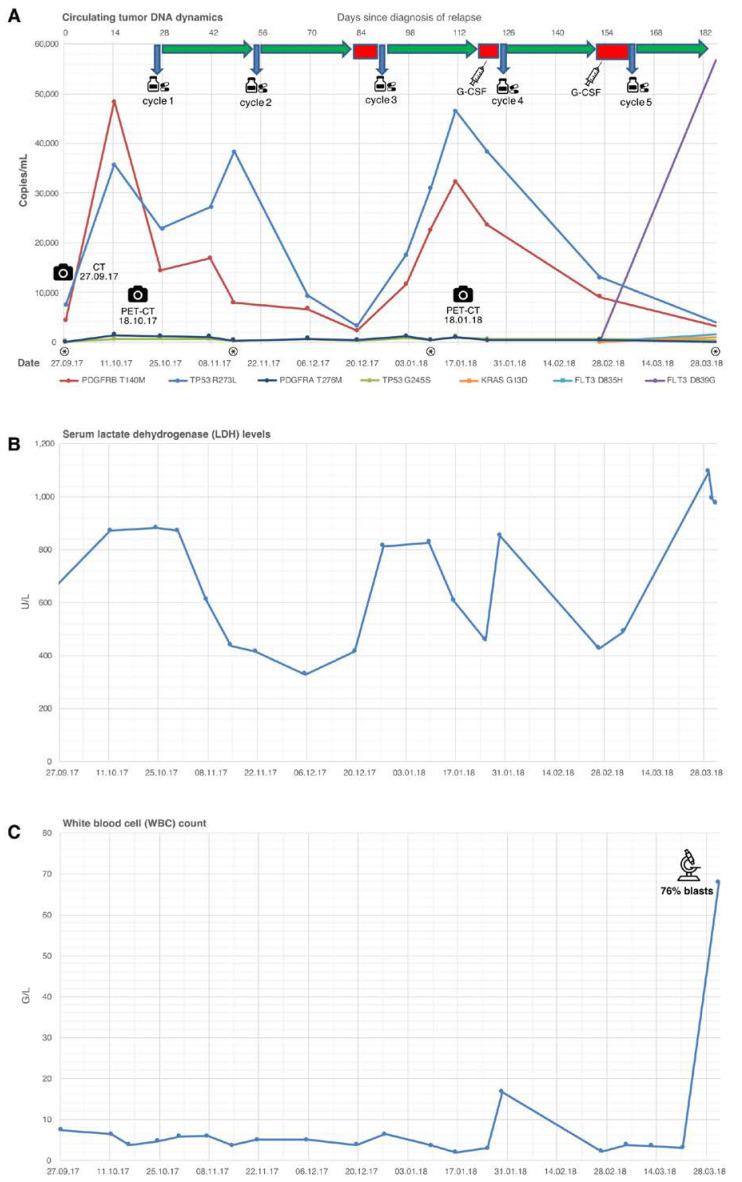
Diffuse large B cell lymphomas (DLBCL) are the most common neoplasia of the lymphatic system. Circulating cell-free DNA released from tumor cells (ctDNA) has been studied in many tumor entities and successfully used to monitor treatment and follow up. Studies of ctDNA in DLBCL so far have mainly focused on tracking mutations in peripheral blood initially detected by next-generation sequencing (NGS) of tumor tissue from one lymphoma manifestation site. This approach, however, cannot capture the mutational heterogeneity of different tumor sites in its entirety. In this case report, we present repetitive targeted next-generation sequencing combined with digital PCR out of peripheral blood of a patient with DLBCL relapse. By combining both detection methods, we were able to detect a new dominant clone of ctDNA correlating with the development of secondary therapy-related acute myeloid leukemia (t-AML) during the course of observation. Conclusively, our case report reinforces the diagnostic importance of ctDNA in DLBCL as well as the importance of repeated ctDNA sequencing combined with focused digital PCR assays to display the dynamic mutational landscape during the clinical course.
弥漫性大B细胞淋巴瘤(DLBCL)是淋巴系统最常见的肿瘤。肿瘤细胞释放的循环游离DNA(ctDNA)已在许多肿瘤实体中得到研究,并成功用于监测治疗和随访。迄今为止,DLBCL中ctDNA的研究主要集中在追踪最初通过对一个淋巴瘤表现部位的肿瘤组织进行下一代测序(NGS)检测到的外周血中的突变。然而,这种方法无法全面捕捉不同肿瘤部位的突变异质性。在本病例报告中,我们展示了对一名DLBCL复发患者外周血进行重复靶向下一代测序并结合数字PCR的方法。通过结合这两种检测方法,我们能够在观察过程中检测到一个与继发性治疗相关急性髓系白血病(t-AML)发生相关的新的ctDNA优势克隆。总之,我们的病例报告强化了ctDNA在DLBCL中的诊断重要性,以及重复ctDNA测序结合聚焦数字PCR检测以展示临床过程中动态突变图谱的重要性。