Deshors Pauline, Arnauduc Florent, Boëlle Betty, Cohen-Jonathan Moyal Elizabeth, Courtade-Saïdi Monique, Evrard Solène M
Institut Claudius Regaud, IUCT Oncopole, 31059 Toulouse, France.
Faculty of Medicine, Paul Sabatier University, Toulouse-3, 31062 Toulouse, France.
Cancers (Basel). 2022 Mar 18;14(6):1551. doi: 10.3390/cancers14061551.
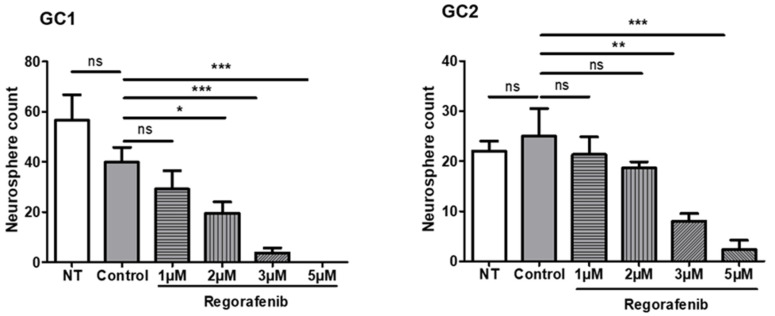
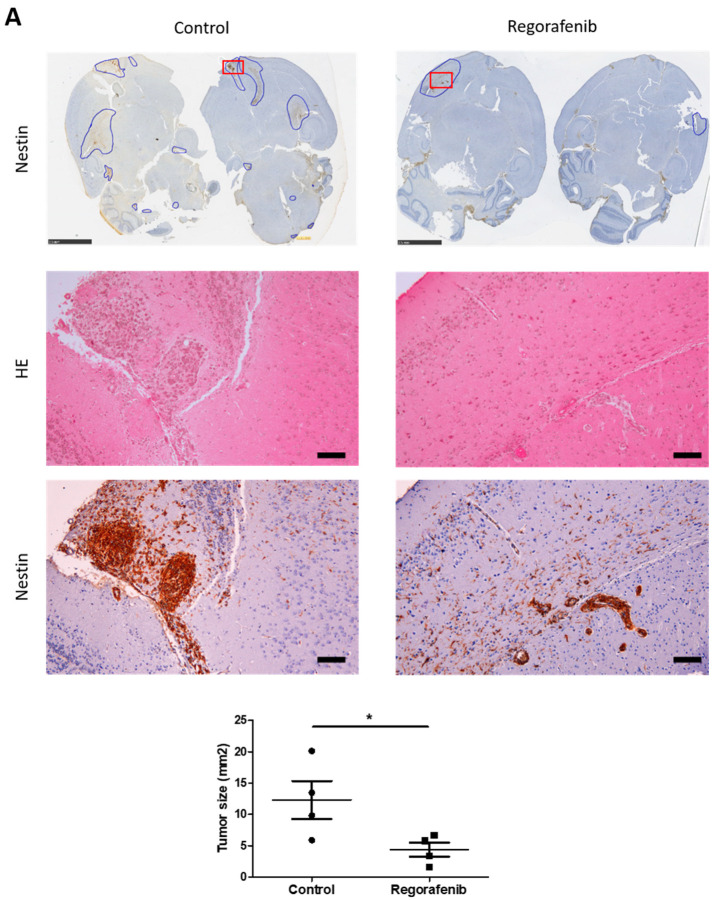
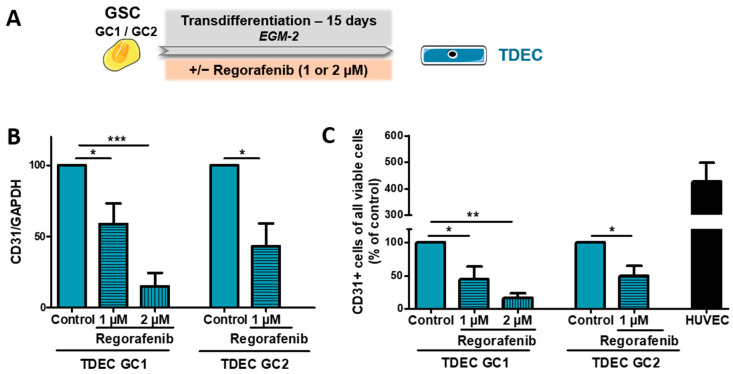
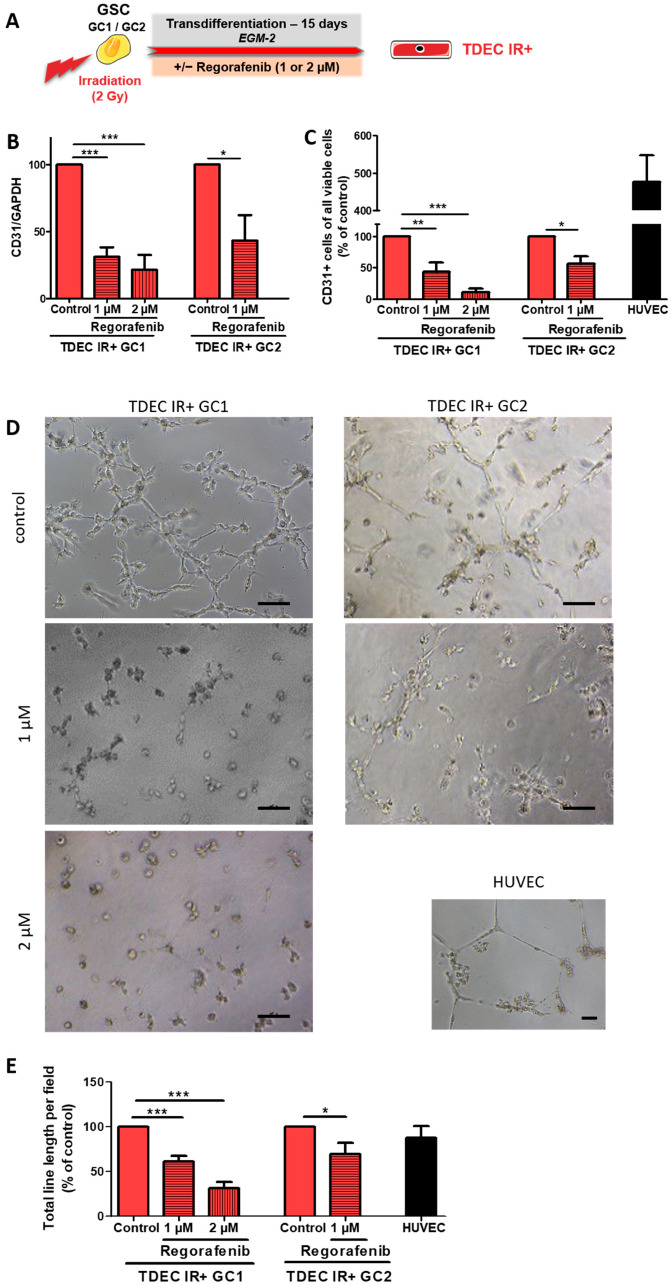
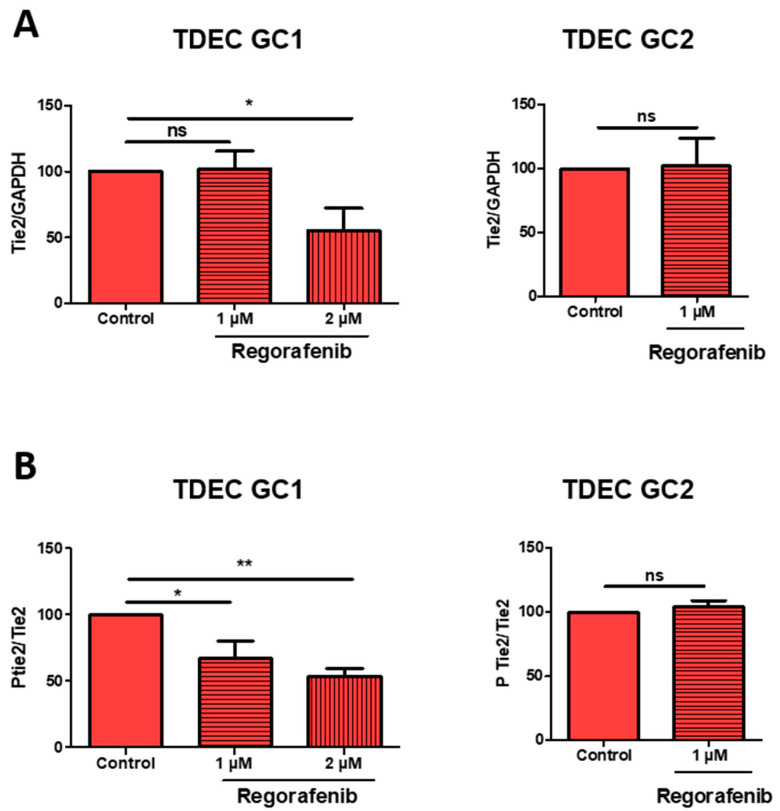
Glioblastomas (GBM) are aggressive brain tumours with a poor prognosis despite heavy therapy that combines surgical resection and radio-chemotherapy. The presence of a subpopulation of GBM stem cells (GSC) contributes to tumour aggressiveness, resistance and recurrence. Moreover, GBM are characterised by abnormal, abundant vascularisation. Previous studies have shown that GSC are directly involved in new vessel formation via their transdifferentiation into tumour-derived endothelial cells (TDEC) and that irradiation (IR) potentiates the pro-angiogenic capacity of TDEC via the Tie2 signalling pathway. We therefore investigated the impact of regorafenib, a multikinase inhibitor with anti-angiogenic and anti-tumourigenic activity, on GSC and TDEC obtained from irradiated GSC (TDEC IR+) or non-irradiated GSC (TDEC). Regorafenib significantly decreases GSC neurosphere formation in vitro and inhibits tumour formation in the orthotopic xenograft model. Regorafenib also inhibits transdifferentiation by decreasing CD31 expression, CD31+ cell count, pseudotube formation in vitro and the formation of functional blood vessels in vivo of TDEC and TDEC IR+. All of these results confirm that regorafenib clearly impacts GSC tumour formation and transdifferentiation and may therefore be a promising therapeutic option in combination with chemo/radiotherapy for the treatment of highly aggressive brain tumours.
胶质母细胞瘤(GBM)是侵袭性脑肿瘤,尽管采用了手术切除和放化疗相结合的强化治疗,其预后仍很差。GBM干细胞(GSC)亚群的存在导致肿瘤具有侵袭性、耐药性和复发性。此外,GBM的特征是血管生成异常且丰富。先前的研究表明,GSC通过转分化为肿瘤来源的内皮细胞(TDEC)直接参与新血管形成,并且辐射(IR)通过Tie2信号通路增强TDEC的促血管生成能力。因此,我们研究了瑞戈非尼(一种具有抗血管生成和抗肿瘤活性的多激酶抑制剂)对从照射后的GSC(TDEC IR +)或未照射的GSC(TDEC)获得的GSC和TDEC的影响。瑞戈非尼在体外显著减少GSC神经球的形成,并在原位异种移植模型中抑制肿瘤形成。瑞戈非尼还通过降低TDEC和TDEC IR +的CD31表达、CD31 +细胞计数、体外假管形成以及体内功能性血管的形成来抑制转分化。所有这些结果证实,瑞戈非尼明显影响GSC肿瘤形成和转分化,因此可能是与化疗/放疗联合用于治疗高度侵袭性脑肿瘤的一种有前景的治疗选择。