Morote Juan, Borque-Fernando Angel, Triquell Marina, Celma Anna, Regis Lucas, Escobar Manel, Mast Richard, de Torres Inés M, Semidey María E, Abascal José M, Sola Carles, Servian Pol, Salvador Daniel, Santamaría Anna, Planas Jacques, Esteban Luis M, Trilla Enrique
Department of Urology, Vall d'Hebron Hospital, 08035 Barcelona, Spain.
Department of Surgery, Universitat Autònoma de Barcelona, 08193 Barcelona, Spain.
Cancers (Basel). 2022 Mar 21;14(6):1589. doi: 10.3390/cancers14061589.
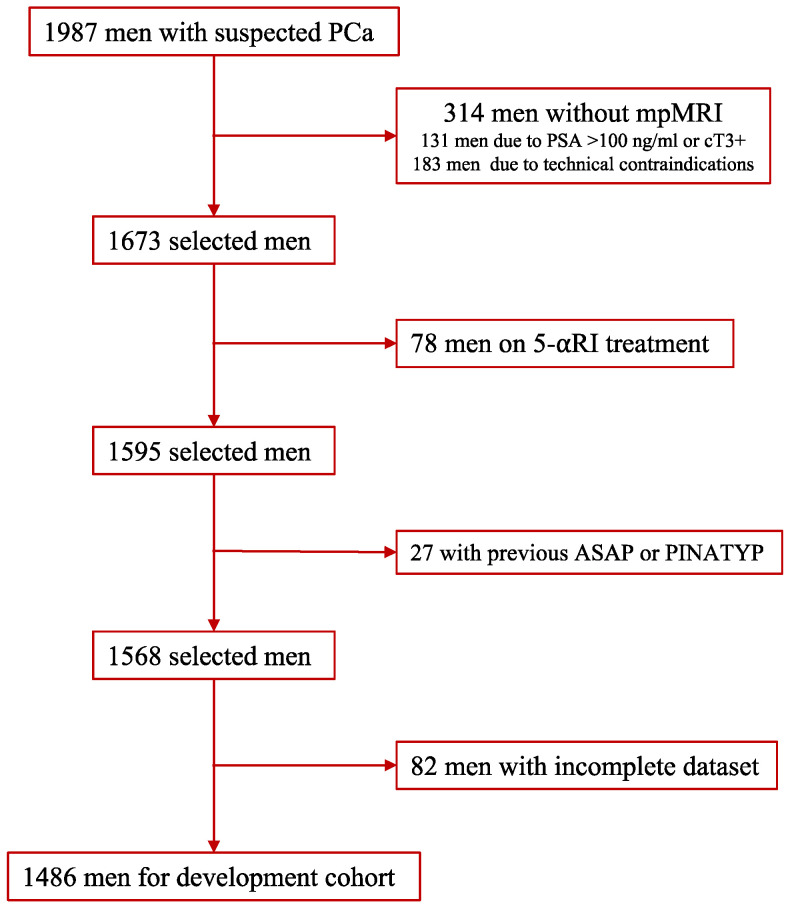
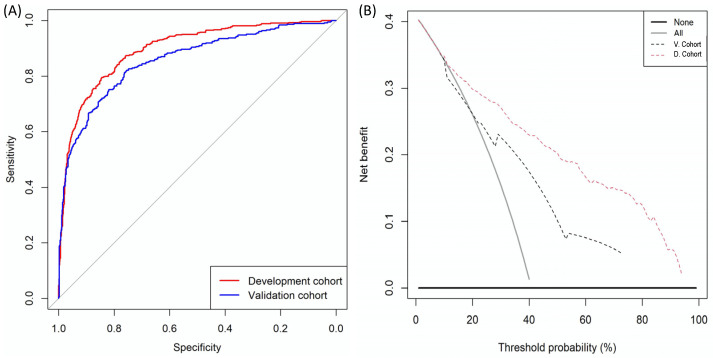
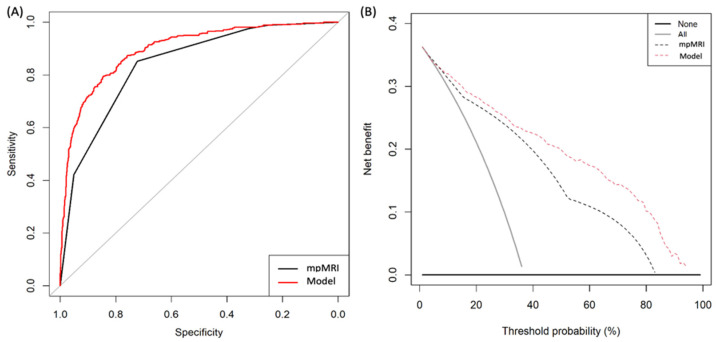
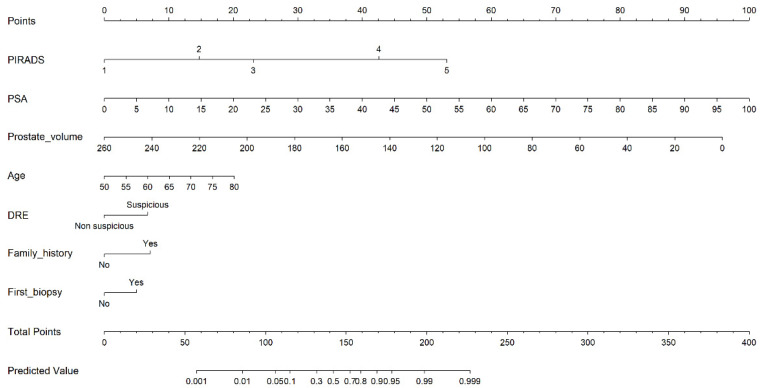
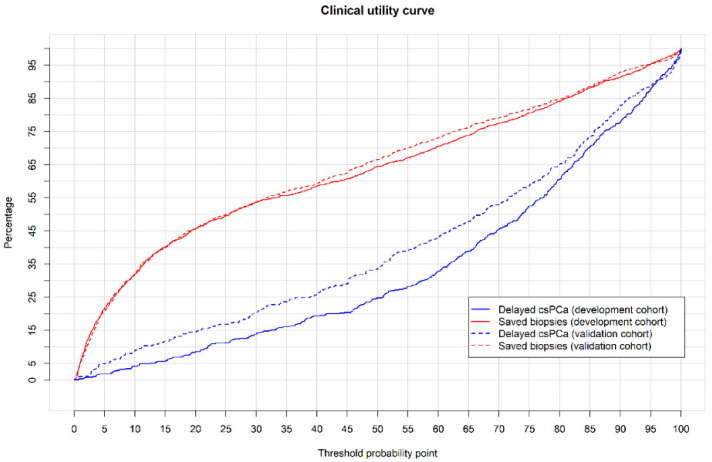
A new and externally validated MRI-PM for csPCa was developed in the metropolitan area of Barcelona, and a web-RC designed with the new option of selecting the csPCa probability threshold. The development cohort comprised 1486 men scheduled to undergo a 3-tesla multiparametric MRI (mpMRI) and guided and/or systematic biopsies in one academic institution of Barcelona. The external validation cohort comprised 946 men in whom the same diagnostic approach was carried out as in the development cohort, in two other academic institutions of the same metropolitan area. CsPCa was detected in 36.9% of men in the development cohort and 40.8% in the external validation cohort (p = 0.054). The area under the curve of mpMRI increased from 0.842 to 0.897 in the developed MRI-PM (p < 0.001), and from 0.743 to 0.858 in the external validation cohort (p < 0.001). A selected 15% threshold avoided 40.1% of prostate biopsies and missed 5.4% of the 36.9% csPCa detected in the development cohort. In men with PI-RADS <3, 4.3% would be biopsied and 32.3% of all existing 4.2% of csPCa would be detected. In men with PI-RADS 3, 62% of prostate biopsies would be avoided and 28% of all existing 12.4% of csPCa would be undetected. In men with PI-RADS 4, 4% of prostate biopsies would be avoided and 0.6% of all existing 43.1% of csPCa would be undetected. In men with PI-RADS 5, 0.6% of prostate biopsies would be avoided and none of the existing 42.0% of csPCa would be undetected. The Barcelona MRI-PM presented good performance on the overall population; however, its clinical usefulness varied regarding the PI-RADS category. The selection of csPCa probability thresholds in the designed RC may facilitate external validation and outperformance of MRI-PMs in specific PI-RADS categories.
在巴塞罗那大都市区开发了一种用于临床显著性前列腺癌(csPCa)的新型且经过外部验证的磁共振成像前列腺模型(MRI-PM),并设计了一个网络风险计算器(web-RC),新增了选择csPCa概率阈值的选项。开发队列包括1486名计划在巴塞罗那的一家学术机构接受3特斯拉多参数磁共振成像(mpMRI)以及引导性和/或系统性活检的男性。外部验证队列包括946名男性,在同一大都市区的另外两家学术机构中,他们接受了与开发队列相同的诊断方法。在开发队列中,36.9%的男性被检测出患有csPCa,在外部验证队列中这一比例为40.8%(p = 0.054)。在开发的MRI-PM中,mpMRI的曲线下面积从0.842增加到0.897(p < 0.001),在外部验证队列中从0.743增加到0.858(p < 0.001)。选定的15%阈值避免了40.1%的前列腺活检,且在开发队列中检测出的36.9%的csPCa中有5.4%未被检测到。在前列腺影像报告和数据系统(PI-RADS)评分<3的男性中,4.3%的人会接受活检,且在所有存在的4.2%的csPCa中能检测出32.3%。在PI-RADS评分为3的男性中,62%的前列腺活检可被避免,且在所有存在的12.4%的csPCa中有28%未被检测到。在PI-RADS评分为4的男性中,4%的前列腺活检可被避免,且在所有存在的43.1%的csPCa中有0.6%未被检测到。在PI-RADS评分为5的男性中,0.6%的前列腺活检可被避免,且所有存在的42.0%的csPCa均未漏检。巴塞罗那MRI-PM在总体人群中表现良好;然而,其临床实用性因PI-RADS类别而异。在设计的风险计算器中选择csPCa概率阈值可能有助于外部验证以及MRI-PM在特定PI-RADS类别中的卓越表现。