García-Ríos Estéfani, Leivas Alejandra, Mancebo Francisco J, Sánchez-Vega Laura, Lanzarot Diego, Aguado José María, Martínez-López Joaquín, Paciello María Liz, Pérez-Romero Pilar
National Center for Microbiology, Instituto de Salud Carlos III Majadahonda, 28221 Madrid, Spain.
Department of Science, Universidad Internacional de Valencia-VIU, PintorSorolla 21, 46002 Valencia, Spain.
Biomedicines. 2022 Mar 9;10(3):630. doi: 10.3390/biomedicines10030630.
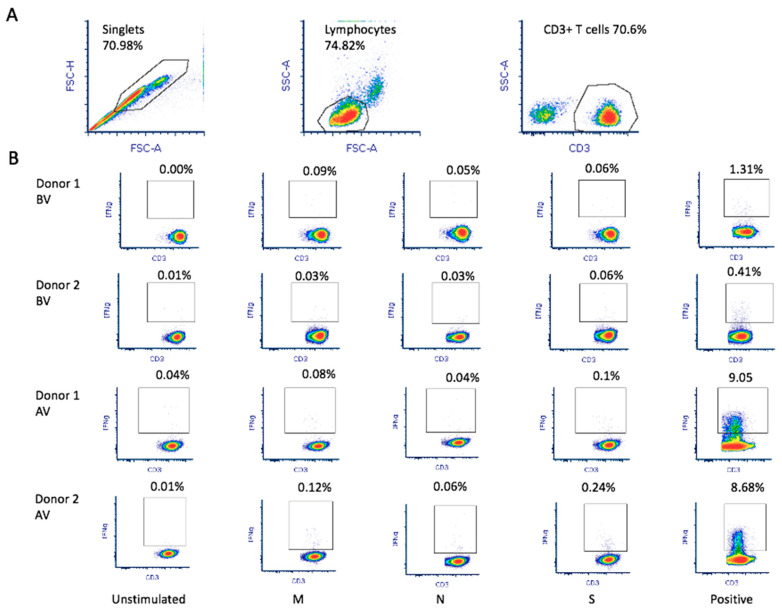
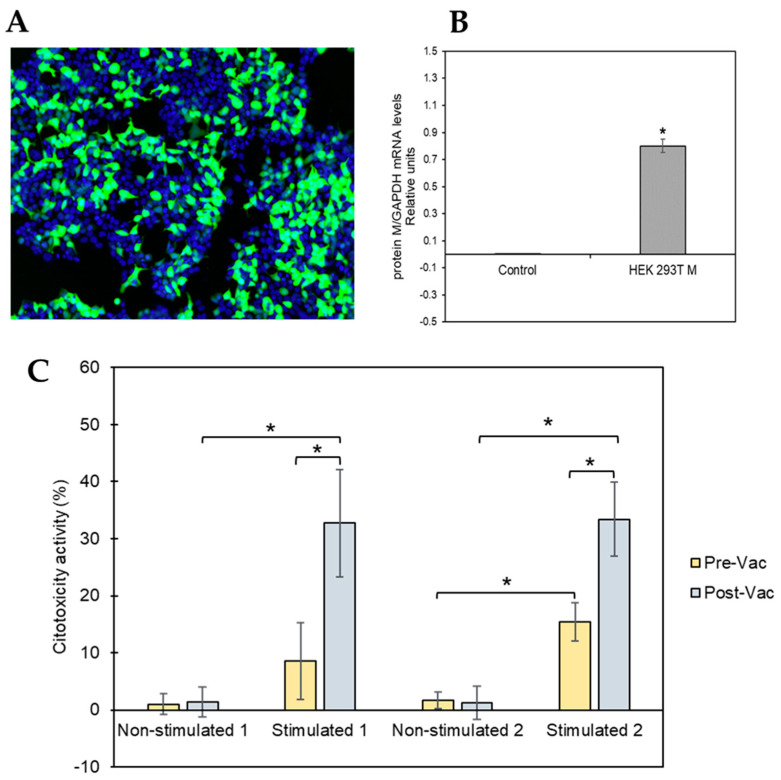
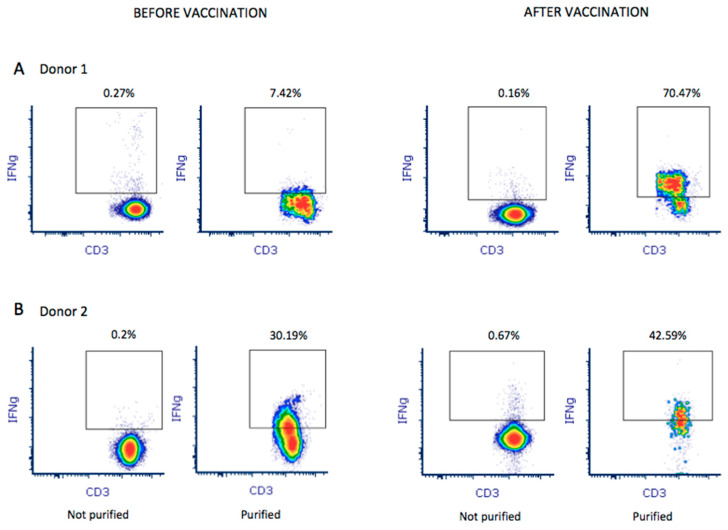
In order to demonstrate the feasibility of preparing clinical-grade SARS-CoV-2-specific T-cells from convalescent donors and the ability of these cells to neutralize the virus in vitro, we used blood collected from two COVID-19 convalescent donors (before and after vaccination) that was stimulated with specific SARS-CoV-2 peptides followed by automated T-cell isolation using the CliniMacs Prodigy medical device. To determine cytotoxic activity, HEK 293T cells were transfected to express the SARS-CoV-2 M protein, mimicking SARS-CoV-2 infection. We were able to quickly and efficiently isolate SARS-CoV-2-specific T lymphocytes from both donors before and after they received the Pfizer-BioNTech vaccine. Althoughbefore vaccination, the final product contained up to 7.42% and 30.19% of IFN-γ+ CD3+ T-cells from donor 1 and donor 2, respectively, we observed an enrichment of the IFN-γ+ CD3+ T-cells after vaccination, reaching 70.47% and 42.59%, respectively. At pre-vaccination, the isolated SARS-CoV-2-specific T-cells exhibited cytotoxic activity that was significantly higher than that of unstimulated controls (donor 2: 15.41%, -value 3.27 × 10). The cytotoxic activity of the isolated SARS-CoV-2-specific T-cells also significantly increased after vaccination (donor 1: 32.71%, -value 1.44 × 10; donor 2: 33.38%, -value 3.13 × 10). In conclusion, we demonstrated that SARS-CoV-2-specific T-cells can quickly and efficiently be stimulated from the blood of convalescent donors using SARS-CoV-2-specific peptides followed by automated isolation. Vaccinated convalescent donors have a higher percentage of SARS-CoV-2-specific T-cells and may be more suitable as donors. Although further studies are needed to assess the clinical utility of the functional isolated SARS-CoV-2-specific T-cells in patients, previous studies using the same stimulation and isolation methods applied to other pathologies support this idea.
为了证明从康复供体中制备临床级严重急性呼吸综合征冠状病毒2(SARS-CoV-2)特异性T细胞的可行性以及这些细胞在体外中和病毒的能力,我们使用了从两名新冠康复供体(接种疫苗前后)采集的血液,用特异性SARS-CoV-2肽刺激后,使用CliniMacs Prodigy医疗设备进行自动化T细胞分离。为了确定细胞毒性活性,将人胚肾293T细胞转染以表达SARS-CoV-2 M蛋白,模拟SARS-CoV-2感染。我们能够在两名供体接种辉瑞-BioNTech疫苗前后快速有效地从他们的血液中分离出SARS-CoV-2特异性T淋巴细胞。虽然在接种疫苗前,最终产物分别含有来自供体1和供体2的高达7.42%和30.19%的干扰素-γ+CD3+T细胞,但我们观察到接种疫苗后干扰素-γ+CD3+T细胞富集,分别达到70.47%和42.59%。在接种疫苗前,分离出的SARS-CoV-2特异性T细胞表现出的细胞毒性活性显著高于未刺激的对照(供体2:15.41%,P值3.27×10)。接种疫苗后,分离出的SARS-CoV-2特异性T细胞的细胞毒性活性也显著增加(供体1:32.71%,P值1.44×10;供体2:33.38%,P值3.13×10)。总之,我们证明了使用SARS-CoV-2特异性肽并随后进行自动化分离,可以从康复供体的血液中快速有效地刺激出SARS-CoV-2特异性T细胞。接种疫苗的康复供体中SARS-CoV-2特异性T细胞的百分比更高,可能更适合作为供体。尽管需要进一步研究来评估功能分离的SARS-CoV-2特异性T细胞在患者中的临床效用,但先前使用相同刺激和分离方法应用于其他病症的研究支持了这一观点。