Saleh Tareq, Alhesa Ahmad, El-Sadoni Mohammed, Abu Shahin Nisreen, Alsharaiah Elham, Al Shboul Sofian, Awad Heyam, Bloukh Sarah, Al-Balas Mahmoud, Alsalem Mohammad, Azab Bilal, Aladily Tariq N
Department of Basic Medical Sciences, Faculty of Medicine, The Hashemite University, Zarqa 13133, Jordan.
Department of Pathology, Microbiology and Forensic Medicine, School of Medicine, The University of Jordan, Amman 11942, Jordan.
Diagnostics (Basel). 2022 Feb 28;12(3):609. doi: 10.3390/diagnostics12030609.
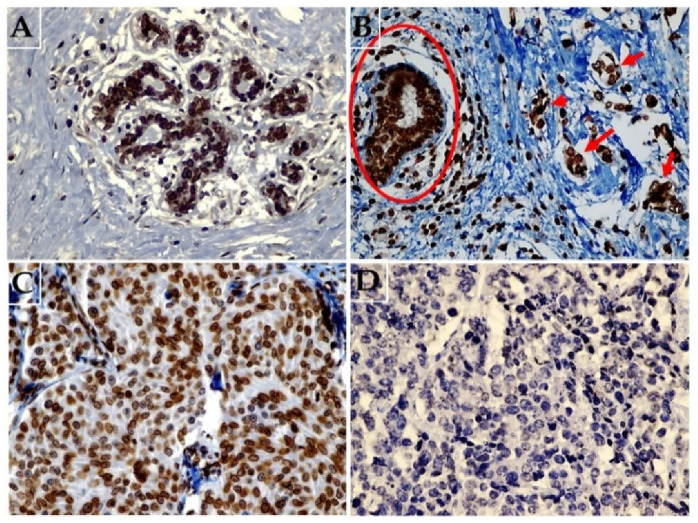
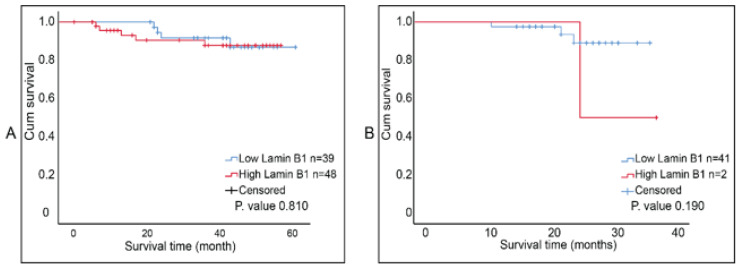
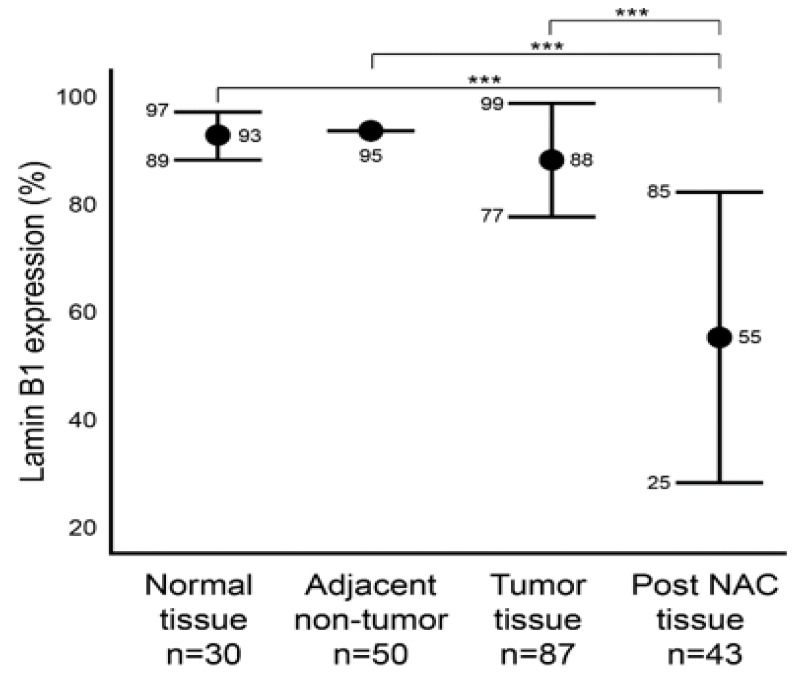
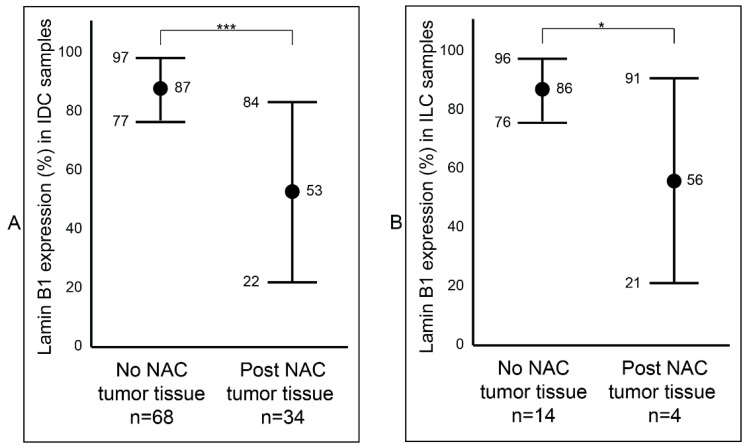
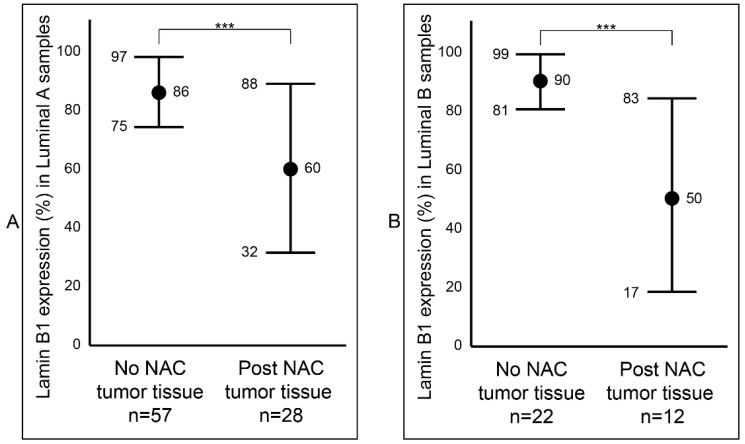
Senescence is a major response to cancer chemotherapy and has been linked to unfavorable therapy outcomes. Lamin B1 is a component of the nuclear lamina that plays a pivotal role in chromatin stability. Downregulation of lamin B1 represents an established biomarker for cellular senescence. However, the protein expression level of lamin B1 in malignant tissue, particularly of the breast, has not been previously described. In this work, we investigated lamin B1 protein expression in normal breast epithelium, malignant breast tissue (including adjacent non-malignant tissue) and in malignant tissue exposed to neoadjuvant chemotherapy (NAC) using immunohistochemistry (IHC) in three patient groups (n = 15, n = 87, and n = 43, respectively). Our results indicate that lamin B1 mean positive expression was 93% in normal breast epithelium and 88% in malignant breast cells, but significantly decreased (mean: 55%, p < 0.001) in malignant breast tissue after exposure to NAC, suggestive of senescence induction. No significant association between lamin B1 expression and other clinicopathological characteristics or survival of breast cancer patients was recorded. To our knowledge, this is the first report that established the baseline protein expression level of lamin B1 in normal and malignant breast tissue, and its reduction following exposure to chemotherapy. In conclusion, lamin B1 downregulation can be used reliably as a component of multiple biomarker batteries to identify therapy-induced senescence (TIS) in clinical cancer.
细胞衰老(又称“老化”)是癌症化疗的主要反应,且与不良治疗结果相关。核纤层蛋白B1是核纤层的一个组成部分,在染色质稳定性方面起着关键作用。核纤层蛋白B1的下调是细胞衰老的一个既定生物标志物。然而,此前尚未描述过核纤层蛋白B1在恶性组织,尤其是乳腺组织中的蛋白表达水平。在这项研究中,我们使用免疫组织化学(IHC)方法,在三组患者(分别为n = 15、n = 87和n = 43)中,研究了正常乳腺上皮、恶性乳腺组织(包括相邻的非恶性组织)以及接受新辅助化疗(NAC)的恶性组织中核纤层蛋白B1的蛋白表达情况。我们的结果表明,核纤层蛋白B1在正常乳腺上皮中的平均阳性表达率为93%,在恶性乳腺细胞中为88%,但在接受NAC后的恶性乳腺组织中显著降低(平均为55%,p < 0.001),提示诱导了细胞衰老。未记录到核纤层蛋白B1表达与乳腺癌患者的其他临床病理特征或生存率之间存在显著关联。据我们所知,这是第一份确定正常和恶性乳腺组织中核纤层蛋白B1的基线蛋白表达水平,以及其在化疗后降低情况的报告。总之,核纤层蛋白B1的下调可可靠地用作多种生物标志物组合的一个组成部分,以识别临床癌症中治疗诱导的细胞衰老(TIS)。