Han Byoungduck, Lee Gyu Bae, Yim Sun Young, Cho Kyung-Hwan, Shin Koh Eun, Kim Jung-Hwan, Park Yong-Gyu, Han Kyung-Do, Kim Yang-Hyun
Department of Family Medicine, Korea University College of Medicine, Seoul 02841, Korea.
Department of Internal Medicine, Korea University College of Medicine, Seoul 02841, Korea.
Diagnostics (Basel). 2022 Mar 9;12(3):663. doi: 10.3390/diagnostics12030663.
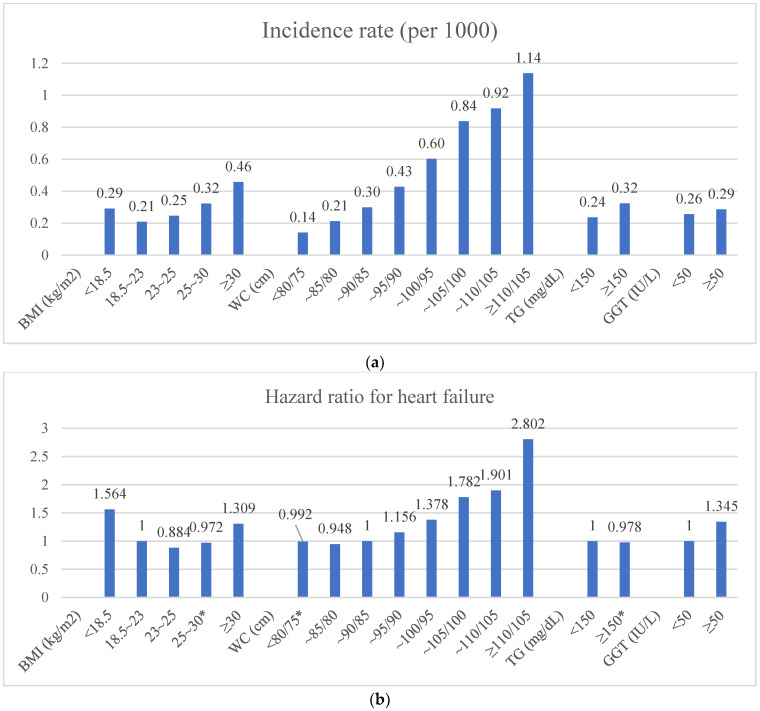
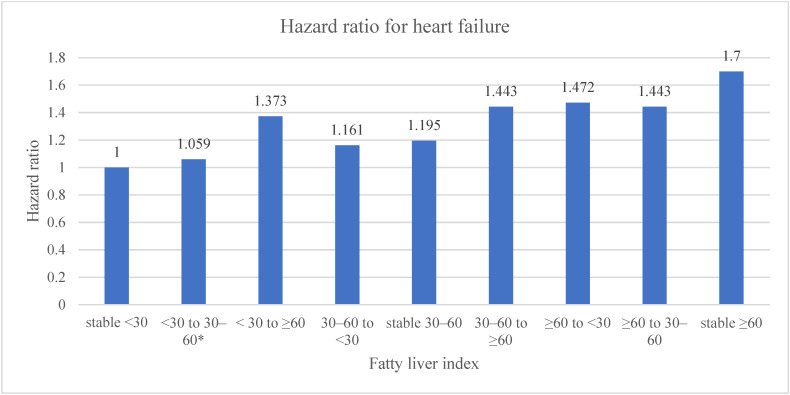
Fatty liver index (FLI) is a simple and useful index that evaluates non-alcoholic fatty liver disease (NAFLD), particularly in large epidemiologic studies. Heart failure (HF) is becoming a burden to public health as the global trend toward an aging society continues. Thus, we investigated the effect of FLI on the incidence of HF using large cohort data from the Korean National Health Insurance health database. Methods and Results: A total of 7,958,538 subjects aged over 19 years without baseline HF (men = 4,142,264 and women = 3,816,274) were included. Anthropometric and biochemical measurements were evaluated. FLI scores were calculated and FLI ≥ 60 was considered as having NAFLD. Hazard ratios (HRs) and 95% confidence intervals (CIs) for HF incidence were analysed using multivariable time-dependent Cox proportional hazard models. During a mean follow up of 8.26 years, 17,104 participants developed HF. The FLI components associated with the incidence of HF and FLI showed a causal relationship with HF; the FLI ≥ 60 group had a higher HR for HF (HR 1.493; 95% CIs 1.41−1.581) than the FLI < 30 group. Subgroup analysis showed that fatty liver (FLI ≥ 60) with age ≥ 65 years or women displayed higher HR for HF than fatty liver with age < 65 or men, respectively. An increase in FLI score significantly increased the HR for HF except for those with a FLI score change from <30 to 30−60. Conclusion: NAFLD defined by FLI and increase in FLI score were associated with the incidence of HF. Further detailed prospective studies are needed.
脂肪肝指数(FLI)是一种简单且有用的指标,用于评估非酒精性脂肪性肝病(NAFLD),尤其适用于大型流行病学研究。随着全球社会老龄化趋势的持续,心力衰竭(HF)正成为公共卫生的一大负担。因此,我们利用韩国国民健康保险健康数据库中的大型队列数据,研究了FLI对HF发病率的影响。方法与结果:共纳入7958538名19岁以上无基线HF的受试者(男性 = 4142264人,女性 = 3816274人)。对人体测量和生化指标进行了评估。计算FLI评分,FLI≥60被视为患有NAFLD。使用多变量时间依赖性Cox比例风险模型分析HF发病率的风险比(HR)和95%置信区间(CI)。在平均8.26年的随访期间,17104名参与者发生了HF。与HF发病率相关的FLI成分以及FLI与HF之间存在因果关系;FLI≥60组的HF风险比(HR 1.493;95%CI 1.41 - 1.581)高于FLI<30组。亚组分析表明,年龄≥65岁的脂肪肝(FLI≥60)或女性的HF风险比分别高于年龄<65岁的脂肪肝或男性。除了FLI评分从<30变为30 - 60的情况外,FLI评分的增加显著增加了HF的风险比。结论:由FLI定义的NAFLD以及FLI评分的增加与HF的发病率相关。需要进一步进行详细的前瞻性研究。