Doyon-Laliberté Kim, Aranguren Matheus, Poudrier Johanne, Roger Michel
Centre de Recherche du Centre, Hospitalier de l'Université de Montréal (CRCHUM), Tour Viger 900 Rue St-Denis, Montréal, QC H2X 0A9, Canada.
Département de Microbiologie, Infectiologie et Immunologie de l'Université de Montréal, Montréal, QC H2X 0A9, Canada.
Int J Mol Sci. 2022 Mar 21;23(6):3372. doi: 10.3390/ijms23063372.
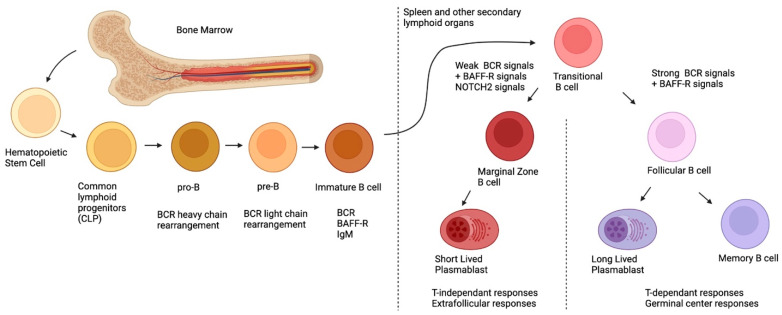
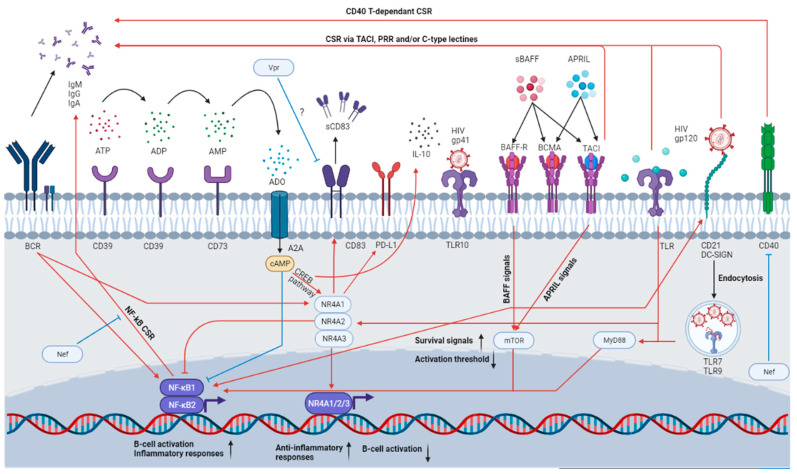
Inflammation in the context of Human Immunodeficiency Virus (HIV) establishes early and persists beyond antiretroviral therapy (ART). As such, we have shown excess B-cell activating factor (BAFF) in the blood of HIV-infected progressors, as soon as in the acute phase, and despite successful ART. Excess BAFF was associated with deregulation of the B-cell compartment; notably, with increased frequencies of a population sharing features of both transitional immature (TI) and marginal zone (MZ) B-cells, we termed Marginal Zone precursor-like (MZp). We have reported similar observations with HIV-transgenic mice, Simian Immunodeficiency Virus (SIV)-infected macaques, and more recently, with HIV-infected Beninese commercial sex workers, which suggests that excess BAFF and increased frequencies of MZp B-cells are reliable markers of inflammation in the context of HIV. Importantly, we have recently shown that in healthy individuals, MZps present an important regulatory B-cell (Breg) profile and function. Herein, we wish to review our current knowledge on MZ B-cell populations, especially their Breg status, and that of other B-cell populations sharing similar features. BAFF and its analog A Proliferation-Inducing Ligand (APRIL) are important in shaping the MZ B-cell pool; moreover, the impact that excess BAFF-encountered in the context of HIV and several chronic inflammatory conditions-may exert on MZ B-cell populations, Breg and antibody producing capacities is a threat to the self-integrity of their antibody responses and immune surveillance functions. As such, deregulations of MZ B-cell populations contribute to autoimmune manifestations and the development of MZ lymphomas (MZLs) in the context of HIV and other inflammatory diseases. Therefore, further comprehending the mechanisms regulating MZ B-cell populations and their functions could be beneficial to innovative therapeutic avenues that could be deployed to restore MZ B-cell immune competence in the context of chronic inflammation involving excess BAFF.
在人类免疫缺陷病毒(HIV)感染的情况下,炎症反应在早期就已出现,并在抗逆转录病毒疗法(ART)之后持续存在。因此,我们发现,即使在急性期,且尽管抗逆转录病毒疗法取得成功,HIV感染进展者的血液中也存在过量的B细胞活化因子(BAFF)。过量的BAFF与B细胞区室的失调有关;值得注意的是,具有过渡性未成熟(TI)和边缘区(MZ)B细胞特征的细胞群体频率增加,我们将其称为边缘区前体样(MZp)细胞。我们在HIV转基因小鼠、感染猿猴免疫缺陷病毒(SIV)的猕猴以及最近在感染HIV的贝宁商业性工作者中也观察到了类似现象,这表明过量的BAFF和MZp B细胞频率增加是HIV感染情况下炎症反应的可靠标志物。重要的是,我们最近发现,在健康个体中,MZp细胞呈现出重要的调节性B细胞(Breg)特征和功能。在此,我们希望回顾一下我们目前对MZ B细胞群体的认识,尤其是它们的Breg状态以及其他具有相似特征的B细胞群体的状态。BAFF及其类似物增殖诱导配体(APRIL)在塑造MZ B细胞库方面具有重要作用;此外,在HIV感染和几种慢性炎症情况下出现的过量BAFF可能对MZ B细胞群体、Breg细胞以及抗体产生能力产生影响,这对其抗体反应和免疫监视功能的自身完整性构成威胁。因此,MZ B细胞群体失调会导致HIV感染和其他炎症性疾病情况下自身免疫表现以及MZ淋巴瘤(MZL)的发生。所以,进一步了解调节MZ B细胞群体及其功能的机制,可能有助于开辟创新治疗途径,以恢复在涉及过量BAFF慢性炎症情况下的MZ B细胞免疫能力。