Sasaki Yuri, Shobugawa Yugo, Nozaki Ikuma, Takagi Daisuke, Nagamine Yuiko, Funato Masafumi, Chihara Yuki, Shirakura Yuki, Lwin Kay Thi, Zin Poe Ei, Bo Thae Zarchi, Sone Tomofumi, Win Hla Hla
Department of International Health and Collaboration, National Institute of Public Health, Wako City 351-0197, Japan.
Graduate School of Medical and Dental Sciences, Niigata University, Niigata City 951-8510, Japan.
Int J Environ Res Public Health. 2022 Mar 9;19(6):3216. doi: 10.3390/ijerph19063216.
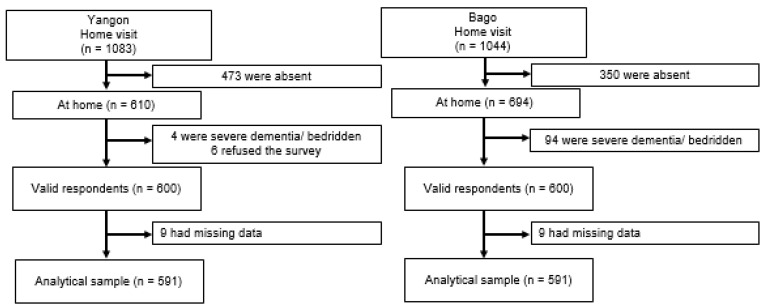
Few studies have examined whether objective or subjective economic status (ES) has a greater association with the happiness of older adults, despite concerns regarding the growing economic cost of morbidity and their functional dependence in developing countries with aging populations. Thus, this study examined whether objective/subjective ES was associated with happiness in older adults in two Myanmar regions. A multistage random sampling procedure and face-to-face interviews were conducted in the urban and rural areas of Myanmar. The happiness of 1200 participants aged >60 years was evaluated using a single happiness score ranging from 0 (very unhappy) to 10 (very happy). The wealth index, used as an objective ES, was calculated from 17 household asset items, such as radio, washing machines, and television. Subjective ES was assessed by asking “Which of the following best describes your current financial situation in light of general economic conditions?” Responses ranged from “very difficult” to “very comfortable”. Both low objective and subjective ES were negatively associated with happiness, after adjusting for confounding variables and stratification by region (urban and rural areas). Although objective and subjective ES had similar associations with happiness in urban areas, subjective ES had a stronger association in rural areas.
尽管在人口老龄化的发展中国家,人们对发病率不断上升的经济成本及其功能依赖问题感到担忧,但很少有研究探讨客观或主观经济状况(ES)与老年人幸福感之间的关联是否更强。因此,本研究调查了缅甸两个地区老年人的客观/主观经济状况与幸福感之间是否存在关联。在缅甸的城乡地区采用多阶段随机抽样程序并进行面对面访谈。使用从0(非常不幸福)到10(非常幸福)的单一幸福得分对1200名年龄大于60岁的参与者的幸福感进行评估。作为客观经济状况的财富指数是根据收音机、洗衣机和电视等17项家庭资产项目计算得出的。主观经济状况通过询问“根据总体经济状况,以下哪一项最能描述您目前的财务状况?”来评估。回答范围从“非常困难”到“非常舒适”。在对混杂变量进行调整并按地区(城市和农村地区)分层后,低客观经济状况和主观经济状况均与幸福感呈负相关。尽管客观和主观经济状况在城市地区与幸福感的关联相似,但主观经济状况在农村地区的关联更强。