Wang Fangyi, Wang Yongchao, Ji Xiaokang, Wang Zhiping
Department of Occupational and Environmental Health, School of Public Health, Cheeloo College of Medicine, Shandong University, Jinan 250012, China.
Department of Biostatistics, School of Public Health, Cheeloo College of Medicine, Shandong University, Jinan 250012, China.
Int J Environ Res Public Health. 2022 Mar 10;19(6):3245. doi: 10.3390/ijerph19063245.
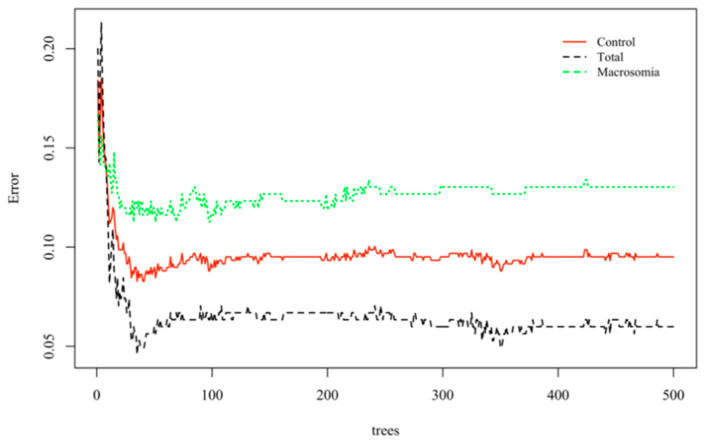
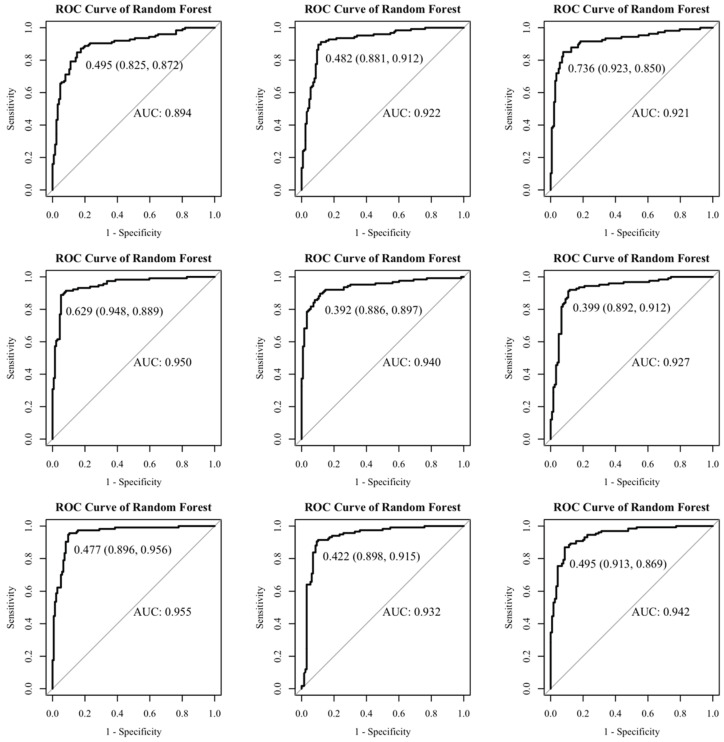
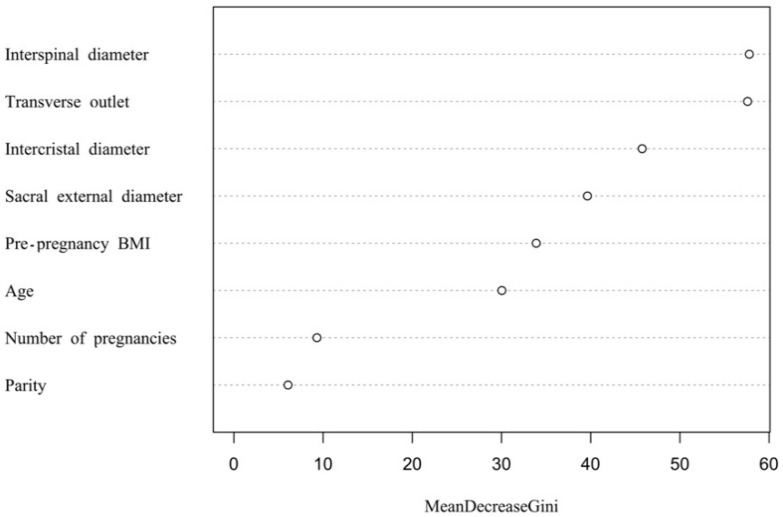
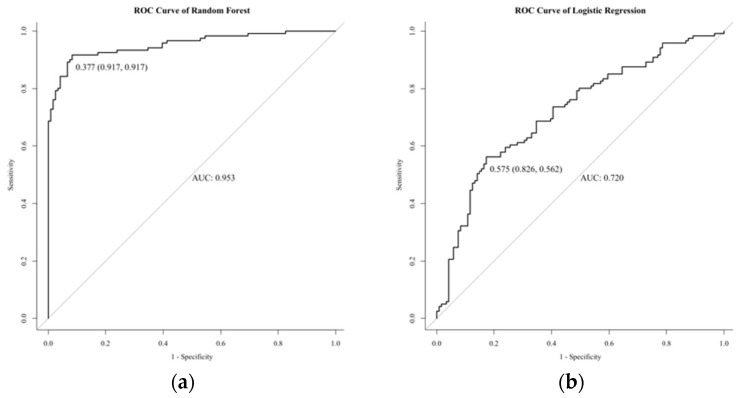
(1) Background: Macrosomia is prevalent in China and worldwide. The current method of predicting macrosomia is ultrasonography. We aimed to develop new predictive models for recognizing macrosomia using a random forest model to improve the sensitivity and specificity of macrosomia prediction; (2) Methods: Based on the Shandong Multi-Center Healthcare Big Data Platform, we collected the prenatal examination and delivery data from June 2017 to May 2018 in Jinan, including the macrosomia and normal-weight newborns. We constructed a random forest model and a logistic regression model for predicting macrosomia. We compared the validity and predictive value of these two methods and the traditional method; (3) Results: 405 macrosomia cases and 3855 normal-weight newborns fit the selection criteria and 405 pairs of macrosomia and control cases were brought into the random forest model and logistic regression model. On the basis of the average decrease of the Gini coefficient, the order of influencing factors was: interspinal diameter, transverse outlet, intercristal diameter, sacral external diameter, pre-pregnancy body mass index, age, the number of pregnancies, and the parity. The sensitivity, specificity, and area under curve were 91.7%, 91.7%, and 95.3% for the random forest model, and 56.2%, 82.6%, and 72.0% for logistic regression model, respectively; the sensitivity and specificity were 29.6% and 97.5% for the ultrasound; (4) Conclusions: A random forest model based on the maternal information can be used to predict macrosomia accurately during pregnancy, which provides a scientific basis for developing rapid screening and diagnosis tools for macrosomia.
(1)背景:巨大儿在中国及全球都很普遍。目前预测巨大儿的方法是超声检查。我们旨在使用随机森林模型开发新的预测模型以识别巨大儿,从而提高巨大儿预测的敏感性和特异性;(2)方法:基于山东多中心医疗大数据平台,我们收集了2017年6月至2018年5月济南地区的产前检查和分娩数据,包括巨大儿和正常体重新生儿。我们构建了用于预测巨大儿的随机森林模型和逻辑回归模型。我们比较了这两种方法与传统方法的有效性和预测价值;(3)结果:405例巨大儿病例和3855例正常体重新生儿符合入选标准,将405对巨大儿和对照病例纳入随机森林模型和逻辑回归模型。基于基尼系数的平均下降情况,影响因素的顺序为:棘间径、出口横径、髂嵴间径、骶外径、孕前体重指数、年龄、妊娠次数和产次。随机森林模型的敏感性、特异性和曲线下面积分别为91.7%、91.7%和95.3%,逻辑回归模型分别为56.2%、82.6%和72.0%;超声检查的敏感性和特异性分别为29.6%和97.5%;(4)结论:基于母体信息的随机森林模型可用于孕期准确预测巨大儿,为开发巨大儿快速筛查和诊断工具提供了科学依据。