Affiliated Hospital of Jiaxing University, The First Hospital of Jiaxing, Jiaxing, Zhejiang, China.
College of Data Science, Jiaxing University, Jiaxing, Zhejiang, China.
BMC Anesthesiol. 2024 Sep 19;24(1):334. doi: 10.1186/s12871-024-02720-5.
Catheter-related bladder discomfort (CRBD) commonly occurs in patients who have indwelling urinary catheters while under general anesthesia. And moderate-to-severe CRBD can lead to significant adverse events and negatively impact patient health outcomes. However, current screening studies for patients experiencing moderate-to-severe CRBD after waking from general anesthesia are insufficient. Constructing predictive models with higher accuracy using multiple machine learning techniques for early identification of patients at risk of experiencing moderate-to-severe CRBD during general anesthesia resuscitation.
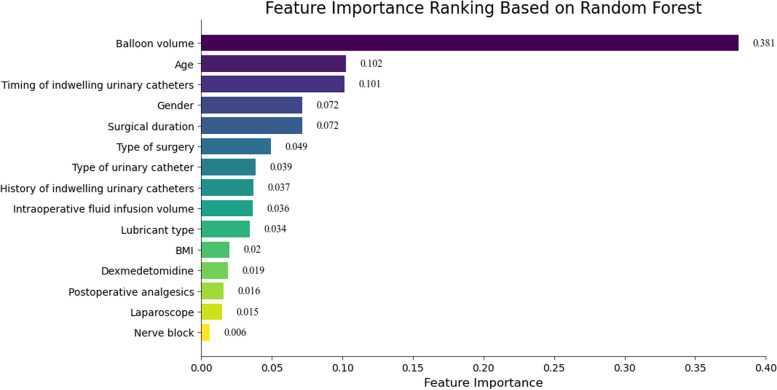
Eight hundred forty-six patients with indwelling urinary catheters who were resuscitated in a post-anesthesia care unit (PACU). Trained researchers used the CRBD 4-level assessment method to evaluate the severity of a patient's CRBD. They then inputted 24 predictors into six different machine learning algorithms. The performance of the models was evaluated using metrics like the area under the curve (AUC).
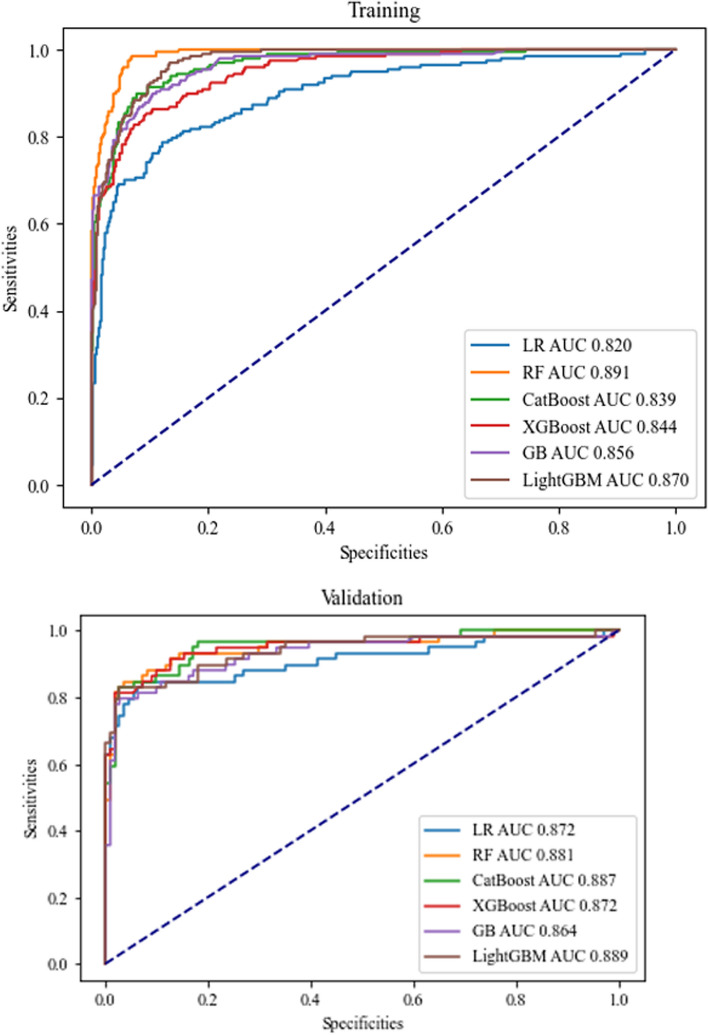
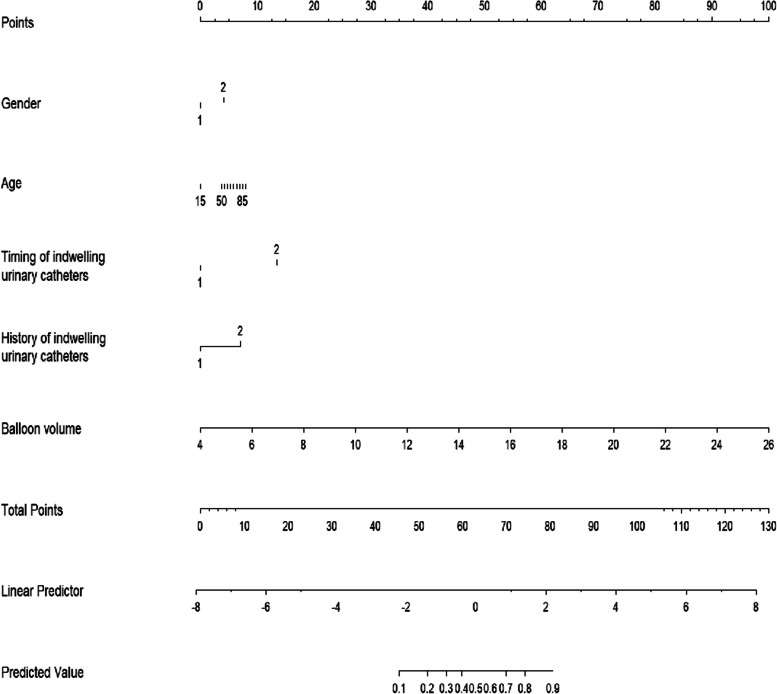
The AUCs of the six models ranged from 0.82 to 0.89. Among them, the RF model displayed the highest predictive ability, with an AUC of 0.89 (95%CI: 0.87, 0.91). Additionally, it achieved an accuracy of 0.93 (95%CI: 0.91, 0.95), 0.80 sensitivity, 0.98 specificity, 0.94 positive predictive value (PPV), 0.92 negative predictive value (NPV), 0.87 F1 score, and 0.07 Brier score. The logistic regression (LR) model has achieved good results (AUC:0.87) and converted into a nomogram.
The study has successfully developed a machine learning prediction model that exhibits excellent predictive capabilities in identifying patients who may develop moderate-to-severe CRBD after undergoing general anesthesia. Furthermore, the study also presents a nomogram, which serves as a valuable tool for clinical healthcare professionals, enabling them to intervene at an early stage for better patient outcomes.
在全身麻醉下留置导尿管的患者常发生导管相关膀胱不适(CRBD),中度至重度 CRBD 可导致严重不良事件,并对患者健康结局产生负面影响。然而,目前针对全身麻醉苏醒后出现中重度 CRBD 的患者进行筛查的研究还不够。使用多种机器学习技术构建预测模型,以提高准确性,从而早期识别全身麻醉复苏期间发生中重度 CRBD 风险的患者。
846 例在麻醉后恢复室(PACU)复苏的留置导尿管患者。经过培训的研究人员使用 CRBD 4 级评估方法评估患者 CRBD 的严重程度。然后,他们将 24 个预测因子输入到六种不同的机器学习算法中。使用曲线下面积(AUC)等指标评估模型的性能。
六种模型的 AUC 范围为 0.82 至 0.89。其中,随机森林(RF)模型的预测能力最高,AUC 为 0.89(95%CI:0.87,0.91)。此外,它的准确率为 0.93(95%CI:0.91,0.95),敏感性为 0.80,特异性为 0.98,阳性预测值(PPV)为 0.94,阴性预测值(NPV)为 0.92,F1 评分为 0.87,Brier 评分 0.07。逻辑回归(LR)模型也取得了较好的结果(AUC:0.87),并转化为诺模图。
本研究成功开发了一种机器学习预测模型,在识别全身麻醉后可能发生中重度 CRBD 的患者方面具有出色的预测能力。此外,研究还提出了一个诺模图,为临床医护人员提供了有价值的工具,以便他们能够进行早期干预,从而改善患者的结局。