School of Tourism, Huangshan University, Huangshan 245041, China.
School of Journalism and Communication, Guangzhou University, Guangzhou 510006, China.
Int J Environ Res Public Health. 2022 Mar 21;19(6):3736. doi: 10.3390/ijerph19063736.
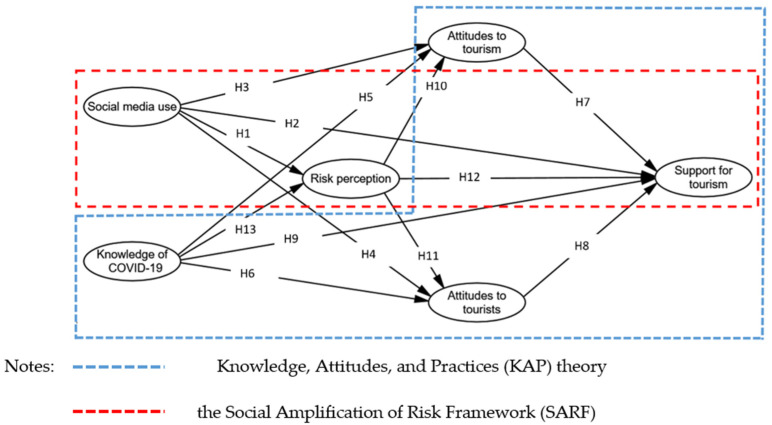
Given that the concept of risk perception stems primarily from consumer behaviour, tourism research has tended to address the issue from tourists' perspective, resulting in a lack of consideration of destination residents' risk perception and its impact on their attitudes and subsequent behaviour. Based on the social amplification of risk framework (SARF) and the knowledge, attitudes, and practices (KAP) theory, this study constructed a theoretical model to deepen the understanding of destination residents' support for tourism. Results indicate that residents' social media use, knowledge of COVID-19 and attitudes to tourism and tourists are all positively related to their support for tourism. Furthermore, residents' risk perception is negatively associated with their attitudes to tourism, attitudes to tourists and support for tourism. However, the relationship between residents' social media use and risk perception was not confirmed. Theoretical and managerial implications were discussed.
鉴于风险感知的概念主要源自消费者行为,旅游研究往往从游客的角度来解决这个问题,因此忽略了对目的地居民风险感知及其对态度和后续行为的影响的考虑。本研究以风险社会放大框架(SARF)和知识、态度和实践(KAP)理论为基础,构建了一个理论模型,以深化对目的地居民对旅游支持的理解。研究结果表明,居民对社交媒体的使用、对 COVID-19 的了解以及对旅游和游客的态度都与他们对旅游的支持呈正相关。此外,居民的风险感知与他们对旅游的态度、对游客的态度和对旅游的支持呈负相关。然而,居民对社交媒体的使用与风险感知之间的关系并未得到证实。本文讨论了理论和管理方面的意义。