Müller Nicolas, Al-Haj Husain Nadin, Chen Liang, Özcan Mutlu
Center of Dental Medicine, Division of Dental Biomaterials, Clinic for Reconstructive Dentistry, University of Zurich, Plattenstrasse 22, 8032 Zurich, Switzerland.
Department of Reconstructive Dentistry and Gerodontology, School of Dental Medicine, University of Bern, 3010 Bern, Switzerland.
Materials (Basel). 2022 Mar 16;15(6):2186. doi: 10.3390/ma15062186.
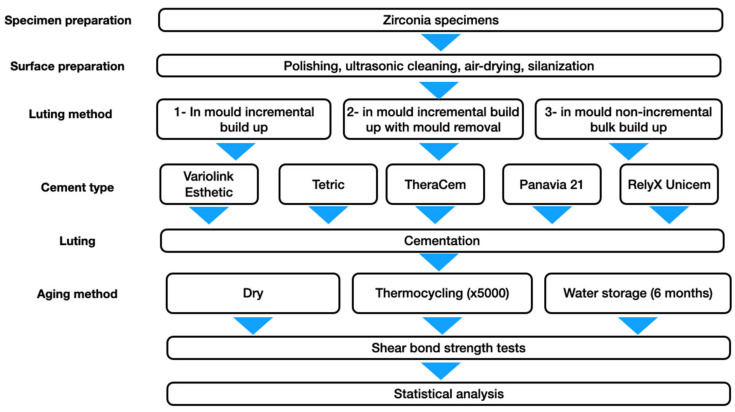
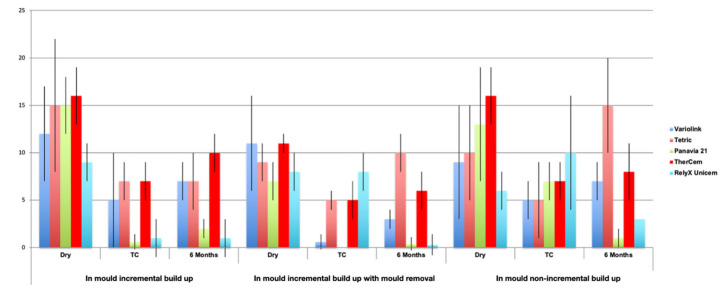
Bonding to zirconia presents a great challenge, as the clinical guidelines for predictable adhesion are not sufficiently validated. The aim of this study was to assess the influence of various bonding methodologies of various resin cements on zirconia, using different aging protocols. Manufactured zirconia specimens (N = 300 and n = 20 per group) were randomly assigned to three luting protocols: 1—in mould incremental build up; 2—in mould incremental build up with mould removal; 3—in mould non-incremental bulk build up. Five dual, photo- and chemical-cure resin cements were used, namely, Variolink Esthetic (Ivoclar), Tetric (Ivoclar), Panavia (Kuraray), TheraCem (Bisco), and RelyX UniCem (3M ESPE), and were applied on primed zirconia using photopolymerization protocols. Thereafter, the specimens were subjected to the following three ageing methods: 1—dry; 2—thermocycling (×5000; 5−55 °C); 3—3−6 months of water storage. Using a universal testing machine, the specimens were loaded under shear, at 1 mm/min crosshead speed. An analysis of the data was performed using three-way ANOVA and the Bonferroni method. The moulding type, ageing and luting cement significantly affected the results (p < 0.05). Among all the protocols under dry conditions, TheraCem (16 ± 3; 11 ± 1; 16 ± 3) showed the best bond strength, while, after thermocycling, TheraCem (7 ± 2) and Tetric (7 ± 2) performed the best with Protocol 1. In Protocol 2, RelyX (7 ± 3) presented the highest result, followed by TheraCem (5 ± 3) and Tetric (5 ± 1) (p < 0.05). Using Protocol 3, RelyX (10 ± 6) showed the highest result, followed by TheraCem (7 ± 2) and Panavia21 (7 ± 2) (p < 0.05). Six months after water storage, TheraCem presented the highest result (10 ± 2) in Protocol 1, while, in Protocols 2 and 3, Tetric (10 ± 2; 15 ± 5) presented the highest result, followed by TheraCem (6 ± 2; 8 ± 3). Adhesion tests using the incremental or bulk method, using moulds, showed the highest results, but removing the mould, and the subsequent ageing, caused a decrease in the adhesion of the resin cements tested on zirconia, probably due to water absorption, with the exclusion of Tetric.
与氧化锆结合面临着巨大挑战,因为可预测粘结的临床指南尚未得到充分验证。本研究的目的是使用不同的老化方案,评估各种树脂水门汀的不同粘结方法对氧化锆的影响。制作的氧化锆标本(N = 300,每组n = 20)被随机分配到三种粘结方案:1——在模具中逐层堆积;2——在模具中逐层堆积并脱模;3——在模具中一次性整体堆积。使用了五种双重固化、光固化和化学固化的树脂水门汀,即Variolink Esthetic(义获嘉)、Tetric(义获嘉)、Panavia(可乐丽)、TheraCem(必思科)和RelyX UniCem(3M ESPE),并使用光聚合方案应用于预处理的氧化锆上。此后,标本经历以下三种老化方法:1——干燥;2——热循环(×5000;5 - 55°C);3——3至6个月的水储存。使用万能试验机,以1毫米/分钟的十字头速度对标本进行剪切加载。使用三因素方差分析和Bonferroni方法对数据进行分析。成型类型、老化和粘结水门汀对结果有显著影响(p < 0.05)。在所有干燥条件下的方案中,TheraCem(16 ± 3;11 ± 1;16 ± 3)显示出最佳粘结强度,而在热循环后,TheraCem(7 ± 2)和Tetric(7 ± 2)在方案1中表现最佳。在方案2中,RelyX(7 ± 3)呈现出最高结果,其次是TheraCem(5 ± 3)和Tetric(5 ± 1)(p < 0.05)。使用方案3时,RelyX(10 ± 6)显示出最高结果,其次是TheraCem(7 ± 2)和Panavia21(7 ± 2)(p < 0.05)。水储存6个月后,TheraCem在方案1中呈现出最高结果(10 ± 2),而在方案2和3中,Tetric(10 ± 2;15 ± 5)呈现出最高结果,其次是TheraCem(6 ± 2;8 ± 3)。使用模具的增量或整体方法进行的粘结测试显示出最高结果,但脱模以及随后的老化导致在氧化锆上测试的树脂水门汀的粘结力下降,这可能是由于吸水所致,但Tetric除外。