Liu Tun, Qin Yue, Qi Huaguang, Luo Zhenguo, Yan Liang, Yu Pengfei, Dong Buhuai, Zhao Songchuan, Wu Xucai, Chang Zhen, Liu Zhian, Liu Xuemei, Yuan Tao, Li Houkun, Xiao Li, Wang Gang
Department of Anesthesiology, Xi'an Honghui Hospital, Xi'an Jiaotong University Health Science Center, Xi'an, China.
Department of Functional Inspection Section, Xi'an Honghui Hospital, Xi'an Jiaotong University Health Science Center, Xi'an, China.
Front Pharmacol. 2022 Mar 7;13:840320. doi: 10.3389/fphar.2022.840320. eCollection 2022.
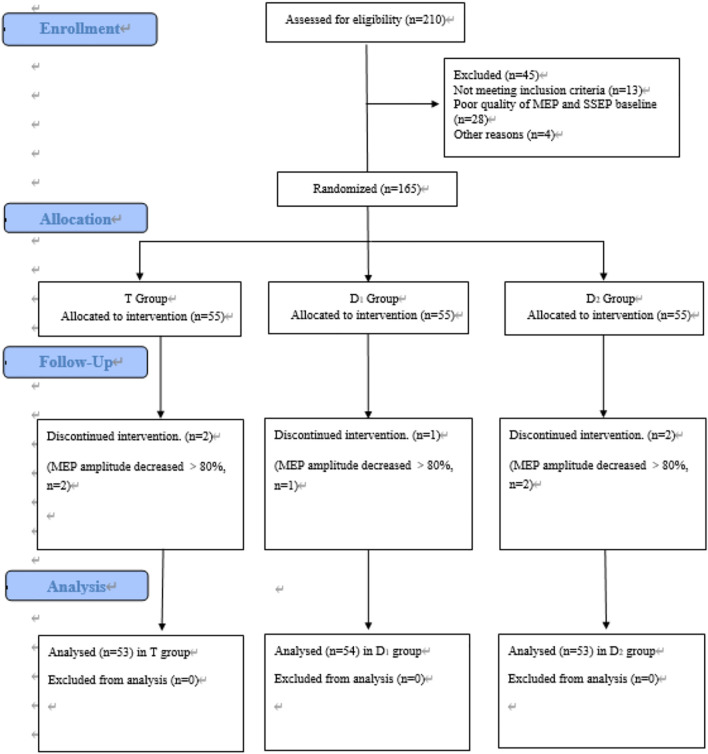
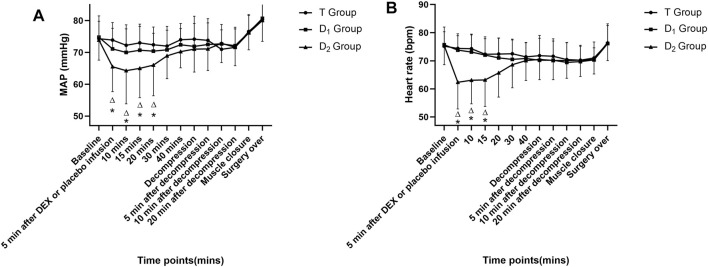
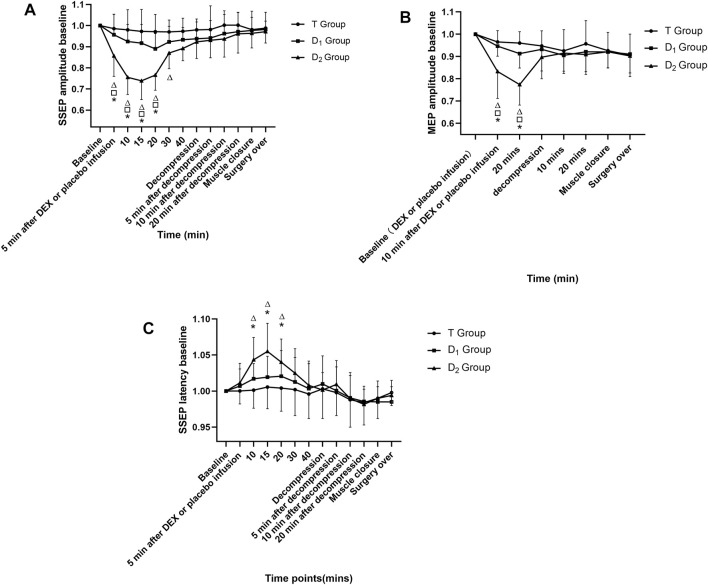
The effect of a bolus dose of dexmedetomidine on intraoperative neuromonitoring (IONM) parameters during spinal surgeries has been variably reported and remains a debated topic. A randomized, double-blinded, placebo-controlled study was performed to assess the effect of dexmedetomidine (1 μg/kg in 10 min) followed by a constant infusion rate on IONM during thoracic spinal decompression surgery (TSDS). A total of 165 patients were enrolled and randomized into three groups. One group received propofol- and remifentanil-based total intravenous anesthesia (TIVA) (T group), one group received TIVA combined with dexmedetomidine at a constant infusion rate (0.5 μg kg h) (D group), and one group received TIVA combined with dexmedetomidine delivered in a loading dose (1 μg kg in 10 min) followed by a constant infusion rate (0.5 μg kg h) (D group). The IONM data recorded before test drug administration was defined as the baseline value. We aimed at comparing the parameters of IONM. In the D group, within-group analysis showed suppressive effects on IONM parameters compared with baseline value after a bolus dose of dexmedetomidine. Furthermore, the D group also showed inhibitory effects on IONM recordings compared with both the D group and the T group, including a statistically significant decrease in SSEP amplitude and MEP amplitude, and an increase in SSEP latency. No significance was found in IONM parameters between the T group and the D group. Dexmedetomidine delivered in a loading dose can significantly inhibit IONM parameters in TSDS. Special attention should be paid to the timing of a bolus dose of dexmedetomidine under IONM. However, dexmedetomidine delivered at a constant speed does not exert inhibitory effects on IONM data.
关于大剂量右美托咪定对脊柱手术中神经监测(IONM)参数的影响,已有不同的报道,仍是一个有争议的话题。本研究进行了一项随机、双盲、安慰剂对照试验,以评估右美托咪定(1μg/kg,10分钟内输注完毕)随后持续输注对胸椎减压手术(TSDS)中IONM的影响。共纳入165例患者并随机分为三组。一组接受丙泊酚和瑞芬太尼复合全凭静脉麻醉(T组),一组接受丙泊酚和瑞芬太尼复合全凭静脉麻醉并持续输注右美托咪定(0.5μg·kg-1·h-1)(D1组),另一组接受丙泊酚和瑞芬太尼复合全凭静脉麻醉并先给予负荷剂量右美托咪定(1μg/kg,10分钟内输注完毕)随后持续输注(0.5μg·kg-1·h-1)(D2组)。给药前记录的IONM数据定义为基线值。我们旨在比较IONM参数。在D2组,组内分析显示,给予大剂量右美托咪定后,IONM参数与基线值相比有抑制作用。此外,D2组与D1组和T组相比,对IONM记录均有抑制作用,包括体感诱发电位(SSEP)波幅和运动诱发电位(MEP)波幅有统计学意义的降低,以及SSEP潜伏期延长。T组和D1组之间的IONM参数无显著差异。在TSDS中,负荷剂量的右美托咪定可显著抑制IONM参数。在IONM监测下,应特别注意给予大剂量右美托咪定的时机。然而,持续输注右美托咪定对IONM数据无抑制作用。