Department of Surgery, University of New Mexico School of Medicine, MSC10 5610, 1 University of New Mexico, Albuquerque, NM, 87131, USA.
Department of Surgery, University of Washington School of Medicine, Seattle, USA.
Surg Endosc. 2022 Dec;36(12):9304-9312. doi: 10.1007/s00464-022-09186-x. Epub 2022 Mar 24.
The COVID-19 pandemic caused many surgical providers to conduct outpatient evaluations using remote audiovisual conferencing technology (i.e., telemedicine) for the first time in 2020. We describe our year-long institutional experience with telemedicine in several general surgery clinics at an academic tertiary care center and examine the relationship between area-based socioeconomic measures and the likelihood of telemedicine participation.
We performed a retrospective review of our outpatient telemedicine utilization among four subspecialty clinics (including two acute care and two elective surgery clinics). Geocoding was used to link patient visit data to area-based socioeconomic measures and a multivariable analysis was performed to examine the relationship between socioeconomic indicators and patient participation in telemedicine.
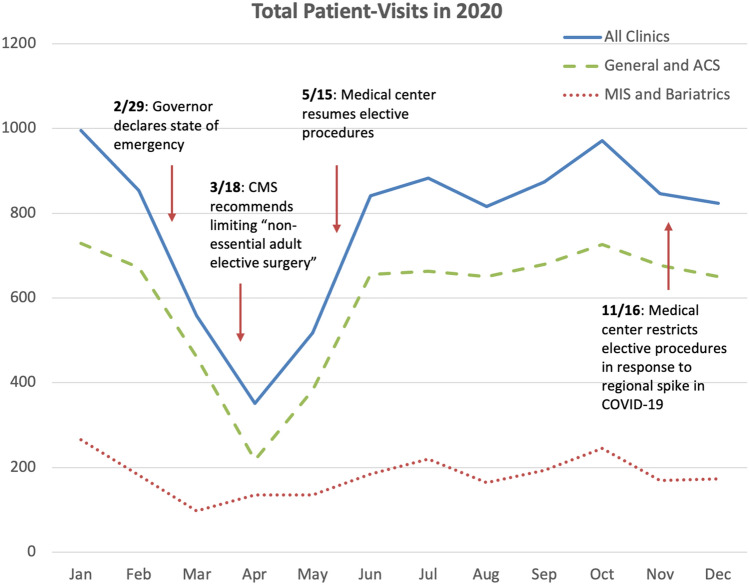
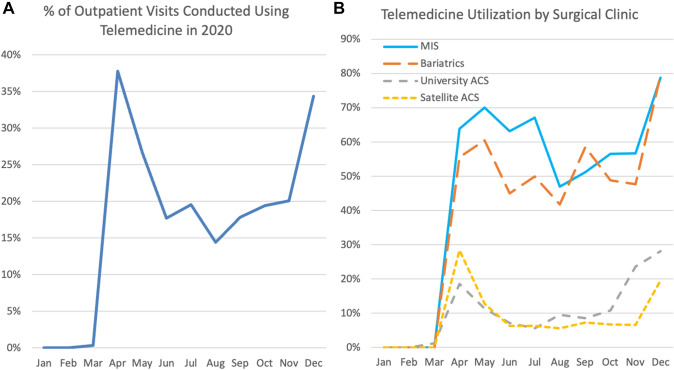
While total outpatient visits per month reached a nadir in April 2020 (65% decrease in patient visits when compared to January 2020), there was a sharp increase in telemedicine utilization during the same month (38% of all visits compared to 0.8% of all visits in the month prior). Higher rates of telemedicine utilization were observed in the two elective surgery clinics (61% and 54%) compared to the two acute care surgery clinics (14% and 9%). A multivariable analysis demonstrated a borderline-significant linear trend (p = 0.07) between decreasing socioeconomic status and decreasing odds of telemedicine participation among elective surgery visits. A sensitivity analysis to examine the reliability of this trend showed similar results.
Telemedicine has many patient-centered benefits, and this study demonstrates that for certain elective subspecialty clinics, telemedicine may be utilized as the preferred method for surgical consultations. However, to ensure the equitable adoption and advancement of telemedicine services, healthcare providers will need to focus on mitigating the socioeconomic barriers to telemedicine participation.
2020 年 COVID-19 大流行期间,许多外科医生首次使用远程视听会议技术(即远程医疗)进行门诊评估。我们描述了在学术三级保健中心的几个普通外科诊所中,远程医疗使用一年的机构经验,并研究了基于区域的社会经济指标与远程医疗参与可能性之间的关系。
我们对四个亚专科诊所(包括两个急症和两个择期手术诊所)的门诊远程医疗利用情况进行了回顾性审查。使用地理编码将患者就诊数据与基于区域的社会经济指标相关联,并进行多变量分析,以研究社会经济指标与患者参与远程医疗之间的关系。
虽然每月门诊就诊次数在 2020 年 4 月达到最低点(与 2020 年 1 月相比,患者就诊次数减少了 65%),但同月远程医疗利用率急剧上升(与上月相比,所有就诊次数中有 38%为远程医疗就诊,而只有 0.8%为远程医疗就诊)。在两个择期手术诊所中,远程医疗利用率较高(61%和 54%),而在两个急症手术诊所中,远程医疗利用率较低(14%和 9%)。多变量分析显示,在择期手术就诊中,社会经济地位下降与远程医疗参与机会减少之间存在线性趋势(p=0.07),但这种趋势具有边缘显著性。一项敏感性分析表明,这种趋势具有可靠性。
远程医疗具有许多以患者为中心的好处,本研究表明,对于某些特定的择期亚专科诊所,远程医疗可能被用作外科咨询的首选方法。然而,为了确保远程医疗服务的公平采用和发展,医疗保健提供者需要专注于减轻远程医疗参与的社会经济障碍。