Osterwalder Uli, Surber Christian
Sun Protection Facilitator GmbH, Pfeffingerstr. 82, 4053, Basel, Schweiz.
Dermatologische Klinik, UniversitätsSpital Zürich, Gloriastr. 31, 8091, Zürich, Schweiz.
Hautarzt. 2022 Apr;73(4):276-282. doi: 10.1007/s00105-022-04958-x. Epub 2022 Mar 25.
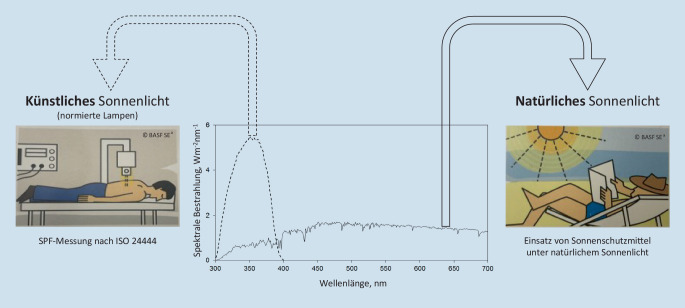
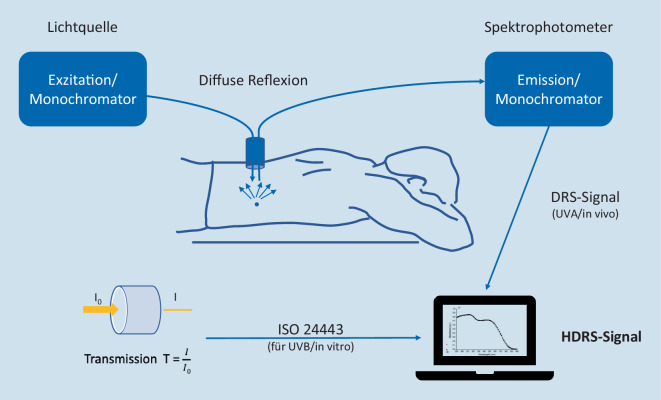
The task of the first sunscreens was to prevent the development of sunburn and, following the spirit of the 1950/1960s, to not impair the tanning of the skin. The need to quantify the protective performance soon arose. Originally with the help of natural-nowadays artificial-sunlight, a method was developed to determine a sun protection factor (SPF). It is formally defined as a ratio between minimum erythema-effective UV dose on sunscreen-protected skin and minimum erythema-effective UV dose on unprotected skin (ISO 24444:2019). Three observations question the suitability of the method. (1) Interlaboratory variability: Despite strict standardization, results of SPF determinations from different laboratories are subject to large variations. (2) Natural vs. artificial sunlight: The radiation spectrum of artificial sunlight differs from that of natural sunlight. SPFs determined with artificial sunlight (as depicted on all sunscreens currently on the market) are significantly too high compared to SPF determination with natural sunlight. (3) Erythema burden: When determining SPF, subjects are exposed to potentially harmful radiation. Against this background alternative methods-in vitro SPF, hybrid diffuse reflectance spectroscopy (HDRS) and in silico calculations-are presented. These have the potential to replace the current method. As an immediate measure, it is recommended to return to the comprehensible description of low, medium, high, and very high protection and in the future to take into account the spectrum of natural sunlight.
最初,防晒霜的任务是防止晒伤,并且按照20世纪50年代/60年代的理念,不影响皮肤晒黑。很快就出现了量化防护性能的需求。最初是借助自然阳光——如今是人工阳光——开发出一种测定防晒系数(SPF)的方法。它被正式定义为涂抹防晒霜皮肤的最小红斑有效紫外线剂量与未防护皮肤的最小红斑有效紫外线剂量之比(ISO 24444:2019)。有三点观察结果对该方法的适用性提出了质疑。(1)实验室间的变异性:尽管进行了严格的标准化,但不同实验室测定的SPF结果仍存在很大差异。(2)自然阳光与人工阳光:人工阳光的辐射光谱与自然阳光不同。用人工阳光测定的SPF(如目前市场上所有防晒霜所标注的)与用自然阳光测定的SPF相比明显过高。(3)红斑负担:在测定SPF时,受试者会暴露于潜在有害的辐射中。在此背景下,提出了替代方法——体外SPF、混合漫反射光谱法(HDRS)和计算机模拟计算。这些方法有可能取代当前的方法。作为一项即时措施,建议恢复对低、中、高和非常高防护的易懂描述,并在未来考虑自然阳光的光谱。