Chou Oscar Hou In, Zhou Jiandong, Lee Teddy Tai Loy, Kot Thompson, Lee Sharen, Wai Abraham Ka Chung, Wong Wing Tak, Zhang Qingpeng, Cheng Shuk Han, Liu Tong, Vassiliou Vassilios S, Cheung Bernard Man Yung, Tse Gary
Division of Clinical Pharmacology, Department of Medicine, School of Clinical Medicine, University of Hong Kong, Hong Kong, China.
Epidemiology Research Unit, Cardiovascular Analytics Group, Hong Kong, China.
Clin Res Cardiol. 2022 Oct;111(10):1098-1103. doi: 10.1007/s00392-022-02007-0. Epub 2022 Mar 25.
Both COVID-19 infection and COVID-19 vaccines have been associated with the development of myopericarditis. The objective of this study is to (1) analyse the rates of myopericarditis after COVID-19 infection and COVID-19 vaccination in Hong Kong, (2) compared to the background rates, and (3) compare the rates of myopericarditis after COVID-19 vaccination to those reported in other countries.
This was a population-based cohort study from Hong Kong, China. Patients with positive RT-PCR test for COVID-19 between 1st January 2020 and 30th June 2021 or individuals who received COVID-19 vaccination until 31st August were included. The main exposures were COVID-19 positivity or COVID-19 vaccination. The primary outcome was myopericarditis.
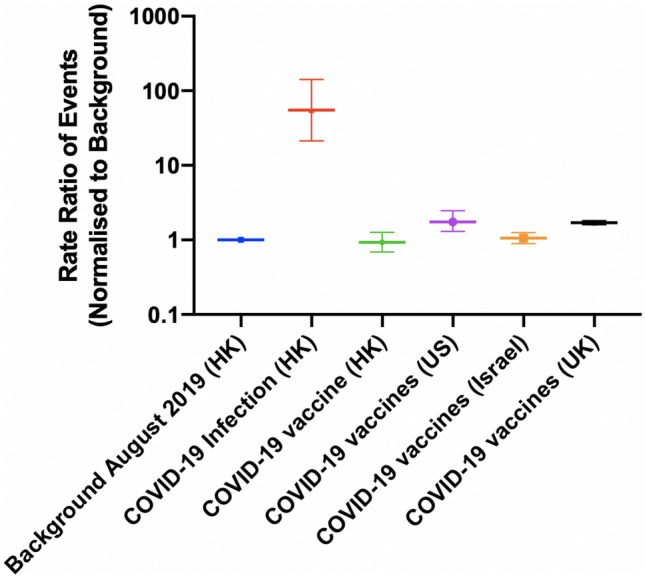
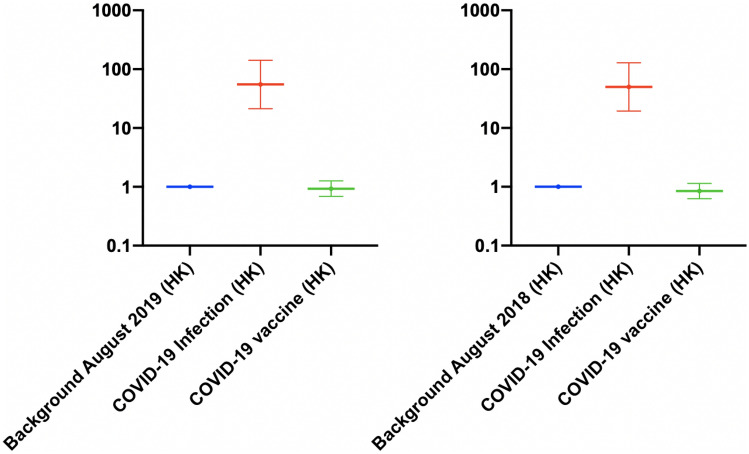
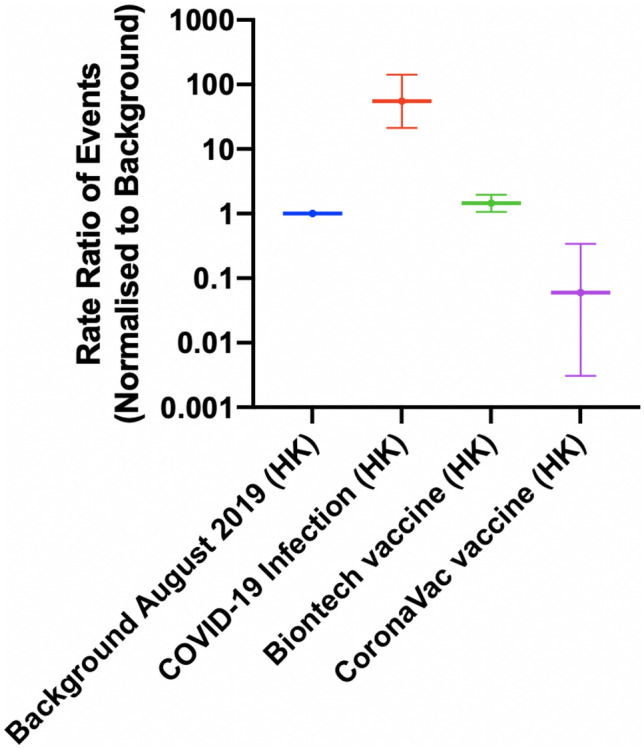
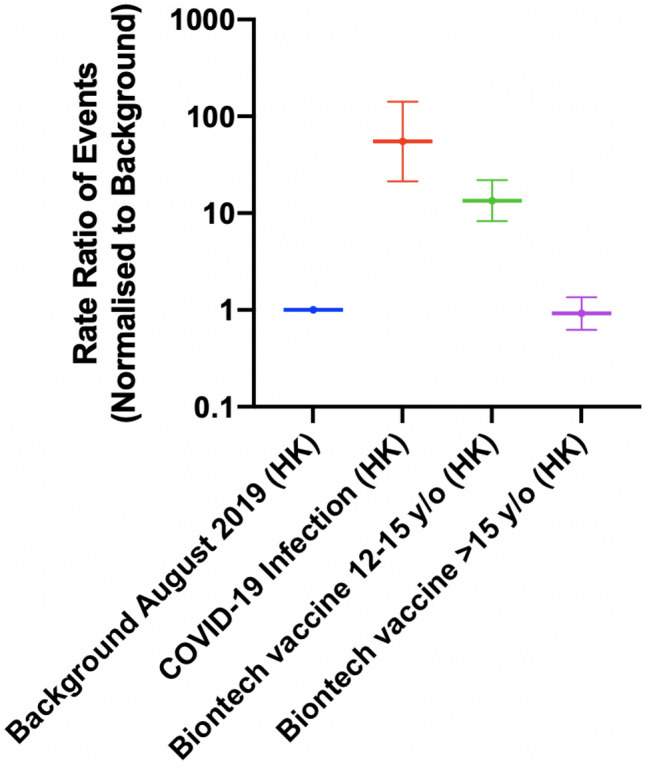
This study included 11,441 COVID-19 patients from Hong Kong, four of whom suffered from myopericarditis (rate per million: 326; 95% confidence interval [CI] 127-838). The rate was higher than the pre-COVID-19 background rate in 2019 (rate per million: 5.5, 95% CI 4.1-7.4) with a rate ratio of 55.0 (95% CI 21.4-141). Compared to the background rate, the rate of myopericarditis among vaccinated subjects in Hong Kong was similar (rate per million: 5.5; 95% CI 4.1-7.4) with a rate ratio of 0.93 (95% CI 0.69-1.26). The rates of myocarditis after vaccination in Hong Kong were comparable to those vaccinated in the United States, Israel, and the United Kingdom.
COVID-19 infection was associated with significantly higher rate of myopericarditis compared to the vaccine-associated myopericarditis.
新型冠状病毒肺炎(COVID-19)感染和COVID-19疫苗均与心肌炎的发生有关。本研究的目的是:(1)分析香港地区COVID-19感染和COVID-19疫苗接种后心肌炎的发生率;(2)与背景发生率进行比较;(3)将COVID-19疫苗接种后心肌炎的发生率与其他国家报告的发生率进行比较。
这是一项基于中国香港地区人群的队列研究。纳入2020年1月1日至2021年6月30日期间COVID-19逆转录聚合酶链反应(RT-PCR)检测呈阳性的患者,或截至8月31日接种过COVID-19疫苗的个体。主要暴露因素为COVID-19阳性或COVID-19疫苗接种。主要结局为心肌炎。
本研究纳入了11441名来自香港的COVID-19患者,其中4人患有心肌炎(每百万人口发生率:326;95%置信区间[CI] 127-838)。该发生率高于2019年COVID-19大流行前的背景发生率(每百万人口发生率:5.5,95% CI 4.1-7.4),发生率比值为55.0(95% CI 21.4-141)。与背景发生率相比,香港接种疫苗人群中心肌炎的发生率相似(每百万人口发生率:5.5;95% CI 4.1-7.4),发生率比值为0.93(95% CI 0.69-1.26)。香港接种疫苗后心肌炎的发生率与美国、以色列和英国接种疫苗后的发生率相当。
与疫苗相关的心肌炎相比,COVID-19感染与显著更高的心肌炎发生率相关。