Center for Nutrition, Lifestyle and Disease Prevention, School of Public Health, Loma Linda University, Loma Linda, CA 92350, USA.
Roche Diagnostic Solutions, Clinical Development Core, Clinical Development Medical Affairs, Tucson, AZ 85755, USA.
Nutrients. 2022 Mar 11;14(6):1174. doi: 10.3390/nu14061174.
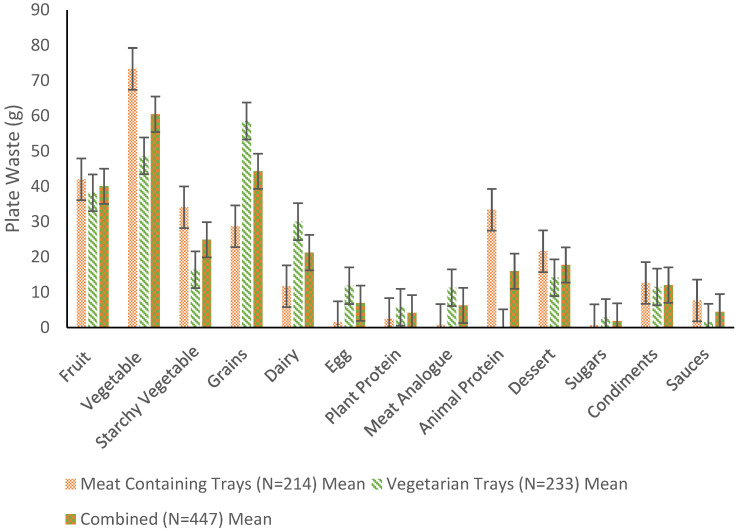
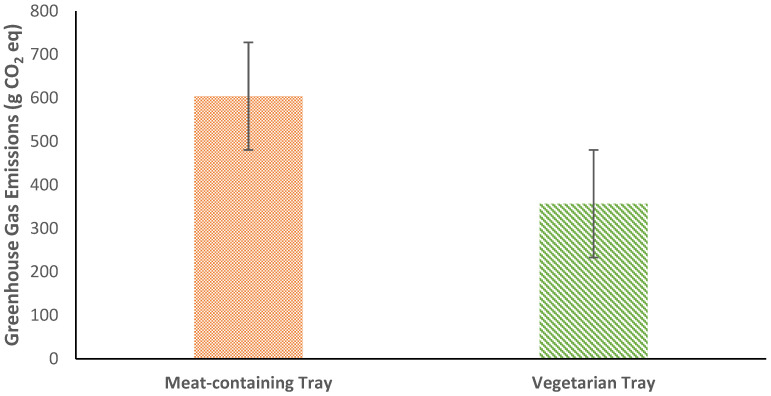
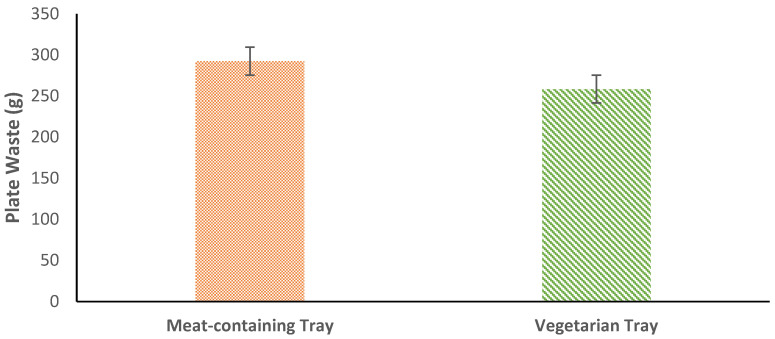
Vegetarian diets can satisfy nutritional requirements and have lower environmental impacts than those containing meat. However, fruits and vegetables are wasted at higher rates than meat. Reducing both food waste (FW) and the environmental impacts associated with food production is an important sustainability goal. Therefore, the aim of this study was to examine potential tradeoffs between vegetarian meals’ lower impacts but potentially higher FW compared to meat-containing meals. To examine this, seven consecutive days of plate FW data from Loma Linda University Medical Center (LLUMC) patients were collected and recorded from 471 meals. Mean total FW and associated greenhouse gas emissions (GHGE) were higher among meat-containing meals (293 g/plate, 604 g CO2-eq/plate) than vegetarian meals (259 g/plate, 357 g CO2-eq/plate) by 34 g (p = 0.05) and 240 g CO2-eq (p < 0.001), respectively. Statistically significant differences were observed in both FW and associated GHGE across major food categories, except fruit, when comparing vegetarian and meat-containing meals. Overall, vegetarian meals were preferable to meat-containing meals served at LLUMC both in terms of minimizing FW and lowering environmental impacts. Other institutions serving vegetarian meal options could expect similar advantages, especially in reduced GHGE due to the high CO2 embodied in meat.
素食饮食可以满足营养需求,对环境的影响也小于含肉类的饮食。然而,水果和蔬菜的浪费率比肉类更高。减少食物浪费(FW)和与食物生产相关的环境影响是一个重要的可持续性目标。因此,本研究旨在研究素食餐的潜在权衡,即其较低的环境影响,但与含肉类的餐相比,FW 可能更高。为了研究这一点,从洛马林达大学医学中心(LLUMC)的患者那里收集了连续 7 天的餐盘 FW 数据,并从 471 份餐中记录下来。与素食餐(259 克/盘,357 克 CO2-eq/盘)相比,含肉类餐(293 克/盘,604 克 CO2-eq/盘)的总 FW 和相关温室气体排放(GHGE)更高,分别高出 34 克(p = 0.05)和 240 克 CO2-eq(p < 0.001)。当比较素食餐和含肉类餐时,除了水果之外,在主要食物类别中都观察到 FW 和相关 GHGE 的差异具有统计学意义。总的来说,与 LLUMC 提供的含肉类餐相比,素食餐在减少 FW 和降低环境影响方面更具优势。其他提供素食餐选择的机构也可以预期到类似的优势,尤其是由于肉类中含有大量的 CO2,因此 GHGE 会降低。