Hellenic Health Foundation, HHF, Kaisareias 13 & Alexandroupoleos, 115 27 Athens, Greece.
Nutrients. 2022 Mar 11;14(6):1193. doi: 10.3390/nu14061193.
This study aimed to investigate the food and macronutrient intake of the population in Greece and evaluate its adherence to the Greek traditional Mediterranean diet.
Adults over 18 years old ( = 4011) were included from the 2013-2014 National Health and Nutrition survey-HYDRIA. Dietary intake was collected using two 24-h recall interviews and a nonquantitative food frequency questionnaire. Macronutrient intakes were calculated using an updated version of the Greek FCT.
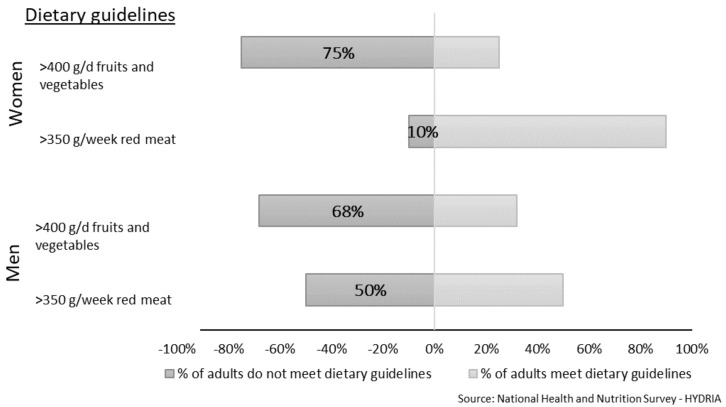
Only 28.3% of the adult population had high adherence to the Greek traditional Mediterranean diet, with a higher percentage (39.7%) observed for participants over 65 years compared to those under 65 years (25.5%). Differences in adherence to the MD were observed among the four geographical regions in Greece. Younger adults had a higher intake of meat, cereals, alcoholic and nonalcoholic beverages, and sugar products than older individuals who consumed more vegetables, fruits, legumes, dairy, fish, and lipids (mainly from olive oil). Adults do not meet the international dietary recommendations for the intake of several foods and macronutrients.
The adult Greek population, especially younger people, has headed away from the Greek traditional Mediterranean diet. These observations indicate potential detrimental consequences in terms of morbidity and mortality.
本研究旨在调查希腊人口的食物和宏量营养素摄入量,并评估其对希腊传统地中海饮食的依从性。
从 2013-2014 年国家健康和营养调查-HYDRIA 中纳入 18 岁以上的成年人(n=4011)。膳食摄入量通过两次 24 小时回顾性访谈和非定量食物频率问卷收集。使用希腊 FCT 的更新版本计算宏量营养素摄入量。
只有 28.3%的成年人口高度遵循希腊传统地中海饮食,65 岁以上人群的比例(39.7%)高于 65 岁以下人群(25.5%)。希腊四个地理区域的 MD 依从性存在差异。年轻成年人的肉类、谷物、含酒精和不含酒精的饮料以及糖制品摄入量高于老年人,而老年人则摄入更多的蔬菜、水果、豆类、乳制品、鱼类和脂肪(主要来自橄榄油)。成年人没有达到国际饮食建议中对几种食物和宏量营养素的摄入量要求。
希腊成年人口,特别是年轻人,已经偏离了希腊传统地中海饮食。这些观察结果表明,在发病率和死亡率方面可能存在潜在的不利后果。