Gaviria Lorena Patrícia, Montsant Lourdes, Azuaje Carlos, González-Díaz Aida, Horcajada Juan P, Limón Enric, Viñas Miguel, Espinal Paula, Fusté Ester
Internal Medicine Service, Hospital Transfronterer de Cerdanya, Puigcerdà, 17520 Girona, Spain.
Microbiology Department, Hospital Universitari de Bellvitge, IDIBELL, Hospitalet de Llobregat, 08907 Barcelona, Spain.
Microorganisms. 2022 Feb 22;10(3):488. doi: 10.3390/microorganisms10030488.
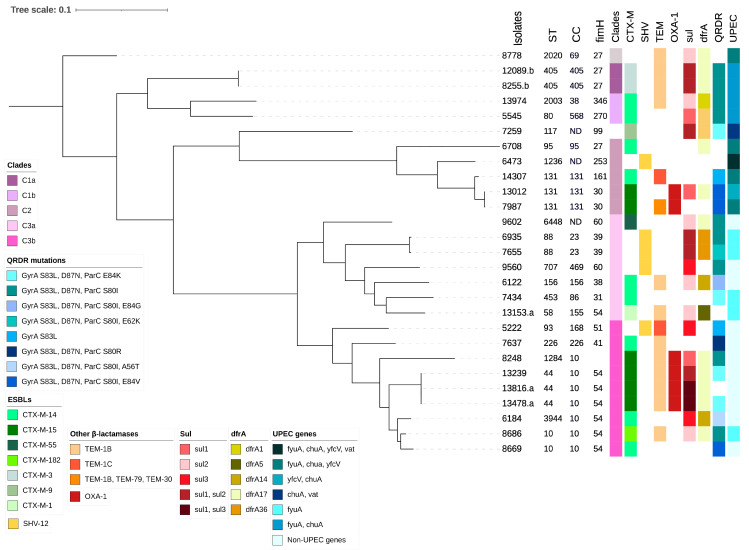
Urinary tract infections caused by extended-spectrum β-lactamase (ESBL-EC) are increasing worldwide and are a current concern because treatment options are often limited. This study investigated antimicrobial susceptibility, antimicrobial resistance genes (ARGs), and the biological diversity of urinary ESBL-EC isolates at Cerdanya Hospital, a European cross-border hospital that combines French and Spanish healthcare models. Bacterial identification and susceptibility were determined using the Microscan WalkAway system and ESBL production was examined by the double-disk synergy method. Isolates were sequenced using the Ion S5 next-generation sequencing system, with the whole-genome sequences then assembled using SPADEs software and analyzed using PubMLST, ResFinder, FimTyper, PlasmidFinder, and VirulenceFinder. A phylogenetic analysis was performed by constructing an assembly-based core-SNV alignment, followed by a phylogenetic tree constructed using Parsnp from the Harvest suite. All isolates studied were multidrug-resistant and could be classified into 19 different sequence types characterized by a high genetic diversity. The most prevalent ESBL-enzymes were CTX-M-14 and CTX-M-15. High-risk international clones (ST131, ST10, and ST405) were also identified. The results demonstrated the absence of a single predominant clone of ESBL-MDR-EC at Cerdanya Hospital.
由超广谱β-内酰胺酶(ESBL-EC)引起的尿路感染在全球范围内呈上升趋势,由于治疗选择往往有限,这一问题目前备受关注。本研究调查了塞尔达尼亚医院(一家融合法国和西班牙医疗模式的欧洲跨境医院)尿路ESBL-EC分离株的抗菌药敏性、抗菌耐药基因(ARGs)及生物多样性。使用Microscan WalkAway系统进行细菌鉴定和药敏测定,通过双纸片协同法检测ESBL的产生。使用Ion S5下一代测序系统对分离株进行测序,然后使用SPAdes软件组装全基因组序列,并使用PubMLST、ResFinder、FimTyper、PlasmidFinder和VirulenceFinder进行分析。通过构建基于组装的核心单核苷酸变异(core-SNV)比对进行系统发育分析,随后使用Harvest套件中的Parsnp构建系统发育树。所有研究的分离株均为多重耐药,可分为19种不同的序列类型,具有高度的遗传多样性。最常见的ESBL酶为CTX-M-14和CTX-M-15。还鉴定出了高风险国际克隆(ST131、ST10和ST405)。结果表明,塞尔达尼亚医院不存在单一占主导地位的ESBL-MDR-EC克隆。