Yang Hongjun, Zhao Yao, Ma Jiaxin, Rong Zhenyang, Chen Jiajia, Wang Yuanchao, Zheng Xiaobo, Ye Wenwu
Key Laboratory of Plant Immunity, Department of Plant Pathology, Nanjing Agricultural University, Nanjing 210095, China.
Key Laboratory of Soybean Disease and Pest Control (Ministry of Agriculture and Rural Affairs), Nanjing Agricultural University, Nanjing 210095, China.
Microorganisms. 2022 Mar 21;10(3):667. doi: 10.3390/microorganisms10030667.
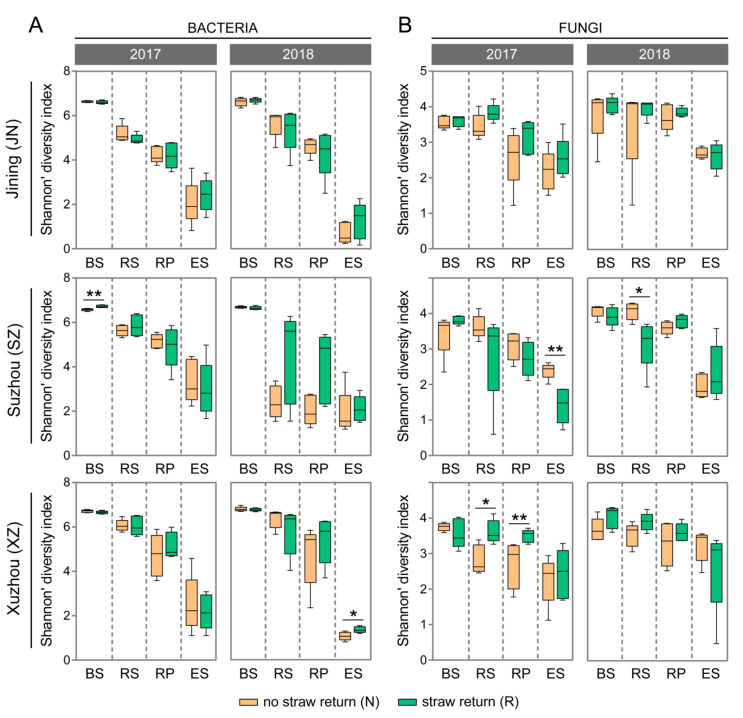
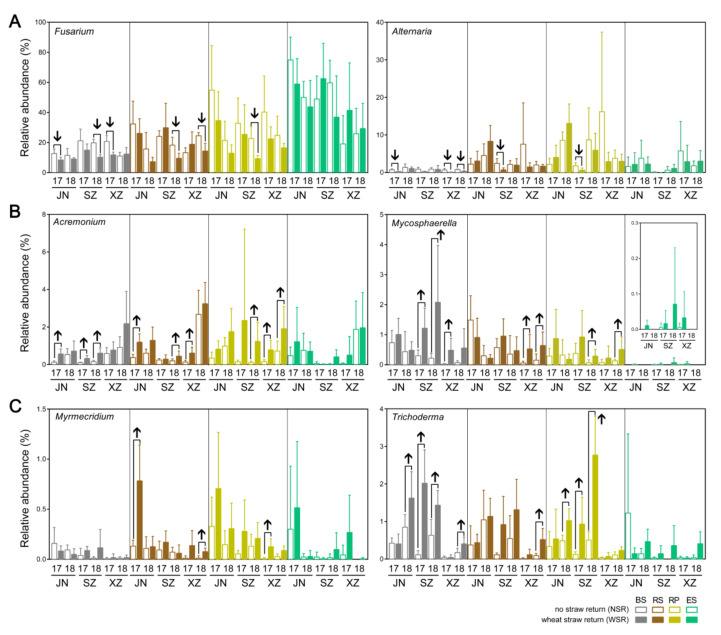
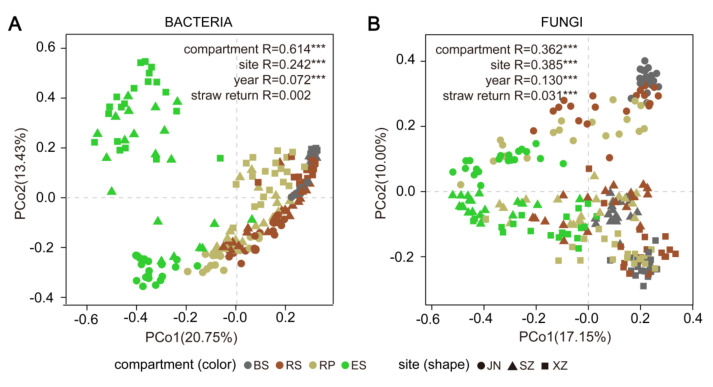
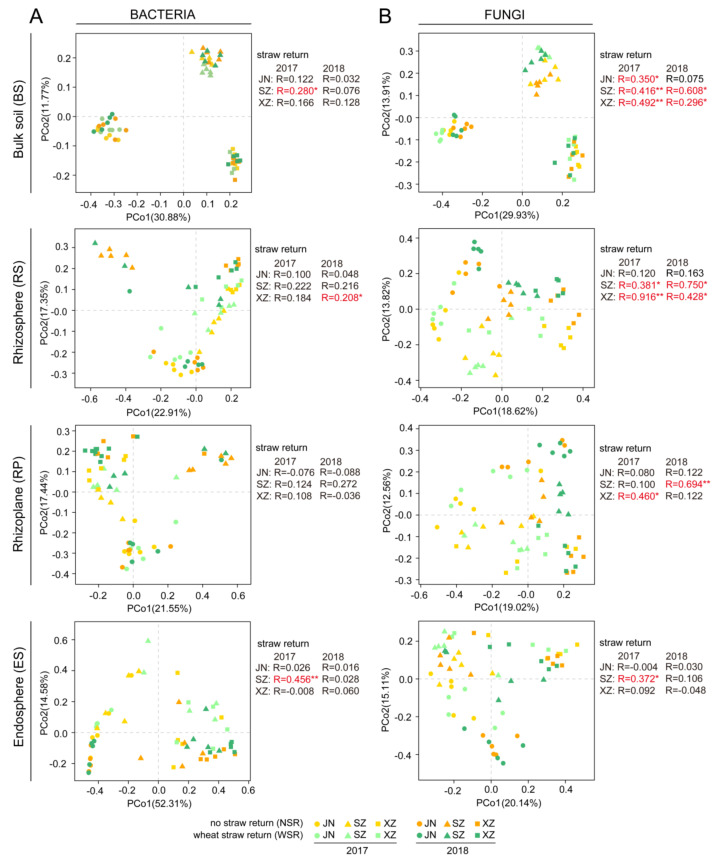
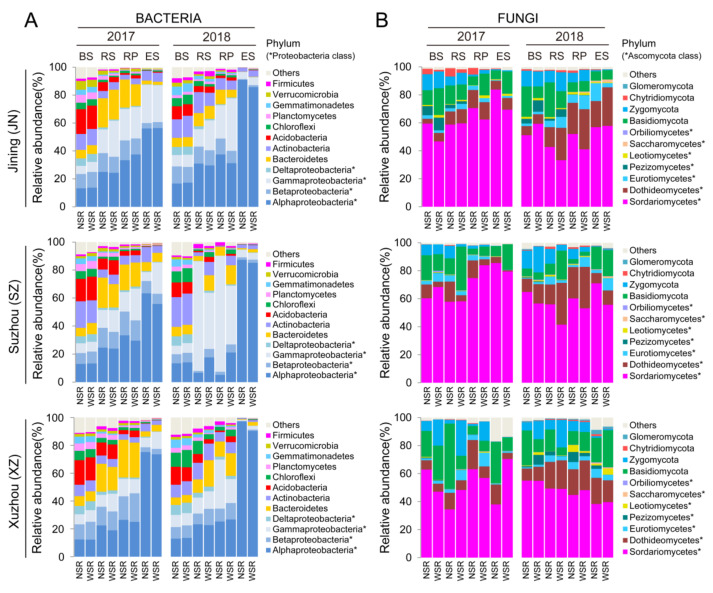
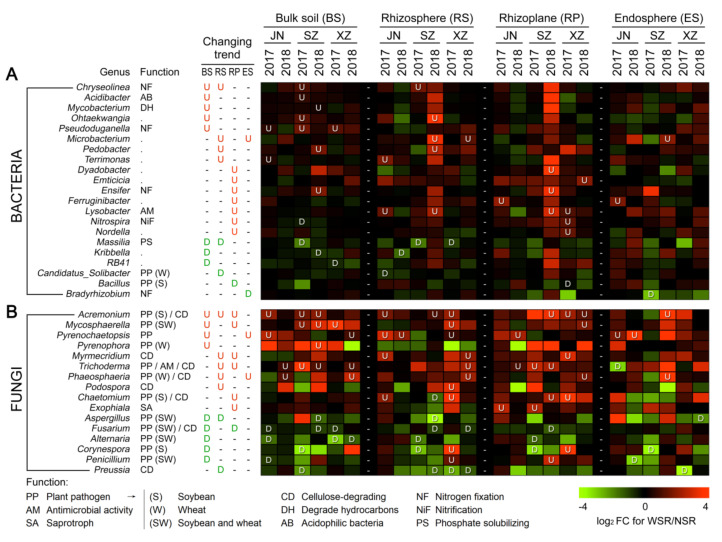
Roots hold complex microbial communities at the soil-root interface, which can affect plant nutrition, growth, and health. Although the composition of plant microbiomes has been extensively described for various plant species and environments, little is known about the effect of wheat straw return (WSR) on the soybean root microbiota. We used Illumina-based 16S rRNA and ITS amplicon sequencing to track changes in bacterial and fungal microbiota in bulk soil and soybean rhizosphere, rhizoplane, s1and endosphere during the third and fourth years after implementing WSR in a wheat-soybean rotation system. The results revealed that WSR had a greater impact on fungal communities than bacterial communities, particularly in bulk soil, rhizosphere, and rhizoplane. WSR enriched the relative abundance of cellulose-degrading fungi (e.g., , , and , among which also had antimicrobial activity), saprotroph (e.g., ), and nitrogen cycling bacteria (e.g., ). Furthermore, WSR depleted the relative abundance of pathogenic fungi (e.g., and ). These data revealed for the first time that WSR had diverse effects on soybean root-associated microbial community composition, not only in soil but also in the rhizosphere, rhizoplane, and endosphere.
根系在土壤-根系界面处维系着复杂的微生物群落,这会影响植物的营养、生长和健康状况。尽管针对多种植物物种和环境,植物微生物组的组成已得到广泛描述,但关于小麦秸秆还田(WSR)对大豆根系微生物群的影响却知之甚少。在小麦-大豆轮作系统中实施WSR后的第三年和第四年,我们使用基于Illumina的16S rRNA和ITS扩增子测序技术,追踪了大田中土壤、大豆根际、根表、根内细菌和真菌微生物群的变化。结果显示,WSR对真菌群落的影响大于细菌群落,尤其是在大田中土壤、根际和根表。WSR提高了纤维素降解真菌(例如,,和,其中也具有抗菌活性)、腐生菌(例如,)和氮循环细菌(例如,)的相对丰度。此外,WSR降低了致病真菌(例如,和)的相对丰度。这些数据首次揭示,WSR对与大豆根系相关的微生物群落组成具有多种影响,不仅在土壤中,在根际、根表和根内亦是如此。