Exotic and Emerging Avian Viral Diseases Research Unit, Southeast Poultry Research Laboratory, United States National Poultry Research Center, Agricultural Research Service, United States Department of Agriculture, Athens, GA 30605, USA.
Viruses. 2022 Mar 8;14(3):554. doi: 10.3390/v14030554.
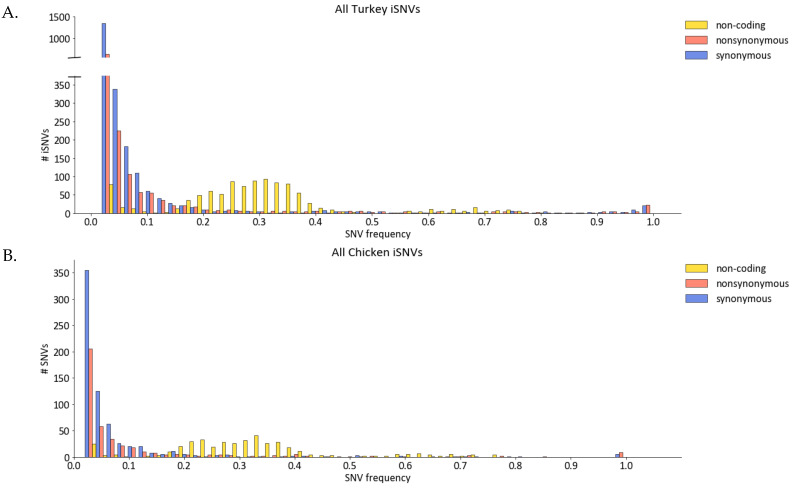
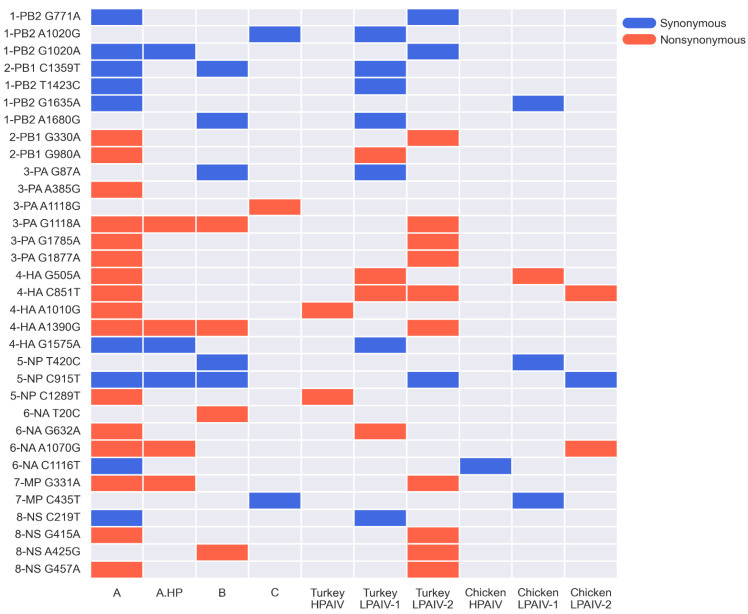
Within-host viral diversity offers a view into the early stages of viral evolution occurring after a virus infects a host. In recent years, advances in deep sequencing have allowed for routine identification of low-frequency variants, which are important sources of viral genetic diversity and can potentially emerge as a major virus population under certain conditions. We examined within-host viral diversity in turkeys and chickens experimentally infected with closely related H7N3 avian influenza viruses (AIVs), specifically one high pathogenicity AIV (HPAIV) and two low pathogenicity AIV (LPAIVs) with different neuraminidase protein stalk lengths. Consistent with the high mutation rates of AIVs, an abundance of intra-host single nucleotide variants (iSNVs) at low frequencies of 2-10% was observed in all samples collected. Furthermore, a small number of common iSNVs were observed between turkeys and chickens, and between directly inoculated and contact-exposed birds. Notably, the LPAIVs have significantly higher iSNV diversities and frequencies of nonsynonymous changes than the HPAIV in both turkeys and chickens. These findings highlight the dynamics of AIV populations within hosts and the potential impact of genetic changes, including mutations in the hemagglutinin gene that confers the high pathogenicity pathotype, on AIV virus populations and evolution.
在宿主内的病毒多样性提供了一种观察病毒在感染宿主后早期进化的方式。近年来,深度测序技术的进步使得常规识别低频变体成为可能,这些低频变体是病毒遗传多样性的重要来源,在某些条件下可能会成为主要病毒群体。我们研究了经过实验感染密切相关的 H7N3 禽流感病毒(AIV)的火鸡和鸡的宿主内病毒多样性,特别是两种具有不同神经氨酸酶蛋白茎长度的低致病性 AIV(LPAIV)和一种高致病性 AIV(HPAIV)。与 AIV 的高突变率一致,在所有采集的样本中都观察到大量低频率(2-10%)的宿主内单核苷酸变体(iSNV)。此外,在火鸡和鸡之间以及直接接种和接触暴露的鸟类之间观察到少数常见的 iSNV。值得注意的是,在火鸡和鸡中,与 HPAIV 相比,LPAIV 具有更高的 iSNV 多样性和非同义突变频率。这些发现强调了宿主内 AIV 群体的动态以及遗传变化的潜在影响,包括赋予高致病性表型的血凝素基因的突变,对 AIV 病毒群体和进化的影响。