School of Biomedical Sciences and Engineering, South China University of Technology, Guangzhou International Campus, Guangzhou 511442, PR China.
School of Medicine, South China University of Technology, Guangzhou 510006, PR China.
J Control Release. 2022 May;345:494-511. doi: 10.1016/j.jconrel.2022.03.033. Epub 2022 Mar 23.
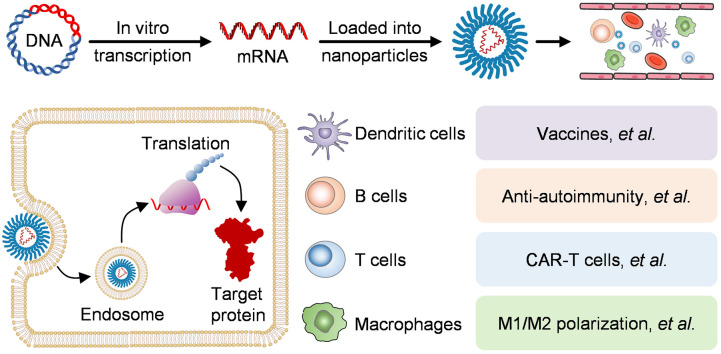
Abnormal immune cell functions are commonly related to various diseases, including cancer, autoimmune diseases, and infectious diseases. Messenger RNA (mRNA)-based therapy can regulate the functions of immune cells or assign new functions to immune cells, thereby generating therapeutic immune responses to treat these diseases. However, mRNA is unstable in physiological environments and can hardly enter the cytoplasm of target cells; thus, effective mRNA delivery systems are critical for developing mRNA therapy. The two mRNA vaccines of Pfizer-BioNTech and Moderna have demonstrated that lipid nanoparticles (LNPs) can deliver mRNA into dendritic cells (DCs) to induce immunization against severe acute respiratory syndrome coronavirus 2, which opened the floodgates to the development of mRNA therapy. Apart from DCs, other immune cells are promising targets for mRNA therapy. This review summarized the barriers to mRNA delivery and advances in mRNA delivery for regulating the functions of different immune cells.
异常的免疫细胞功能通常与各种疾病有关,包括癌症、自身免疫性疾病和传染病。基于信使 RNA(mRNA)的治疗可以调节免疫细胞的功能或赋予免疫细胞新的功能,从而产生治疗性免疫反应来治疗这些疾病。然而,mRNA 在生理环境中不稳定,几乎无法进入靶细胞的细胞质;因此,有效的 mRNA 传递系统对于开发 mRNA 治疗至关重要。辉瑞-生物技术公司和 Moderna 的两种 mRNA 疫苗已经证明,脂质纳米颗粒(LNPs)可以将 mRNA 递送至树突状细胞(DC)中,以诱导针对严重急性呼吸综合征冠状病毒 2 的免疫,这为 mRNA 治疗的发展打开了大门。除了 DC 之外,其他免疫细胞也是 mRNA 治疗的有前途的靶标。这篇综述总结了 mRNA 传递的障碍和在调节不同免疫细胞功能方面的 mRNA 传递的进展。