Population Health and Genomics, University of Dundee, Dundee, UK.
Late Stage Development, Cardiovascular, Renal and Metabolism (CVRM), BioPharmaceuticals R&D, AstraZeneca PLC, Gothenburg, Sweden.
BMJ Open Gastroenterol. 2022 Mar;9(1). doi: 10.1136/bmjgast-2021-000817.
The aim of this study was to investigate the association between obesity, diabetes and metabolic related liver dysfunction and the incidence of cancer.
This study was conducted with health record data available from the National Health Service in Tayside and Fife. Genetics of Diabetes Audit and Research Tayside, Scotland (GoDARTS), Scottish Health Research Register (SHARE) and Tayside and Fife diabetics, three Scottish cohorts of 13 695, 62 438 and 16 312 patients, respectively, were analysed in this study. Participants in GoDARTS were a volunteer sample, with half having type 2 diabetes mellitus(T2DM). SHARE was a volunteer sample. Tayside and Fife diabetics was a population-level cohort. Metabolic dysfunction-related liver disease (MDLD) was defined using alanine transaminase measurements, and individuals with alternative causes of liver disease (alcohol abuse, viruses, etc) were excluded from the analysis.
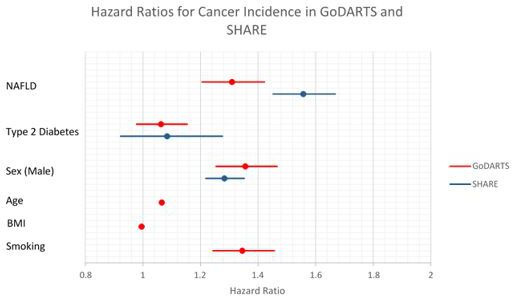
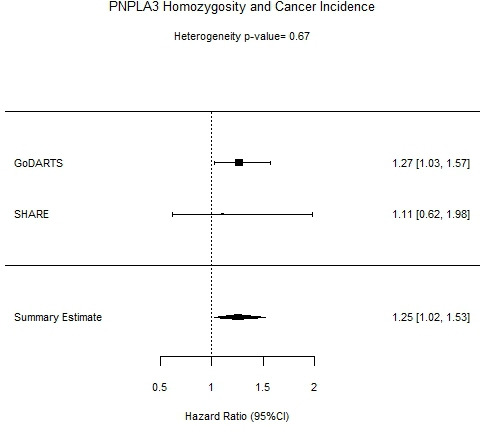
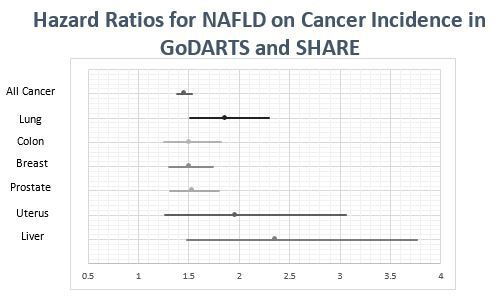
MDLD associated with increased cancer incidence with a HR of 1.31 in a Cox proportional hazards model adjusted for sex, type 2 diabetes, body mass index(BMI), and smoking status (95% CI 1.27 to 1.35, p<0.0001). This was replicated in two further cohorts, and similar associations with cancer incidence were found for Fatty Liver Index (FLI), Fibrosis-4 Index (FIB-4) and non-alcoholic steatohepatitis (NASH). Homozygous carriers of the common non-alcoholic fatty liver disease (NAFLD) risk-variant PNPLA3 rs738409 had increased risk of cancer. (HR=1.27 (1.02 to 1.58), p=3.1×10 ). BMI was not independently associated with cancer incidence when MDLD was included as a covariate.
MDLD, FLI, FIB-4 and NASH associated with increased risk of cancer incidence and death. NAFLD may be a major component of the relationship between obesity and cancer incidence.
本研究旨在探讨肥胖、糖尿病和代谢相关肝功能障碍与癌症发病之间的关联。
本研究利用苏格兰泰赛德和法夫的国民保健服务健康记录数据进行。本研究分析了苏格兰糖尿病基因筛查和研究泰赛德(GoDARTS)、苏格兰健康研究登记处(SHARE)和泰赛德和法夫的糖尿病患者三个苏格兰队列,分别有 13695、62438 和 16312 名参与者。GoDARTS 的参与者是志愿者样本,其中一半患有 2 型糖尿病(T2DM)。SHARE 是一个志愿者样本。泰赛德和法夫的糖尿病患者是一个人群队列。代谢相关肝疾病(MDLD)是通过丙氨酸转氨酶测量来定义的,并且排除了有其他原因导致肝疾病(酗酒、病毒等)的个体。
在调整性别、2 型糖尿病、体重指数(BMI)和吸烟状态的 Cox 比例风险模型中,MDLD 与癌症发病率增加相关,风险比(HR)为 1.31(95%CI 1.27 至 1.35,p<0.0001)。这在另外两个队列中得到了复制,并且在脂肪性肝病指数(FLI)、纤维化-4 指数(FIB-4)和非酒精性脂肪性肝炎(NASH)中也发现了与癌症发病率相似的关联。常见的非酒精性脂肪性肝病(NAFLD)风险变异体 PNPLA3 rs738409 的纯合子携带者患癌症的风险增加。(HR=1.27(1.02 至 1.58),p=3.1×10⁻³)。当将 MDLD 作为协变量纳入时,BMI 与癌症发病率的独立相关性降低。
MDLD、FLI、FIB-4 和 NASH 与癌症发病率增加和死亡风险增加相关。NAFLD 可能是肥胖与癌症发病率之间关系的主要组成部分。