Department of Physical Therapy, University of Delaware, 540 S College Avenue, Newark, DE, USA.
Biomechanics and Movement Science Program, University of Delaware, Newark, DE, USA.
Sci Rep. 2022 Mar 25;12(1):5177. doi: 10.1038/s41598-022-08689-w.
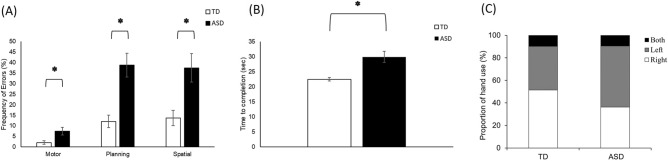
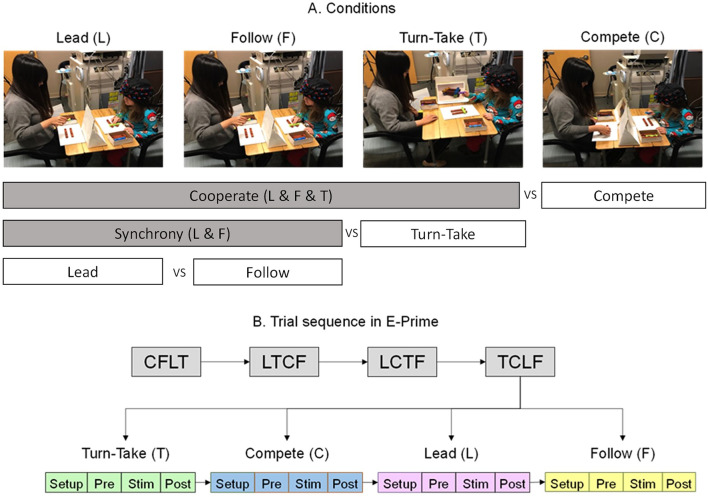
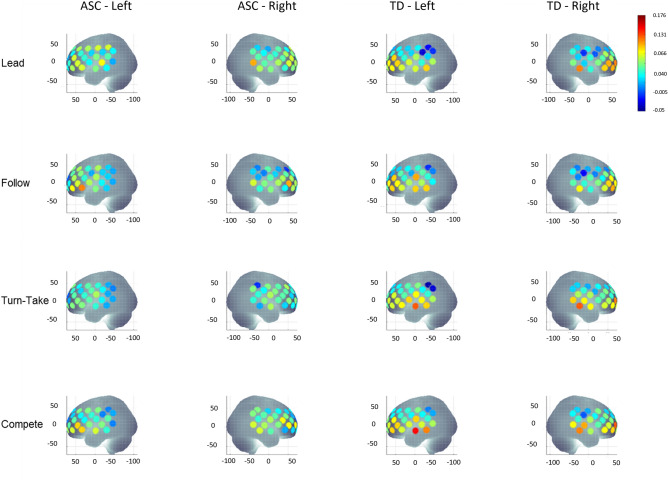
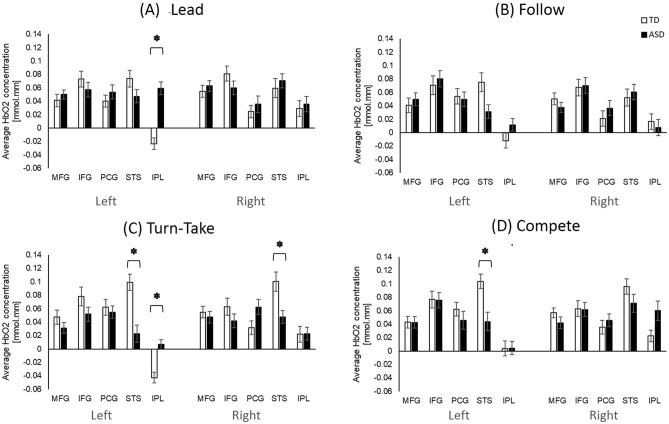
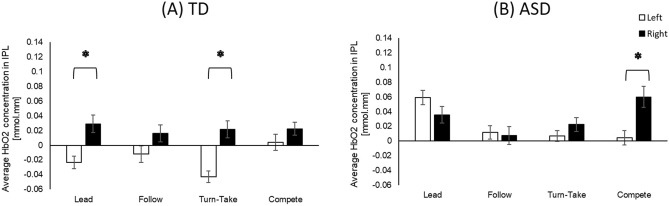
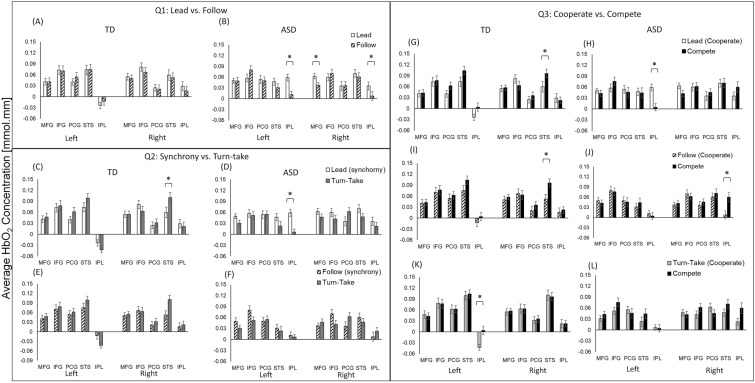
Children with an Autism Spectrum Condition (ASC) have social communication and perceptuomotor difficulties that affect their ability to engage in dyadic play. In this study, we compared spatio-temporal errors and fNIRS-related cortical activation between children with and without an ASC during a Lincoln Log dyadic game requiring them to play leader or follower roles, move in synchrony or while taking turns, and move cooperatively or competitively with an adult partner. Children with an ASC had greater motor, planning, and spatial errors and took longer to complete the building tasks compared to typically developing (TD) children. Children with an ASC had lower superior temporal sulcus (STS) activation during Turn-take and Compete, and greater Inferior Parietal Lobe (IPL) activation during Lead and Turn-take compared to TD children. As dyadic play demands increased, TD children showed greater STS activation during Turn-take (vs. Synchrony) and Compete (vs. Cooperate) whereas children with an ASC showed greater IPL activation during Lead and Compete (vs. Cooperate). Our findings suggest that children with an ASC rely on self-generated action plans (i.e., increased IPL activation) more than relying on their partner's action cues (i.e., reduced STS activation) when engaging in dyadic play including joint actions and competition.
患有自闭症谱系障碍(ASC)的儿童在社交沟通和感知运动方面存在困难,这影响了他们参与双人游戏的能力。在这项研究中,我们比较了在需要他们扮演领导者或追随者角色、同步或轮流移动以及与成人伙伴合作或竞争的林肯积木双人游戏中,患有 ASC 和不患有 ASC 的儿童之间的时空错误和与功能近红外光谱(fNIRS)相关的皮质激活。与典型发育(TD)儿童相比,患有 ASC 的儿童在运动、计划和空间方面的错误更大,完成建筑任务的时间也更长。与 TD 儿童相比,患有 ASC 的儿童在轮流和竞争时颞上沟(STS)的激活较低,而在领导和轮流时顶下小叶(IPL)的激活较高。随着双人游戏要求的提高,TD 儿童在轮流(与同步相比)和竞争(与合作相比)时表现出更高的 STS 激活,而患有 ASC 的儿童在领导和竞争(与合作相比)时表现出更高的 IPL 激活。我们的研究结果表明,在进行双人游戏时,患有 ASC 的儿童更多地依赖于自我产生的行动计划(即增加 IPL 激活),而不是依赖于其伙伴的行动线索(即减少 STS 激活),包括联合行动和竞争。