Department of Clinical Sciences Lund, Ophthalmology, Skåne University Hospital, Lund University, Lund, Sweden.
Department of Ophthalmology, Sahlgrenska University Hospital, Mölndal, Sweden.
Acta Ophthalmol. 2022 Dec;100(8):e1595-e1599. doi: 10.1111/aos.15142. Epub 2022 Mar 25.
To analyse the risk of rhegmatogenous retinal detachment (RRD) after cataract surgery, and to identify possible risk factors.
Observational cohort study of patients undergoing cataract surgery in Region Skåne, southern Sweden, during 2015-2017 were retrieved from the Swedish National Cataract Register. These were then cross-referenced with cases of retinal detachment surgery performed at the Skåne University Hospital in Lund from 2015 to 2020. The main outcome was RRD after cataract surgery. The influence of sex, age, axial length of the eye, rupture of the posterior capsule, patient comorbidity and other cataract complications were analysed.
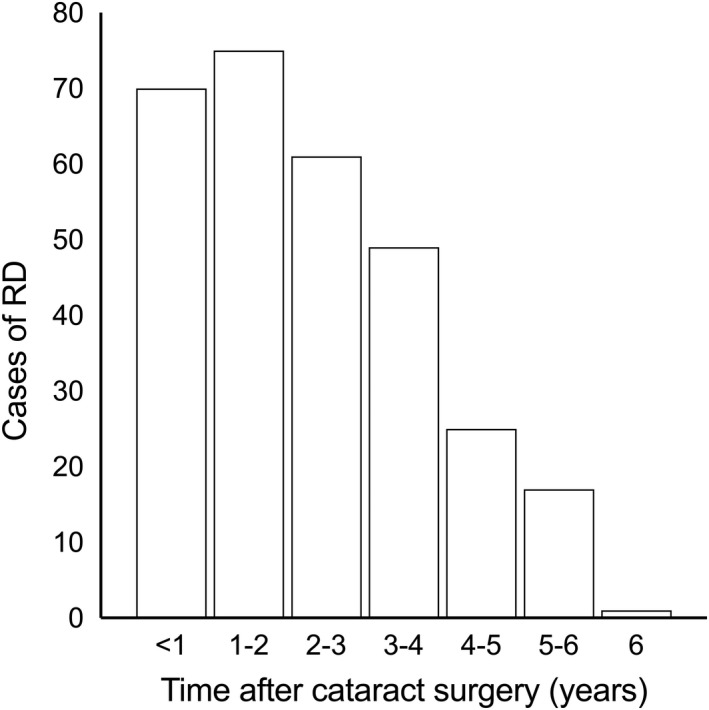
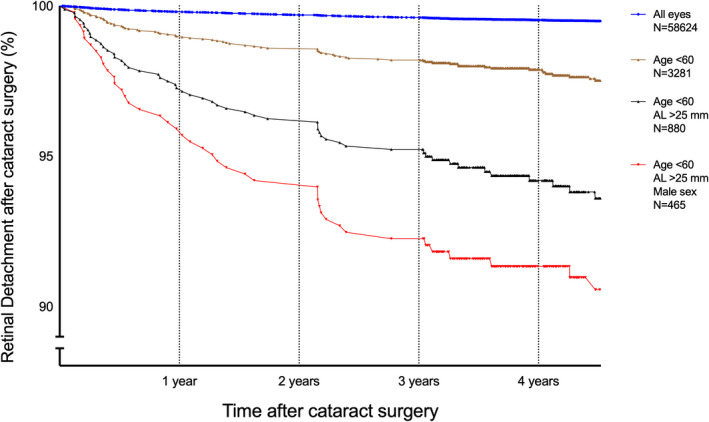
Among the 58 624 cases of cataract surgery, a total of 298 RRDs (0.51%) were identified up to the end of 2020. The mean time from cataract surgery to RRD was 667 days. The mean age was 65.3 years, compared to 74 years in the control group. A strong correlation was found between RDD and age: <60 years, incidence = 0.50%; 60-75 years, incidence = 0.14%; and >75 years, incidence = 0.04%. The correlation with axial length was also very strong: mean value 23.73 mm in those without RRD, and 25.13 mm in those with RRD (p < 0.001). Sex was also strongly correlated to RDD; 68.8% of cases of RRD being men. Among men younger than 60 years of age, with an axial length ≥25 mm, 9.46% exhibited RRD within the follow-up period (mean 4.7 years). Rupture of the posterior capsule was found in 2.01% of RRD patients compared to 0.74% in the control group. Diabetes, glaucoma or pseudoexfoliation had no impact on the prevalence of RRD.
The three main risk factors for RRD following cataract surgery were found to be sex, age and axial length. The highest incidence of RRD (9.46%) were identified among men younger than 60 years of age and an axial length ≥25 mm.
分析白内障手术后孔源性视网膜脱离(RRD)的风险,并确定可能的危险因素。
对 2015 年至 2017 年在瑞典斯科讷地区接受白内障手术的患者进行了观察性队列研究,这些患者的信息来源于瑞典全国白内障登记处。然后将这些数据与 2015 年至 2020 年在隆德斯科讷大学医院进行的视网膜脱离手术的病例进行了交叉核对。主要结局是白内障手术后发生 RRD。分析了性别、年龄、眼球轴长、后囊破裂、患者合并症和其他白内障并发症的影响。
在 58624 例白内障手术中,截至 2020 年底共发现 298 例 RRD(0.51%)。白内障手术后发生 RRD 的平均时间为 667 天。平均年龄为 65.3 岁,而对照组的平均年龄为 74 岁。发现 RDD 与年龄之间存在很强的相关性:<60 岁,发生率为 0.50%;60-75 岁,发生率为 0.14%;>75 岁,发生率为 0.04%。与轴长的相关性也很强:无 RRD 的平均轴长为 23.73mm,有 RRD 的平均轴长为 25.13mm(p<0.001)。性别也与 RDD 有很强的相关性;68.8%的 RRD 患者为男性。在年龄小于 60 岁、轴长≥25mm 的男性中,9.46%在随访期间发生 RRD(平均 4.7 年)。后囊破裂在 RRD 患者中的发生率为 2.01%,而对照组为 0.74%。糖尿病、青光眼或假性剥脱综合征对 RRD 的发生率没有影响。
白内障手术后发生 RRD 的三个主要危险因素是性别、年龄和轴长。年龄小于 60 岁、轴长≥25mm 的男性 RRD 发生率最高(9.46%)。