Zoetis Inc., Parisppany, NJ 07054, USA.
Vet Microbiol. 2022 May;268:109395. doi: 10.1016/j.vetmic.2022.109395. Epub 2022 Mar 11.
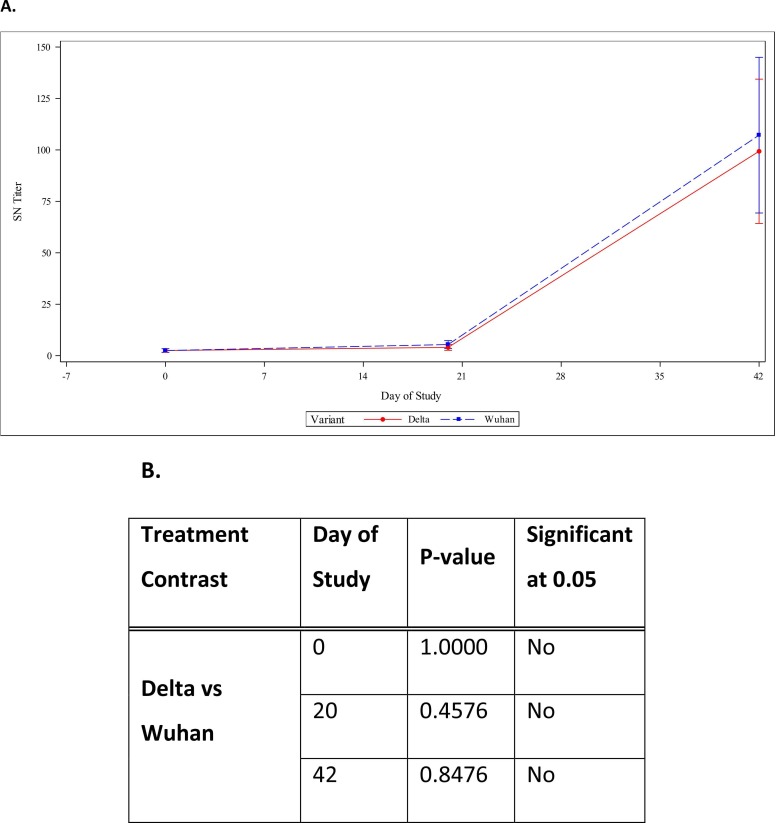
SARS-CoV-2 has exhibited varying pathogenesis in a variety of Mammalia family's including Canidae, Mustelidae, Hominidae, Cervidae, Hyaenidae, and Felidae. Novel SARS-CoV-2 variants characterized by spike protein mutations have recently resulted in clinical and epidemiological concerns, as they potentially have increased infectious rates, increased transmission, or reduced neutralization by antibodies produced via vaccination. Many variants have been identified at this time, but the variant of continuing concern has been the Delta variant (B.1.617.2), due to its increased transmissibility and infectious rate. Felines vaccinated using an experimental SARS-CoV-2 spike protein-based veterinary vaccine mounted a robust immune response to the SARS-CoV-2 spike protein. Using a reporter virus particle system and feline serum, we have verified that vaccinated felines produce antibodies that neutralize the SARS-CoV-2 Wuhan strain and variant B.1.617.2 at comparable levels.
SARS-CoV-2 在包括犬科、鼬科、人科、鹿科、鬣狗科和猫科在内的多种哺乳动物中表现出不同的发病机制。最近,由于新型 SARS-CoV-2 变体的刺突蛋白突变特征,导致了临床和流行病学方面的关注,因为它们可能具有更高的感染率、更高的传播率或降低了通过疫苗接种产生的抗体的中和能力。目前已经鉴定出许多变体,但持续关注的变体一直是 Delta 变体(B.1.617.2),因为它的传染性和感染率更高。使用基于 SARS-CoV-2 刺突蛋白的实验兽医疫苗接种的猫科动物对 SARS-CoV-2 刺突蛋白产生了强烈的免疫反应。使用报告病毒粒子系统和猫科动物血清,我们已经验证了接种疫苗的猫科动物产生的抗体能够以可比水平中和 SARS-CoV-2 武汉株和变体 B.1.617.2。