Institute of Physiology and Pathophysiology, University of Erlangen-Nürnberg, Erlangen, Germany.
Institute of Physiology and Pathophysiology, University of Heidelberg, Heidelberg, Germany.
Physiol Rep. 2022 Mar;10(6):e15194. doi: 10.14814/phy2.15194.
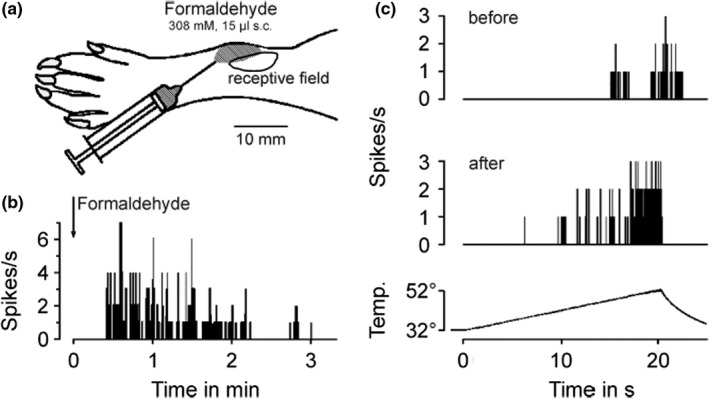
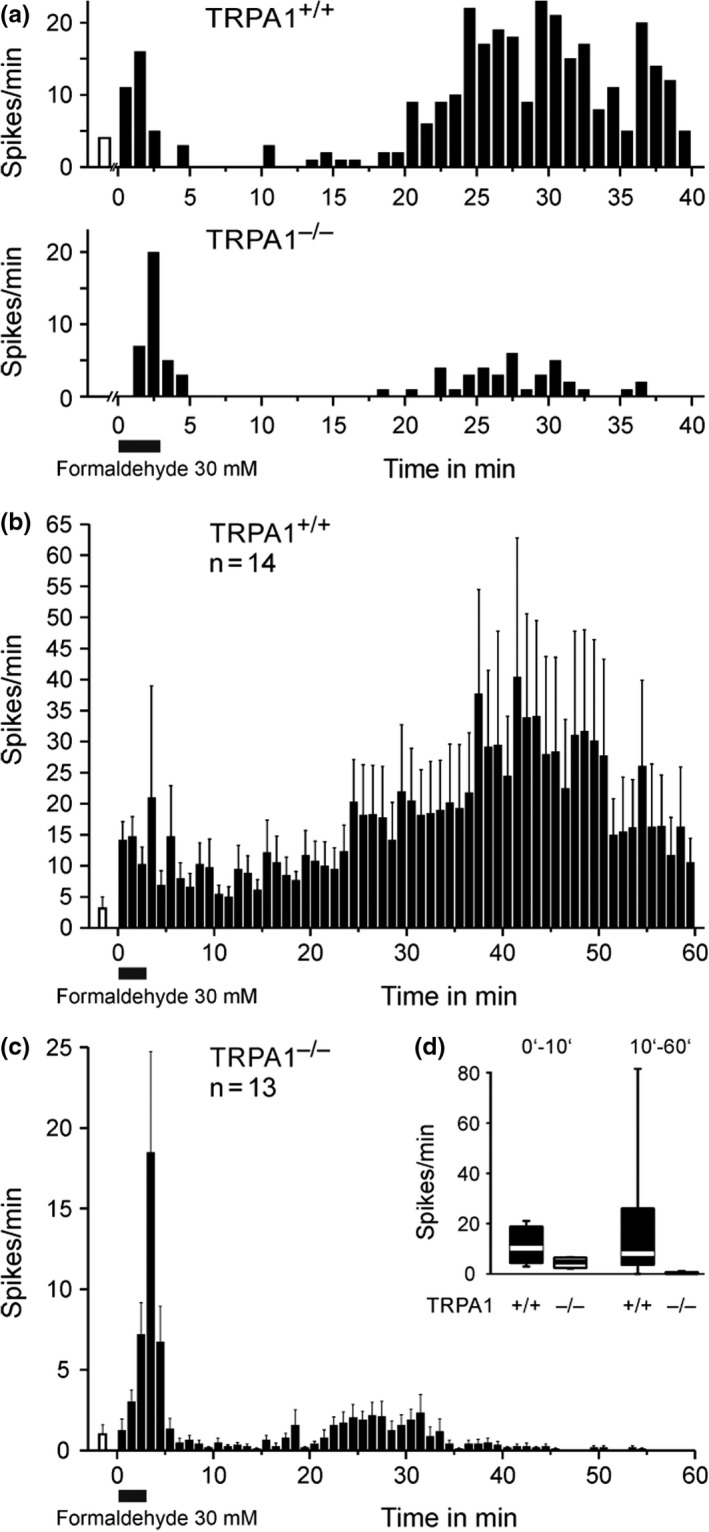
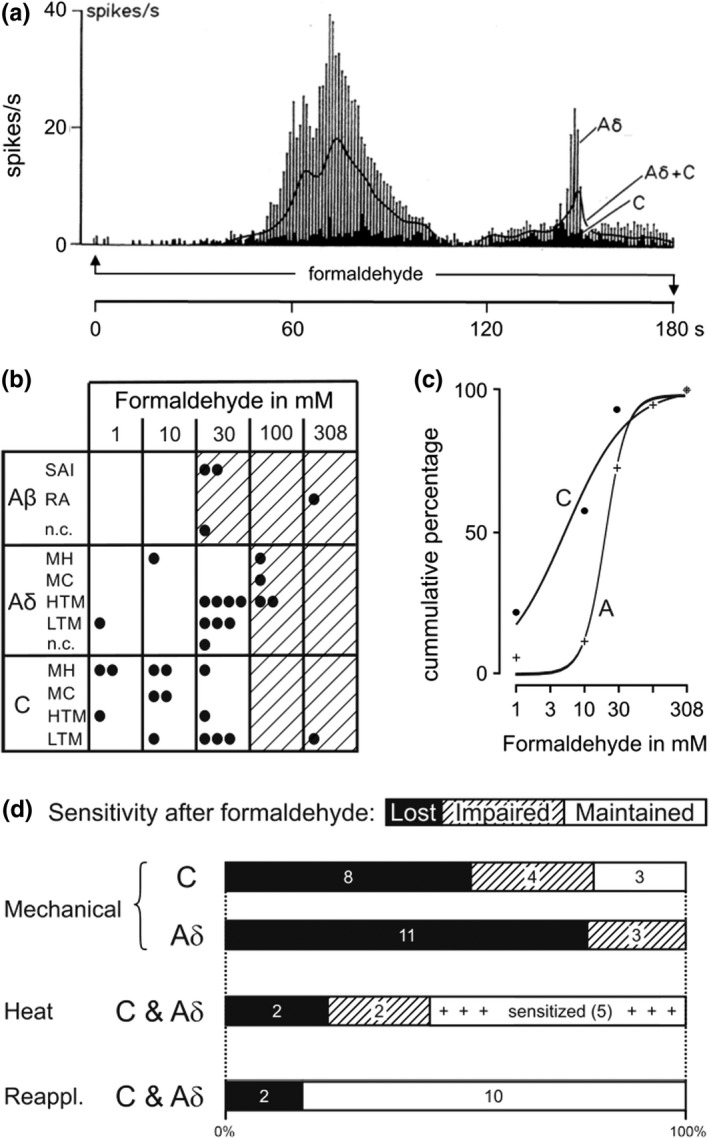
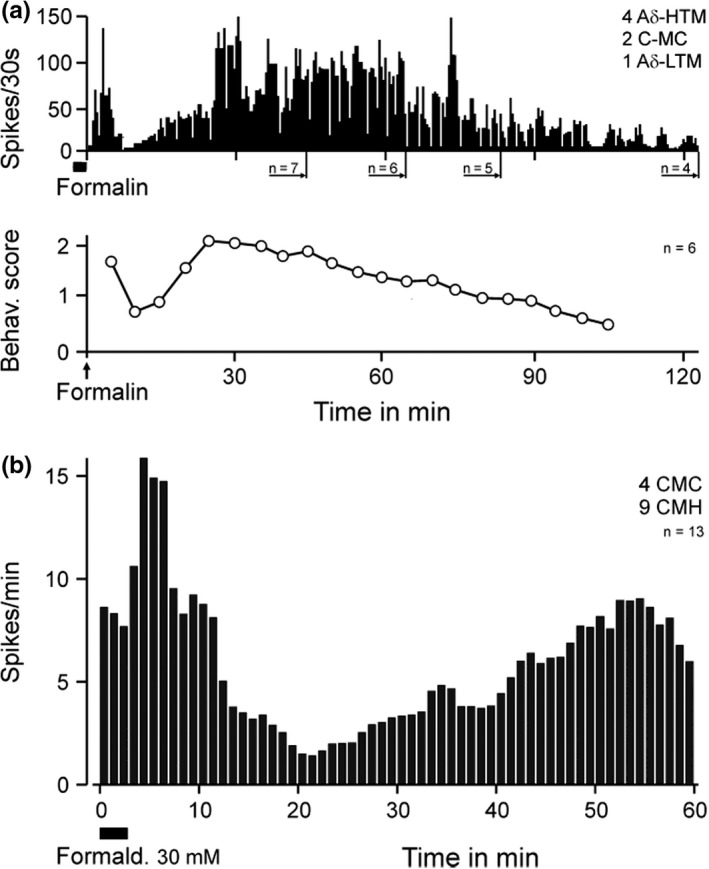
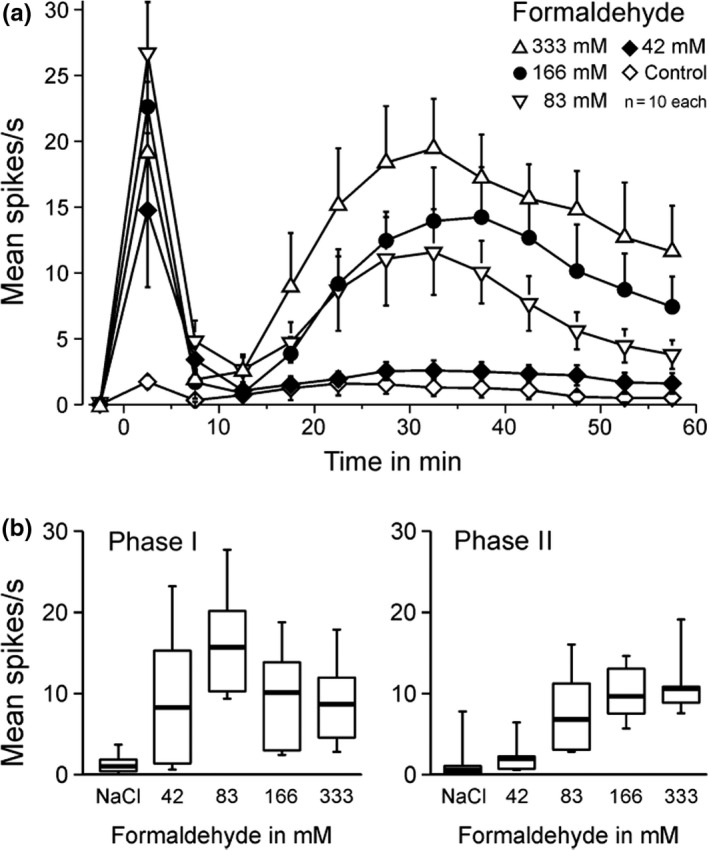
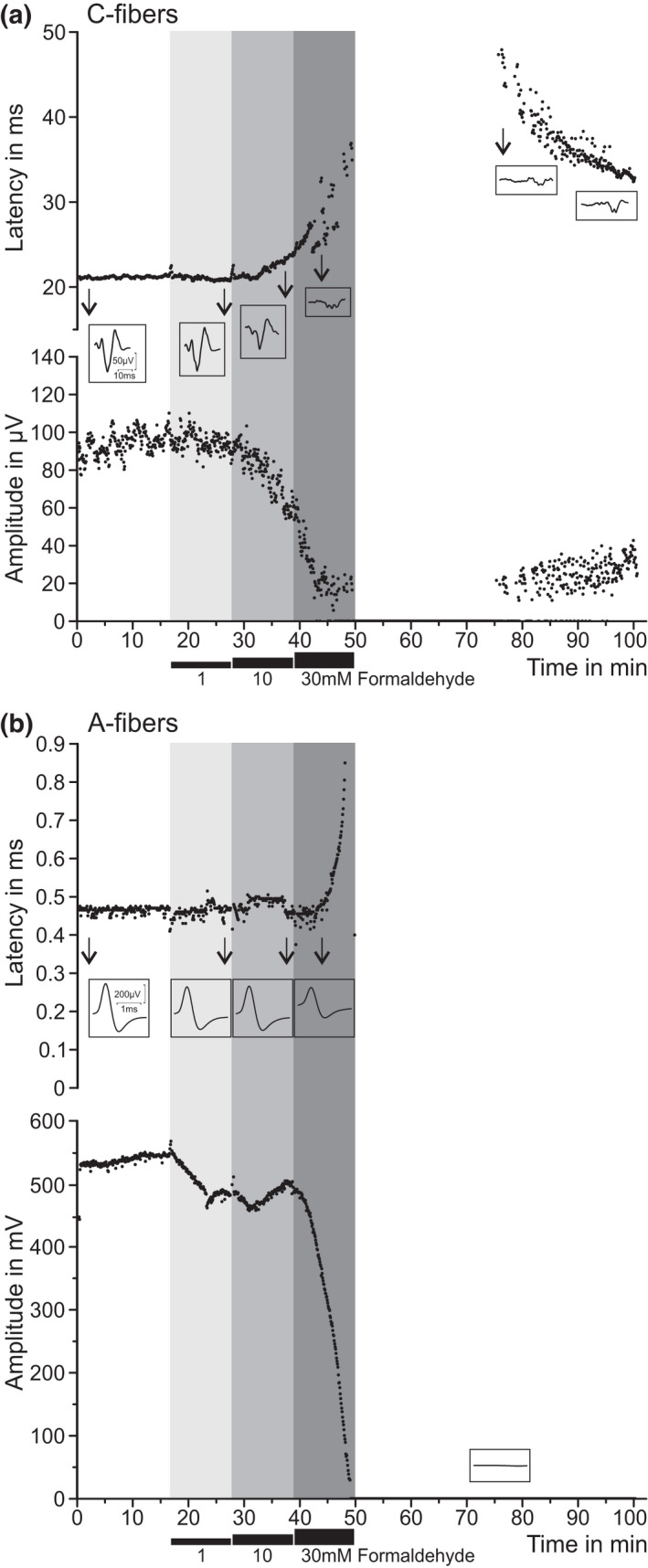
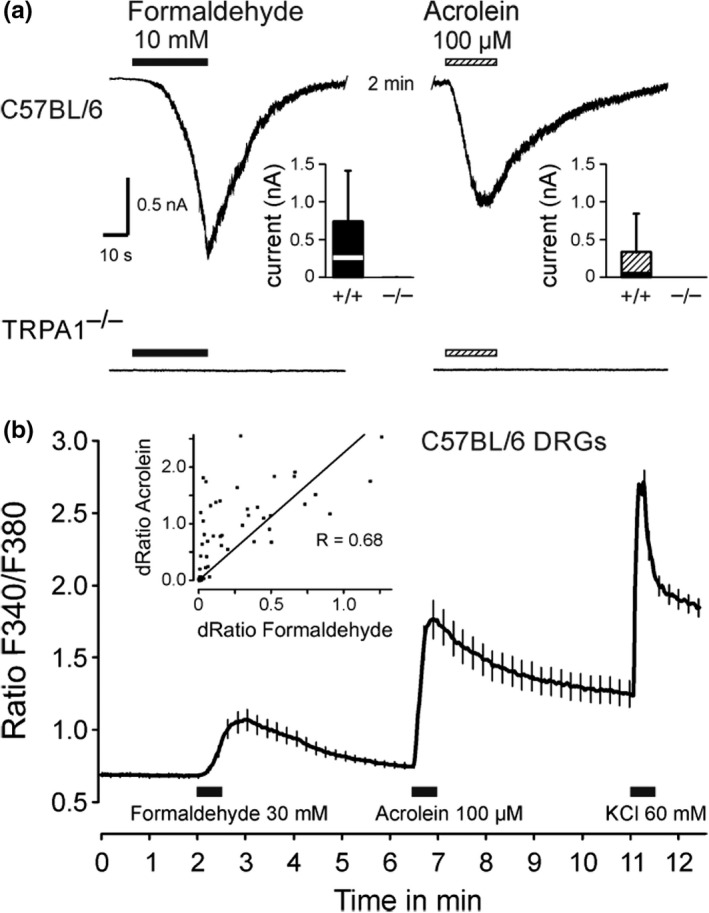
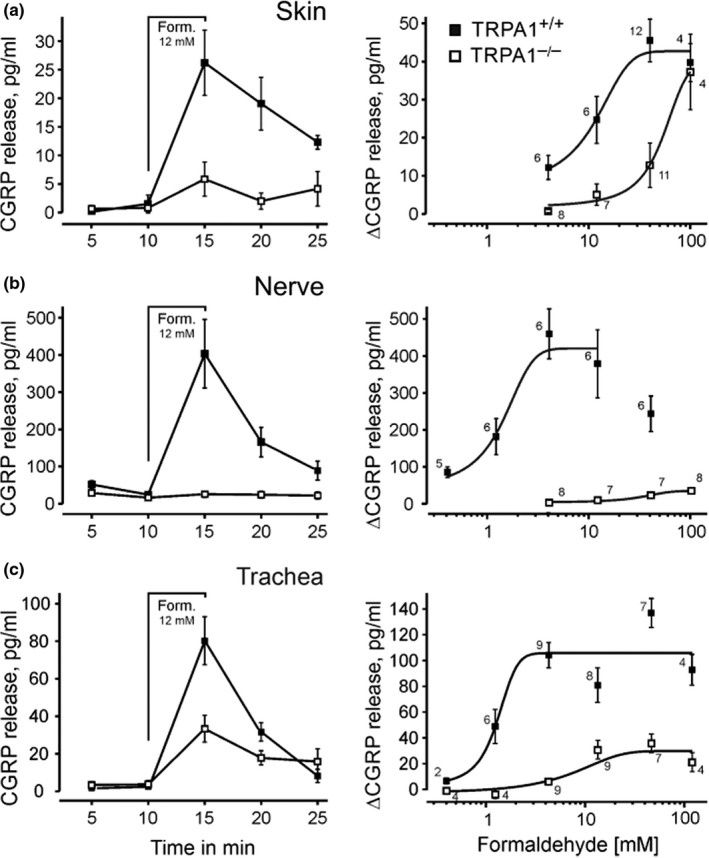
The most widely used formalin test to screen antinociceptive drug candidates is still apostrophized as targeting inflammatory pain, in spite of strong opposing evidence published. In our rat skin-nerve preparation ex vivo, recording from all classes of sensory single-fibers (n = 32), 30 units were transiently excited by formaldehyde concentrations 1-100 mM applied to receptive fields (RFs) for 3 min, C and Aδ-fibers being more sensitive (1-30 mM) than Aβ-fibers. From 30 mM on, ~1% of the concentration usually injected in vivo, all RFs were defunctionalized and conduction in an isolated sciatic nerve preparation was irreversibly blocked. Thus, formaldehyde, generated a state of 'anesthesia dolorosa' in the RFs in so far as after a quiescent interphase all fibers with unmyelinated terminals developed a second phase of vigorous discharge activity which correlated well in time course and magnitude with published pain-related behaviors. Sural nerve filament recordings in vivo confirmed that higher formalin concentrations (> 42 mM) have to be injected to the skin to induce this second phase of discharge. Patch-clamp and calcium-imaging confirmed TRPA1 as the primary transducer of formaldehyde (10 mM) effects on mouse sensory neurons. However, stimulated CGRP release from isolated skin of TRPA1 and TRPA1 mice showed a convergence of the saturating concentration-response curves at 100 mM formaldehyde, which did not occur with nerve and trachea preparations. Finally, skin-nerve recordings from C and Aδ-fibers of TRPA1 mice revealed a massive reduction in formaldehyde (30 mM)-evoked discharge. However, the remaining activity was still biphasic, thus confirming additional unspecific excitotoxic actions of the fixative that diffuses along still excitable axons as previously published. The multiplicity of formaldehyde's actions requires extensive discussion and literature review, leading to a fundamental reevaluation of the formalin test.
最广泛使用的 Formalin 测试筛选抗伤害性药物候选物的方法仍然被认为是针对炎症性疼痛,尽管已经发表了强烈的反对证据。在我们的大鼠皮肤-神经制备物中,从所有感觉单一纤维(n = 32)中记录,30 个单位被 1-100 mM 的甲醛浓度短暂刺激,持续 3 分钟,C 和 Aδ 纤维比 Aβ 纤维更敏感(1-30 mM)。从 30 mM 开始,~1%的体内通常注射的浓度,所有的 RF 都失活,在一个孤立的坐骨神经制备物中,传导是不可逆地阻断的。因此,甲醛在 RF 中产生了一种“疼痛性麻醉”状态,因为在一个静止的间期之后,所有具有无髓鞘末端的纤维都发展出第二阶段的强烈放电活动,这与已发表的与疼痛相关的行为在时间进程和幅度上都很好地相关。体内的腓肠神经细丝记录证实,更高的福马林浓度(>42 mM)必须注射到皮肤中才能诱导这种第二阶段的放电。膜片钳和钙成像证实 TRPA1 是甲醛(10 mM)对小鼠感觉神经元作用的主要传感器。然而,从 TRPA1 和 TRPA1 小鼠的分离皮肤中刺激 CGRP 释放显示出在 100 mM 甲醛时饱和浓度反应曲线的收敛,而在神经和气管制备物中则没有。最后,从 TRPA1 小鼠的 C 和 Aδ 纤维的皮肤-神经记录中发现,甲醛(30 mM)诱发的放电大量减少。然而,剩余的活动仍然是双相的,因此证实了固定剂的额外非特异性兴奋毒性作用,正如以前发表的那样,沿着仍然可兴奋的轴突扩散。甲醛的多种作用需要广泛的讨论和文献综述,导致对福马林测试的基本重新评估。