Koc Gonca, Esmat Habib Ahmad, Coskun Mehmet
Department of Pediatric Radiology, Ege University School of Medicine, Izmir, Turkey.
Department of Radiology, Kabul University of Medical Sciences, Kabul, Afghanistan.
Ann Med Surg (Lond). 2022 Mar 14;76:103483. doi: 10.1016/j.amsu.2022.103483. eCollection 2022 Apr.
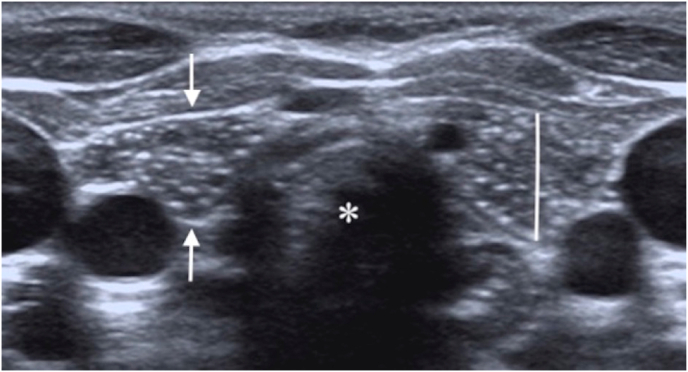
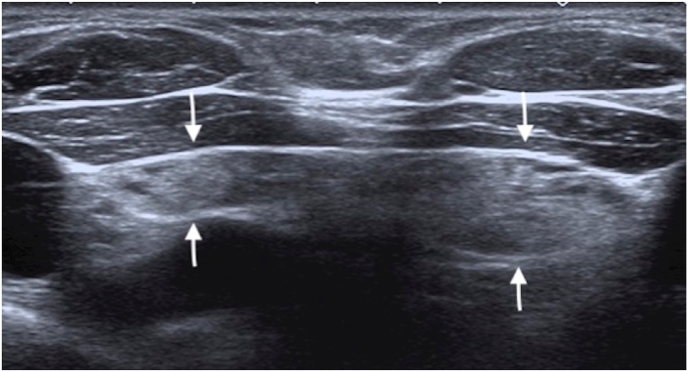
The cervical extension of the thymus is the most common variation. However, this may be mistaken for a soft tissue mass in the neck particularly by the radiologists who are not familiar with the pediatric population and not aware of this variation, leading to unnecessary surgery and increased medical costs. Since the rates of cervicaly extended thymus in children in clinical practice are lacking in Turkey, this study aimed to evaluate the prevalence of cervical extension of the normal thymus in the pediatric population.
This descriptive cross-sectional study included all pediatric patients who were referred to the radiology department for neck ultrasonography between August-October 2018. A high-frequency probe was implemented and 220 patients (152 male, 68 female) with a mean age of 8.7 ± 4.39 years (ranging from 1 month to 18 years of age) were examined.
Cervical extension of the thymus was detected in 103 patients (46.8%). The age of the patients was found to be significantly lower than the age of the patients whose thymus was not extended (7.87 ± 4.15 years and 9.59 ± 4.46 years, respectively. p = 0.006). The mean craniocaudal length of the thymus that cervically extended was 6.41 ± 2.31 mm. There was no significant difference in the length of the thymus between males, females (6.48 ± 2.12 mm and 6.37 ± 2.46 mm. p = 0.924), and different age groups (p = 0.442).
Approximately half of the children have the cervical extension of the thymus. Thus, radiologists and clinicians should be aware of this entity to avoid unnecessary imaging studies and interventional procedures.
胸腺的颈部延伸是最常见的变异情况。然而,这可能会被误诊为颈部软组织肿块,尤其是那些不熟悉儿科人群且不了解这种变异的放射科医生,从而导致不必要的手术和医疗费用增加。由于土耳其临床实践中儿童胸腺颈部延伸的发生率尚不清楚,本研究旨在评估儿科人群中正常胸腺颈部延伸的患病率。
这项描述性横断面研究纳入了2018年8月至10月间因颈部超声检查而转诊至放射科的所有儿科患者。使用高频探头,对220例患者(152例男性,68例女性)进行了检查,患者平均年龄为8.7±4.39岁(年龄范围为1个月至18岁)。
103例患者(46.8%)检测到胸腺颈部延伸。发现有胸腺颈部延伸患者的年龄显著低于胸腺未延伸患者的年龄(分别为7.87±4.15岁和9.59±4.46岁,p = 0.006)。胸腺颈部延伸的平均头尾长度为6.41±2.31毫米。男性、女性(分别为6.48±2.12毫米和6.37±2.46毫米,p = 0.924)以及不同年龄组之间胸腺长度无显著差异(p = 0.442)。
约一半的儿童有胸腺颈部延伸。因此,放射科医生和临床医生应了解这一情况,以避免不必要的影像学检查和介入性操作。